
Showing posts with label 1981. Show all posts

Monday, December 2, 2019

I’d Love To Turn You On At The Movies #232 - Blow Out (1981, dir. Brian De Palma)


Back in 1981, director Brian De Palma followed up his hit thriller Dressed To Kill with something darker and grimmer, gave John Travolta his best on screen role ever (that's right, ever), took a none-too-unbelievable look at American politics, and created his finest film. That film is 1981’s Blow Out, and despite critical acclaim at the time of its release, it was a box office failure, probably in large part due to the film’s bleak outlook - and probably also, as Nancy Allen suggests in the bonus materials contained in the Criterion release of the film, that an intellectual, personal, and political work was released and expected to compete in summer blockbuster season, rather than in the fall, when “critics’ films” tend to come out. But time has been kind to the film, and it's shown itself to be among the smartest and best-made of the run of 1970s political thrillers. It might help that it actually came after the end of the 70s, with Watergate and its aftermath in the rear-view mirror, rather than being released in the thick of it when everything was still unfolding; the kind of behind-the-scenes machinations that power Blow Out no longer seemed like far-fetched paranoia.
The film starts out as a cheesy horror flick, quickly revealed to be a screening of Co-Ed Frenzy, a low-budget slasher film-within-the-film for which cop-turned-soundman Jack Terry (John Travolta) needs to record new sound effects (and which provides a running joke that turns gut-wrenching in the film’s final moments). Out at night recording, he hears (and records) a blow out and sees a car careen off a bridge and plunge underwater. Diving in to save the woman inside, Sally (Nancy Allen), he becomes embroiled in a plot to derail the upcoming presidential election, but due to the constant movement of the shadowy antagonist Burke (John Lithgow) he finds it difficult to convince others that a conspiracy may be afoot.
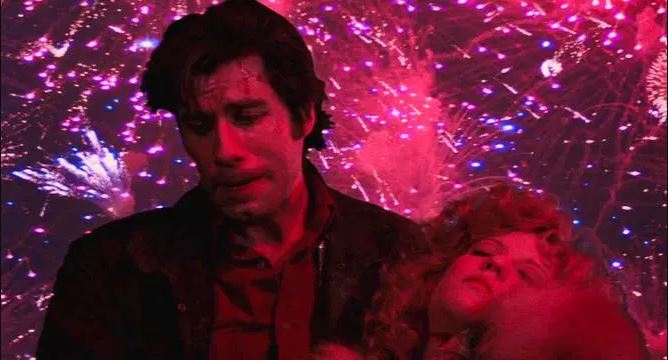
The film is De Palma's finest - the place where his thematic ideas about voyeurism and watching (and here, listening) and systemic violence perpetrated against women mesh with his virtuoso filmmaking in a dazzling array of traveling Steadicam work, split screen, slo-mo, 360 degree pans, and other effects that all heighten and work in service of the story being told, rather than merely drawing attention to themselves. And beyond his famous camerawork, the sound design of the film is marvelous - as befits a movie about a soundman - with the visuals we see and the sounds that accompany them often providing an ironic complement or counterpoint. Even in the seemingly innocuous opening credits sequence where Jack is cataloging his stock effects - gunshots, glass breaking, a body falling to the ground, and so forth - these are played over a split screen montage of a TV broadcast of an event for a presidential hopeful whose car is, unbeknownst to him, about to end up at the bottom of a river, and the entire sequence conveys a lot more than the names of the crew. And later in the film, the disparity between TV news reportage and events we've seen firsthand always provides a chuckle.
And as fine as Travolta is in the film, he's matched scene for scene by Nancy Allen, who as Sally attempts to control her own destiny only to be swept away by forces beyond her control, and those of Travolta’s attempts to protect her. And it would be a disservice to not tip the hat to De Palma regular John Lithgow, whose chameleon-like bow as the villainous Burke keeps the film's seemingly implausible menace feeling very real indeed, or to another De Palma fave Dennis Franz, perfectly sleazy as photographer Manny Karp.
If the film were merely a clever thriller, it would be enough to recommend it, but it's more than that, refracting recent political history - Watergate and Chappaquiddick particularly - through De Palma's ideas to arrive at a fully integrated - dare I say it? - work of art. The film looks at sordid post-Watergate closed-door dealings, with the subsequent mistrust of government coloring the cynical proceedings in a film that endlessly looks outward to the modern political landscape and reflects it darkly back on itself. One wonders what sort of grim thriller could be made out of the raw material of today’s political events.
- Patrick Brown

Monday, August 19, 2019

I'd Love to Turn You On #238 - Guelewar Band of Banjul - Warteef Jigeen (1981)


            I often get asked why I listen to African music when I can't understand the language. It's pretty simple, really - when the music is compelling enough, the words simply don't matter. And often enough I find out that the words are also compelling when I can dig up English translations, but I don't really seek them out, because at its best the music slays all by itself. That's certainly the case here, with this album sung in the Wolof language. The band - Guelewar Band of Banjul (or just Guelewar on some records) - doesn't have a lot written about them and I know only slightly more about the group than about the words.
Bandleader Laye N'Gom started his musical career in the late 1960s, eventually finding his way in the 70s to the successful band The Alligators. After the departure of several members, the Alligators fused with the Super Eagles to become Super Alligators. By 1973, after more personnel changes, they renamed themselves Guelewar (Wolof for "noble warrior") and began infusing their sound with the Western influences of rock, funk, and soul. In 1975 they broke up, reforming a year later with yet more new members and finally released their first recordings in 1977. In 1979, two more albums followed - Warteef Jigeen was one of them - and the band continued through 1982 when they seem to have disbanded and Laye N'Gom (now known as Abdel Kabirr) went on to a solo career. It's more complicated than that too - I'm not even sure what's accurate in this data. N'Gom provides the dates I mentioned in one reissue's liner notes, but the fairly authoritative Discogs site pegs their first album as 1980 and this one as 1981, so either they got released in The Gambia and maybe also surrounding Senegal earlier (and N'gom is correct) but elsewhere later (and so Discogs could also be correct). Or N'gom's memory of things that happened almost 40 years ago is hazy. Or whoever entered the data in Discogs is just wrong. This helps point up why I don't sweat little details like understanding the language - you can never really get to the bottom of it anyway, so why worry?
So let's now talk about what we do know. The killer title cut - the shortest thing on the album at a mere 6:51 - starts off the album strong with the horn blast of two saxophones (Laye Salla and Bass Lo Fara Biram) supported by a supple bassline (Malick Njock Njie), with drums (Adama Sall Adu) and percussion (Alieu Chan N’Gom and Koto Biram N’Gom) clattering funkily in the pocket in the background to kick things off before Moussa N’Gom’s soulful vocal comes in. The saxes drop out, and the voice and rhythm section (plus some restrained guitar from Moussa Njobdi Njie) take things for a few with an occasional sax commentary. At about the four-minute mark, Laye N’Gom’s buzzy synthesizer makes its first showing in the proceedings in a fine solo and the horns return in a grand fashion, then everything comes together for the last minute to take things out. Twice again on the album they return to this kind of driving funk - on "N.T.C. The Gambia," which features fuzz guitar, more enticing synth, and a sax solo in addition to the usual unison horn lines, and "Jilanna" which follows right on the heels of "N.T.C." and makes for a killer 17+ consecutive minutes of the album.
Around this they also essay a slow groover with "Leen Te Koun," which throws heavy emphasis on the 1, just like George Clinton would have it, and provides a showcase again for Moussa N'Gom's vocals trading off with Bass Lo Fara Biram, who sets aside his sax for a bit to take the mic. There's also the 12:01 of the slow ballad "Mamadu Bitike," another feature for both vocalists that finds everyone in the band working toward the total moody effect of the music rather than flashy soloing for the first two-thirds of the song before the percussionists come in at about 8:15 and things kick into a high gear and cut loose. The record closes on " President Diawara" which though I don't speak Wolof, I have to assume is in honor of the first President of The Gambia, Dawda Jawara (Diawara in some Anglicized spellings), under whose leadership as Prime Minister The Gambia achieved independence from the British before the country created the office of President, to which he was elected. This song has the most guitar-y solos of the album from Moussa Njobdi Njie (who elsewhere mostly works in deference to the song), plus Laye’s weird synths and more solo sax - everything they the group has done throughout the album is pulled out again at the end to recap what we’ve heard.
All accounts I've read piece together a view of Guelewar as an influence on music throughout The Gambia and Senegal - their early live shows helping form the blueprint for the Senegambian music that would come to be known as mbalax, and those shows were also an acknowledged influence on the primary superstar of mbalax, Youssou N'Dour. Their recordings, hard to find for decades but this one recently reissued by the Austrian PMG label, show them to be one of the most consistent recording acts of the time, with not only Warteef Jigeen out there, but a (now out of print) compilation called Touki Ba Banjul : Acid Trip From Banjul To Dakar that cops the faster half of this album both superb, and a live album of material from 1982 released by Teranga Beat in 2011 only lesser by virtue of slightly inferior (though by no means bad) sound. Do I understand what's being sung about? No. Do I still after picking up these three releases have a clear picture of the band's history? No. Does it matter? Not a bit; not when the music speaks this clearly.
-         Patrick Brown

Monday, November 5, 2018

I’d Love To Turn You On At The Movies #204 - Diva (1981, dir. Jean-Jacques Beineix)


 About two thirds of the way through Jean-Jacques Beineix’s 1981 film Diva, our hero, Jules, is being chased through a Paris Metro station on his moped by a police officer. He’s wearing all red, tabla music is fading in and out, and the shifting camera angles constantly break the 180-degree rule. It’s a disorienting, beautiful sequence, one that seems so preoccupied with creating a feeling of psychedelia out of context that it prompts the viewer to forget that it makes sense narratively. Depending on your point of view, that’s a critique that could be levied at the rest of the film, too; but the magic of Diva is that it does work in spite of all its massively disparate impulses, plot threads, and philosophical interests.
            At its core, Diva is obsessed with Walter Benjamin’s conception of the “aura”; an individual piece of art, Benjamin says, has a particular aura that one can only truly understand when viewing the original. This posed a problem when art – namely, music and film – was being reproduced on a mass scale. Auras can’t necessarily be replicated, Benjamin says. Cynthia Hawkins, the American opera singer unknowingly involved in Diva’s crime narrative, is aware of that. She stalwartly refuses to record her performances, saying that the beauty of an opera performance is in the collaboration between singer, symphony, and audience on any given night. When Cynthia’s performance in Paris is expertly bootlegged by Jules, a series of events is set in motion that soon embroils her, Jules, the chief of police, some Taiwanese gangsters, and two young bohemians in a thriller more interested in discussing the role of art than delivering high-octane delights.
            Unsurprisingly, then, Diva is just plain beautiful to look at. Shot compositions are painterly, and Beineix’s emphatic use of color throughout the film offers impressionistic sequences that make the viewer feel like they’ve been stuck in a museum for far longer than they’d intended. In a quiet moment halfway through the film, Jules courts Cynthia as they walk through the Tuileries Gardens outside the Louvre. In one of my favorite shots of the film, Jules and Cynthia sit facing away from one another, on different sides of the frame. Jules moves closer to her, transgressing the boundary that divides them, and she smiles. Cynthia, the eponymous diva, is initially reluctant to engage with Jules, a lowly postman, but is so persuaded by his charms that she can’t resist. It’s a beautiful sequence that manages to offer narrative development while highlighting the philosophical interests at the heart of the film.
            I find it hard not to read too deeply into this postmodern dichotomy on display both here and in other threads throughout the film. Jules, the young French sophist bootlegger, courts Cynthia, an American classicist. The police are chasing after a tape that ultimately indicts their chief, but that tape gets confused with the bootlegged recording. The film cleverly – and constantly! – tricks the audience into thinking they’re hearing the commentative, diegetic score to the film, only to pull the rug out from under the viewer and make it clear that the characters are hearing the same noise. Worth noting, too, is how the film’s score expertly blends opera, classical, tabla, and cornball ‘80s synth into one amazing soundtrack. Likewise, the abundant references to both the French New Wave and Hollywood low-brow films that are peppered throughout neutralizes critical discourse in a way that postmodernists will surely love. Its influences all over the place, but Beineix combines them into a singular vision.
             Amid all the philosophical treatises and dissertations in Diva, the film never gets too heady and still manages to deliver a solid caper. There are twists and narrative contrivances aplenty, and there’s a certain, undefinable quality to the characters that makes them just eminently watchable, even if some of the characterization leaves the viewer wanting. Diva marked the beginning of a new micromovement in French filmmaking – the “Cinema du Look” – which is often criticized for being a movement more focused on delivering style before substance. I struggle to see how that critique applies to Diva; this is a film that is rich with thematic interest, impressively timely sociopolitical discourse, and bundles of style. It’s got an aura all its own.
-          Harry Todd

Monday, August 13, 2018

I’d Love To Turn You On At The Movies #198 - Body Heat (1981, dir. Lawrence Kasdan)


In one of my favorite scenes from The Simpsons, Nelson Muntz is seen coming out of a movie theatre showing Naked Lunch. He angrily looks up at the marquee and says, “I can think of at least two things wrong with that title!” If Nelson were exiting Lawrence Kasdan’s stylish noir thriller Body Heat, he would not have said the same. Body Heat delivers on all three things promised in its title. Hot stars William Hurt (in his third appearance) and Kathleen Turner (in her first film role) are undressed and entwined A LOT in this movie. We know much about their bodies by the end of the film. The movie takes place during a stifling heat wave in a small Florida town, and by the end, one is dying for nothing more than a cool shower. And finally, the movie gives flesh to the idea of “body heat” or human sexual chemistry as few films have.
William Hurt plays Ned Racine, an ambulance-chasing lothario whose crappiness as a lawyer is only outdone by his lack of discrimination in sexual partners. He’s defended every loser in the city, and slept with most of the single and unhappily married women. He’s good looking, in a sleazy 70’s porn-star way, so he’s lucky but he seems bored with his usual prey. One night while cruising for love, he meets a beautiful and mysterious woman named Matty Walker (Turner) and begins a wild sexual affair with her. This is not your typical movie affair. Director Kasdan mixes equal parts film technique and softcore porn levels of eroticism to create some seriously hot scenes. The slavish rules of film noir lighting, dialogue (often hilariously stilted), and camera angle were never put more directly to the task of filming sex, and as a result the entire genre is moved forward just a little bit. More than any other way, Body Heat succeeds almost as a tribute to the noir genre and specifically films like The Postman Always Rings Twice.
Obviously, there’s a rub, and it is that Matty is unhappily married to another man (Richard Crenna), who happens to be fabulously wealthy. Matty convinces Ned that if he kills her husband they can live sexily ever after with the money she inherits. Ned, being a sleazy small-town lawyer doesn’t need a lot of convincing. Like many of the best noir thrillers, the characters seem to inhabit an alternate universe where morality is for the weak, and the spoils go the brash. Hmmm, considering the state of the world we currently inhabit, I wonder whether this is the alternate or the actual state of things. Situational ethics and expected results from hard-boiled threats may seem like a crazy way to live, but look how far they’ve taken our president. All this is to point out that there are no protagonists in this film, just antagonists and double-crossers. Even Ned’s friends, a local police detective and the town’s D.A. (ably played by J.A. Preston and an impossibly young Ted Danson respectively) turn out to be the guys leading the investigation of the murder. Nobody can be trusted and loyalty is only skin deep - no matter how beautiful your skin is.
As the investigation heats up and Ned and Matty’s relationship shows cracks, a sense of claustrophobic disaster reigns. Eroticism is replaced with dread as the story devolves into one of the more memorable cross, double-cross, triple-cross, hidden identity plot twists and revelations of modern cinema. Of course, none of it is really that believable, but throughout, Body Heat succeeds as a stylish tribute to film noir sensibilities and conventions, while offering two important actors early screen cred and a scrap book of themselves when they were young and beautiful. For the viewer, it is simply a hell of a lot of fun.

-         Paul Epstein