Showing posts with label Id love to turn you on at the movies. Show all posts

Monday, March 9, 2020

I’d Love To Turn You On At The Movies #237 - Romy and Michele's High School Reunion (1997, dir. David Mirkin)


            Romy and Michele’s High School Reunion, if you weren’t in your teens or twenties in the late 90’s I bet you didn’t see it. It was Mean Girls before Mean Girls. It’s the story of two twenty-something overblown Valley Girls scheming up a plan to wow all the assholes who made fun of them in high school at their upcoming reunion - what’s not to love?
            I have a confession to make, I haven’t seen all of Friends. I know, shame on me I guess. I knew Lisa Kudrow as Michele before I knew her as Phoebe, even though Friends was a constant on television my entire childhood. I just saw this movie way more than I watched Friends. There just couldn’t be another Michele, just like no one else could be Romy but Mira Sorvino. They are the perfect combo of lovable idiots. And their friendship is so pure, you believe anything they say to each other. Romy and Michele have an eye for fashion - it might be the most outrageous eye for fashion but they have it. From the first time you meet them, lying in bed making fun of Pretty Woman decked out in neon colors like they are about to hit the club all the way to the baby pink and blue dresses they made for the reunion there are some seriously insane outfits. The catalyst for their epic life makeover is a chance encounter with former classmate, Heather Mooney (played by the one and only Janeane Garofalo). Now, Heather here is what one might call a stone cold bitch, and she has every right to be a chain-smoking, all-black-wearing, cursing bitch. She is the literal opposite of Romy and Michele. Like Romy and Michele she had a pretty shitty experience in high school thanks to the “A-Group” lead by Christie Masters (Julia Campbell) and her gaggle of dumb cheerleader friends. Heather also had a big time crush on big time nerd Sandy Frink (Alan Cummings), who had a big time crush on Michele. 
            Romy and Michele decide they can’t just show up to the reunion as their underachieving selves. They have to show up with new fancy jobs and hot boyfriends, but the best they can do is borrowing a fancy car and making their own outfits. So they hit the road, come up with the idea to tell everyone they invented Post-its, have a falling out, and then reach the reunion. Not surprisingly the Post-it scheme doesn’t work out, but the good news is they prove to Christie Masters and her bimbo jock husband Billy Christiansen that maybe their lives turned out for the better - even if they didn’t invent Post-its and get called out on it in front of everyone at the reunion. But then here comes Sandy Frink to save the day, showing up in a dang helicopter. Surprise! - turns out the nerd everyone restlessly made fun of in high school is super rich now and comes to the reunion to win Michele's heart with a dance - which Michele only agrees to if Romy can join them because it’s not Michele and Sandy’s high school reunion, it’s Romy and Michele’s high school reunion. Who knew Cyndi Lauper's "Time After Time" would turn out to be the perfect tune for three weirdos to do an even weirder interpretive dance to in front of everyone they went to high school with? Romy and Michele are truly ride-or-die best friends who end up with their own little clothing boutique in L.A. funded by Sandy. In the end they get the life that is perfect for them. 
            This may come as a surprise but Romy and Michele’s High School Reunion is based on a play called Ladies Room by Robin Schiff. Schiff, a member of the Groundlings, also wrote the screenplay for and co-produced the movie. Lisa Kudrow played Michele on stage before she did in the movie, maybe that’s why she is so perfect for this part. She lived with Michele for longer than just the filming of the movie. Dim-witted dry humor saturates the film; it sneaks into every scene. Like when Romy asks Heather, who literally has a cigarette in her hand every time you see her, if anyone has ever told her that smoking can kill you, Heather stares right back at her and responds dripping with sarcasm and a little bit of sincerity “No. No one. Thank You.” Romy goes on thinking she had maybe made a difference in Heather's life, and Heather just goes about her life. It’s what makes the movie great, everything just rolls off Romy and Michele, they don’t take themselves or anything they do too seriously. 
- Anna Lathem 

Monday, February 24, 2020

I’d Love To Turn You On At The Movies #236 - In the Heat of the Night (1967, dir. Norman Jewison)

            I grew up watching the In the Heat of the Night television series all through the ‘80s with my parents. As police procedurals go, there wasn’t anything that particularly stood out about it (I’ve seen every episode multiple times and I couldn’t tell you the plot to any of them) other than it starred the genius Carroll O’Connor who we already knew and loved from playing Archie Bunker for all those years, so we just, as a family, liked it a lot. It would be years before I learned not only that there was a film version produced two decades earlier, but that said film version was, oh I dunno, a hundred million trillion times better than the show.
            For one thing the film, directed by Norman Jewison, is not just an effective whodunit, but it also acts as a lesson in civility. It was released in 1967, a time when the Civil Rights Movement was largely just starting to take shape with regards to actual effective legislation. Some sections of the United States, many in the South, were still rife with racial tension and uneasiness from all citizens. For Jewison, a Canadian, to come along and, in a way, hold a mirror up to those areas by portraying the small Mississippi town of Sparta as a cold, intolerant place was kind of a badass move. Sidney Poitier plays the well-read Philadelphia homicide detective Virgil Tibbs who, while visiting his mother in Sparta, is picked up by a small-time deputy (Warren Oates) as a suspect in the murder of a prominent industrialist. He isn’t doing anything suspicious mind you - other than being black - but again, this is the ‘60s in the deep South so that’s enough. He is taken back to the police headquarters where he meets the other officers and the surly chief of police, Bill Gillespie (Rod Steiger) who is only too eager to assume Tibbs’ guilt as well. Once Tibbs’s alibi is cleared up by his own superior officer, he is asked to assist the Sparta department in their murder investigation; a request he reluctantly agrees to. This is essentially the plot to the pilot episode of the series as well, as they are both based on a novel by John Ball. But that’s really where the similarities end. After the pilot, the series just becomes another yawner prime-time buddy cop drama. The film, a much darker affair, really showcases those racial tensions between the two lead characters, and thus, again, given the time period during which it was released, showcasing the racial tensions in the country at the time. While there is a mutual respect that builds between the two men over the course of the film, they are still not going to be friends. We, the viewers, don’t get the impression at the end that these two are going to even keep in touch, much less continue working together.
            I’d be remiss if I didn’t mention the acting in In the Heat of the Night, which is also top notch. It presents a cast made up of both seasoned veterans and relative newcomers alike. Poitier breathes an ambitious and determined fire into his portrayal of Ball’s Tibbs character, prompting two lesser known but still kind of charming sequels. In some ways, we can see why Gillespie doesn’t like Tibbs. He is arrogant and stubborn, something Gillespie calls him out on almost immediately. Tibbs is supposedly a genius homicide detective, yet he is at first unwilling to help on a case he knows that he can solve. Gillespie only responds with racist remarks because it’s the only defense he knows. And can we just talk about Rod Steiger for a second? Holy shit, that guy, right? It takes a lot for me to prefer an actor over my beloved Carroll O’Connor, but Steiger’s Chief Gillespie is truly one of the greatest characters in film history, something his Best Actor Oscar that he received for it supports. He’s got such a seemingly despicable disposition at the beginning of the film, yet we still kind of root for him because we can tell that, deep down, he is a good law man, a fact that Tibbs also begrudgingly recognizes. By the end of the film, we witness a very real change in him as he becomes more empathetic and more tolerant.
Given that the country continues to struggle with issues of bigotry and racism, especially involving law enforcement, In the Heat of the Night remains an important film with an important message that still resonates in America today. Though some of the ways in which it delivers this message can be a bit dated and gratuitous, it’s still a message that bears repeating.
          
  - Jonathan Eagle

Monday, January 27, 2020

I’d Love To Turn You On At The Movies #235 - Poetry (2010, dir. Chang-Dong Lee)


           I've been patiently waiting since 2010 to review this film since our I'd Love to Turn You on at the Movies review program focuses on works over ten years old. Korean director Chang-Dong Lee’s most recent film, 2018’s Burning, garnered a lot of acclaim here in the States, but his two previous efforts, 2007’s Secret Sunshine and (especially) 2010’s Poetry are both better films. For me, Burning is solid enough, but Lee’s layered and complex way with the central relationships in his films is overwhelmed by author Haruki Murakami’s eccentric plotting and characterizations, and Lee has his own eccentricities that are fascinating enough.
            Lee, a South Korean novelist and one-time public official who moved into feature filmmaking, has made only six films in the last 23 years, most of them centering on characters who have difficulty adapting to new surroundings or complicated circumstances, and Poetry may well be the finest of them all. The film opens with a scene of boys playing by a river. One of them sees something floating in the river, and we soon see that it’s a schoolgirl’s body. We will later learn that she’s killed herself because she had been raped. We then cut to Mija Yang (a superb performance by Jeong-hie Yun, who came out of a 15 year retirement from acting to be in this film), a woman in her mid-60s who is waiting in a doctor’s office waiting room because she wants the doctor to examine the source of a tingle in her arm - but on examining her, the doctor is more concerned that she’s forgetting common words and recommends that she get examined at a larger hospital in Seoul, suspecting (correctly) that she may be experiencing the first symptoms of Alzheimer’s. We then see Mija in her day to day routines - caring for an older stroke victim in his home part time for some money, then going home to raise her snotty and indifferent grandson Wook who bothers her for a new phone (she tells him to ask his mother who works in another city; him: “That’s not fair!”), and runs off from playing badminton with her the second he gets a text from his friends.
            The next day she joins a poetry class and is assigned to write a poem, her teacher explaining “Writing poetry is all about finding beauty. It is about discovering beauty in everything we see in front of us in our everyday life.” And so we then find her trying to “see” the everyday and put it into words, to “see” an apple in her kitchen, or out on the front porch still trying to “see” the leaves of a nearby tree when she gets a call from a parent of one of her son’s friends asking her to meet him as soon as possible. After her next poetry class, she meets with the fathers of her son’s friends, finding out that their sons (and her grandson) had been involved in the rape of the young woman who committed suicide, and that the other parents intend to offer the girl’s mother compensatory money which she is now expected to raise.
            And so the film goes forth slowly, moving forward by the accumulation of small details, as Miji winds her way through her world, now turned upside down by the events surrounding her grandson and her own health diagnosis, trying to find the beautiful in an everyday that seems rotten at every level. And this is where the film is special - rather than engage in histrionics over a plot that could easily have become the fodder for melodrama, Lee’s screenplay (which deservedly won the Best Screenplay award at Cannes) keeps its focus on Mija’s internal struggle, portrayed magnificently by Yun, who certainly made the right decision in accepting this role. In fact, Lee wrote the role with Yun in mind, catering the particulars of the character to Yun, who had been a major star of Korean cinema in the late 60s and early 70s, but had dropped to only occasional roles through the 80s and 90s before her retirement in 1994. In an interview, she said of this role: “And after I did the film Manmoobang [in 1994], I got a lot of offers from all kinds of industry people for fifteen years. But I had saved myself and waited for something good to come along, and I got a wonderful film like this one.” With the film’s poignant focus on Mija, rather than on its more lurid elements, we, too, drift through the goings-on, trying to seek the beauty of poetry in a world that seems bereft of such beauty.
            Though it sounds like a difficult subject for a film, and in some respects it is, Yun's sensitive performance (which also won her over a dozen international awards and nominations) is pitch-perfect keep the film grounded and keeps our minds in place with her as she searches amongst the pain and sadness for beauty. The same description could be applied to Lee's films, which are often gut-wrenching in their subject matter, but deeply humanistic in their approach to their characters. As a touching coda, it was publicly announced last year that Yun herself has been suffering from Alzheimer’s since 2009. Her husband, renowned classical pianist Paik Kun-woo, said Yun had to read many of her lines from a paper and that the illness made it impossible for her to do another film.
            - Patrick Brown

Monday, January 13, 2020

I’d Love To Turn You On At The Movies #234 - Mystery Train (1989, dir. Jim Jarmusch)


            Jim Jarmusch’s 1989 anthology film Mystery Train gathers up all of the uniquely Memphis things and presents them to us through the eyes of aliens, people who aren’t natives but who have come to Memphis. The film consists of a trio of short stories that all take place on the same night in Memphis; of a young Japanese couple, an Italian widow, and a Brit as they search for the real Memphis - or at least what they think is the real Memphis. These stories all have common threads that are typically Memphis: a seedy run down motel, Elvis, and a touch of that feeling that maybe locals aren’t so kind to folks that aren’t from 'round here (there is a skepticism in the voice of every Memphis native in the film). Jarmusch takes you on a ride through the nighttime streets of Memphis and leaves you with a mysterious feeling, like maybe it didn’t, or couldn’t, really happen.- Anna Lathem
            Tell me if you’ve heard this one before: a Japanese couple, Italian widow and Joe Strummer walk into a seedy hotel in Memphis, Tennessee…. In Mystery Train that’s exactly what happens, along with a ton of other things. Like many of Jarmusch’s films, there is a common thread that flows through all of the stories that in the end connect them all together. This time it just happens to be the lovely Arcade Hotel. I use the word "hotel" lightly - this place might not even count as a motel; they don’t even have TV’s in the room! Screamin’ Jay Hawkins and Cinque Lee are perfectly out of place as the Night Clerk and Bellboy of the Arcade Hotel. They play off each other well, snarky and strange the entire time, almost as if they had snuck in, replaced the normal staff, and decided to set up strange shop running this hotel. The “hotel” sees all of our characters come and go at some point in the night.
            I think there is a law somewhere that says you can’t talk about Memphis without talking about Elvis, and there is plenty of that in this film. In the first story “Far From Yokohama” Jun and Elvis-obsessed Mitsuko make a pilgrimage to Sun Studios, experience strange American customs like tipping the busboy, and argue over who is better - Elvis or Carl Perkins. In “Ghost” Luisa (Nicoletta Braschi) gets firsthand experience with the phenomenon of everyone having a “ghost of Elvis” story, including getting conned out of twenty bucks by a very enthusiastic story about a man picking up a mysterious hitchhiker that turned out to be the ghost of The King himself just trying to catch a ride back to Graceland. She also experiences her own ghostly vision of The King - or maybe it was all a dream. “Lost In Space” shows us that while Memphis natives might love The King, a surly Brit named Johnny (Joe Strummer) absolutely hates being called Elvis because of the way he looks, stating that he would much rather be nicknamed “Carl Perkins Jr.” as he gets in trouble at a bar and a liquor store.
            Mystery Train, oh how you capture the dirty, dusty and hazy feel that Memphis still has to this day. I don’t know that I’ve ever seen another film that captures what it looks, feels and sounds like on a hot summer night in the south, but somehow Jarmusch manages to do just that. It could be because all scenes interior or exterior that were set at night were actually filmed at night, which gives the film a consistent southern nighttime buzz. Jarmusch brings Technicolor to the darkness of Memphis; polarizing street lights along a pitch black road, railroad crossing lights that beam across a deserted intersection. It is the perfect mysterious setting for these three stories.


- Anna Lathem

Monday, December 30, 2019

I’d Love To Turn You On At The Movies #233 - Candy (1968, dir. Christian Marquand)

            French actor Christian Marquand’s 1968 directorial debut Candy is a film that could only have been made in the late 1960s. It’s one hundred percent a product of its time. It’s a largely plotless, psychedelic hullabaloo with enough gratuitous sexual misadventures to satisfy even the cultiest of cult movie fans or the perviest of sexploitation fans. It’s the type of hippie counter-culture film that seemingly oversaturated this era in cinema but has almost completely disappeared as a style in subsequent decades. It’s been a favorite film of mine ever since I first saw it as a very young man and I’m confident it will soon be one of yours too.
What I love about Candy is not necessarily that it’s such a great film. In fact, the screenplay, written by The Graduate screenwriter Buck Henry, and adapted from the Terry Southern novel of the same name, is for the most part meandering and lackluster. And it’s not even the fact that a strangely large number of amazing, high-profile actors threw caution to the wind and decided that the script wasn’t total schmaltz either (more on this later). No, for me, this film’s role and influence on my life has everything to do with being in the right place at the right time. In fact, if there was ever a moment that I could pinpoint in my life that was my absolute coaxing, albeit perhaps too early, into manhood, I may cite the time that I inadvertently (but intently) watched Candy for the first time. I must have been ten or eleven years old. I don’t really even remember how I stumbled across it. It could’ve been one of those deals where Cinemax was offering a promotional free weekend, or maybe just a routine viewing of USA Up All Nite (for you younger readers, that was a delightful late night trashfest that aired on the USA cable network, hosted by either Elvira or Gilbert Gottfried depending on the night, in the late ‘80s and early ‘90s, which played wonderfully horrible B-movies and exploitation films). All I remember is that I happened upon it quite by accident and even now, in my 40s, I still feel like maybe I’m doing something wrong when I watch it.
            Of course, I, like every male character in the film, was immediately transfixed by the film’s lead, the mesmerizingly beautiful Swedish actress and model Ewa Aulin. Aulin, just 18 years old at the time Candy was filmed, was not very adept at acting in general yet, let alone portraying an American girl, so her acting seems a bit flat. Ultimately though, this doesn’t matter. Contrary to the rest of the cast, this isn’t a film to be watched for its brilliant thespianism. Candy should be watched because it is incredibly sexy, totally weird and beautifully shot by famed Italian cinematographer Giuseppe Rotunno.
As I mentioned, there isn’t much to sift through plot-wise. Candy is a young ingénue who materializes from space (because: drugs). She then sets off on a series of bizarre adventures where she encounters a range of different men, each weirdly needy and pervy in their own way. Her first encounter is with a drunk, lecherous celebrity poet named McPhisto (Richard Burton) who, after a speaking engagement at her school, coerces Candy to get into his car where he proceeds to make grabby sexual advances at her. This sets off a string of similar confrontations. Among Candy’s conquests are a depraved army general (Walter Matthau), a depraved hunchback (Charles Aznavour), a depraved surgeon (James Coburn), a depraved bullshit-artist calling himself an Indian mystic (Marlon Brando) and a (you guessed it: depraved) Mexican gardener played by the decidedly non-Mexican Ringo Starr at his most delightfully (and not-so-subtly) racist best. Candy struggles her way through all these encounters in an almost dreamlike - or, more accurately, drug-induced - state, evidently learning more and more about the nature of life and love as she goes along. Candy seems blissfully unaware of the power she has over these men, which to the chagrin of her parents (John Astin and Elsa Martinelli), leads her into increasingly more troublesome situations the more men she meets. Her sojourn concludes in a large field populated by the entire cast, (which looks remarkably like the last Pitchfork Festival I went to, but I digress), Candy makes her way through everyone and on to the desert where she eventually dissolves, presumably back into space.
            What Candy lacks in narrative structure it more than makes up for in charm and aesthetic feel. The film was undoubtedly made for a ‘60s audience, but if you’re a fan of the look and feel of that decade, or the sound for that matter (among the contributors to the killer soundtrack are The Byrds and Steppenwolf), or if you’re familiar with the films of, say, Roger Corman or Russ Meyer, then Candy might be right up your alley. It’s an incredible piece of ‘60s exploitation celluloid that fits totally at home alongside any of those cult classics.
            - Jonathan Eagle

Monday, December 16, 2019

I’d Love To Turn You On At The Movies #233 - Fear And Loathing In Las Vegas (1998, dir. Terry Gilliam)


The first and foremost prerequisite for enjoying this movie is having read the source material. You simply have got to be acquainted with and appreciative of Hunter S. Thompson’s groundbreaking writing. Nobody excoriated the current state of American political culture in the late 60’s and early 70’s like Thompson. He spoke to the entire generation of drug taking rock and roll fanatics because he was one of them. Like so many of his generation, the double-edged sword of drug advocacy cut both ways within his life, opening avenues of incredible insight and hallucinatory description like no other, but later leaving him creatively impotent and looking like a sad reminder of past mistakes. In his glory though he captured the gestalt with razor precision and spewed his acid-tinged bile across the page with delirious abandon. It was both fun and enlightening to read of his drug-addled exploits while he dismantled conservative orthodoxy with the skill of a surgeon. Because his writing so vividly described states of chemical madness the desire to see it depicted on screen has always been on the short list of generational desires. Like other literary talismans of the era - Naked Lunch, Catch 22 or Slaughterhouse Five - the reality is often not what we saw in our mind’s eye. So to begin with, if you are not already a fan of Thompson’s work, or sympathetic to the psychedelic state of mind, turn back now! This is not some light-hearted comedic romp through goofball party time. This is a dark and disturbing trip into the politically charged wreckage left on the road leading out of the 1960s.
Based on the actual journalistic experiences of Hunter S. Thompson (played with leering glee by Johnny Depp), Fear And Loathing finds him being assigned to cover a motorcycle race in Las Vegas. He loads his crazed lawyer drug buddy Dr. Gonzo (Benecio Del Toro with a 50-pound gut) into a Cadillac convertible loaded with illegal drugs and guns and heads off across the desert to take on Sin City. The assignment itself quickly becomes secondary to the pair’s frenzied drug consumption and anti-social behavior. Much of their behavior is the cornerstone of the book and movie’s reputation, and it is actually not funny, but a super-exaggerated reaction to the hypocrisy and violence of the Nixon era. Thompson reviled middle class values and the macho, police-state culture of 20th century America. The ugliness of Nixon, Vietnam, the war on drugs, and all that went with them was crystallized in Las Vegas and Thompson and Dr. Gonzo can only respond by outdoing the ugliness. As a result, much of the movie involves itself with the frenetic, disturbing, dangerous, often disgusting behavior of drug addled adult delinquents. The drug excess does not seem fun, but scary and sick-making; in fact Del Toro’s character spends much of his screen time vomiting, twitching, oozing and writhing like a stuck pig. This is not ribald humor it is savage satire. Thompson’s written word left many with unease while simultaneously confirming, reflecting and glorifying their youthful excesses - Gilliam’s movie does a woozy good job bringing the hallucinations to life.
Acclaimed for his work with Monty Python and then for his own movies like The Fisher King, Brazil, and 12 Monkeys, Terry Gilliam was clearly acquainted with the original material and the lifestyle it portrayed. He does a remarkable job smoothing the transition points between straight narrative and insane states of drug madness, thus putting the viewer squarely behind the rolling, red eyes of Thompson. He gets the most from his actors as well; Depp and Del Toro are both extraordinary - Depp slithering around like an anesthetically impaired iguana, mugging and dodging Del Toro’s wrecking ball of a character, who veers between utterly menacing and completely disgusting. The era was complex, ugly, and confusing, and Gilliam’s movie is equally so.
The biggest payoffs come in the few reflective scenes, when Gilliam dials back the insanity for a moment and allows Depp’s voiceover to revel in Thompson’s insightful prose. In one scene, Thompson stares out a window and reflects on the changes he has seen since the mid 60’s “We were riding the crest of a high and beautiful wave. So now, five years later, you can go up on a steep hill in Las Vegas and look west and with the right kind of eyes you can almost see the high-water mark, that place where the wave finally broke and rolled back.” It is a poetic moment within the maelstrom of lunacy that surrounds it, and that ultimately is the power of Hunter S. Thompson’s writing and Gilliam’s movie - they both manage to find a kind of beauty within the madness that surrounds them.
- Paul Epstein

Monday, December 2, 2019

I’d Love To Turn You On At The Movies #232 - Blow Out (1981, dir. Brian De Palma)


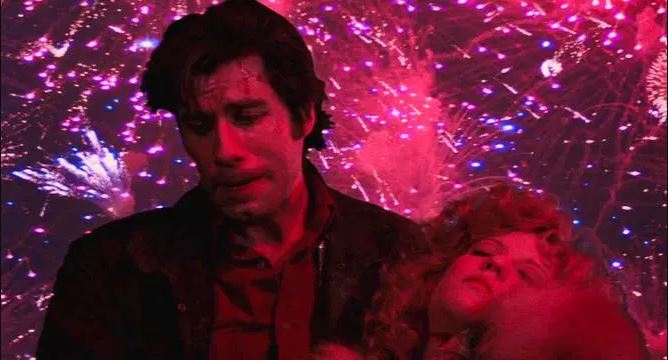
Back in 1981, director Brian De Palma followed up his hit thriller Dressed To Kill with something darker and grimmer, gave John Travolta his best on screen role ever (that's right, ever), took a none-too-unbelievable look at American politics, and created his finest film. That film is 1981’s Blow Out, and despite critical acclaim at the time of its release, it was a box office failure, probably in large part due to the film’s bleak outlook - and probably also, as Nancy Allen suggests in the bonus materials contained in the Criterion release of the film, that an intellectual, personal, and political work was released and expected to compete in summer blockbuster season, rather than in the fall, when “critics’ films” tend to come out. But time has been kind to the film, and it's shown itself to be among the smartest and best-made of the run of 1970s political thrillers. It might help that it actually came after the end of the 70s, with Watergate and its aftermath in the rear-view mirror, rather than being released in the thick of it when everything was still unfolding; the kind of behind-the-scenes machinations that power Blow Out no longer seemed like far-fetched paranoia.
The film starts out as a cheesy horror flick, quickly revealed to be a screening of Co-Ed Frenzy, a low-budget slasher film-within-the-film for which cop-turned-soundman Jack Terry (John Travolta) needs to record new sound effects (and which provides a running joke that turns gut-wrenching in the film’s final moments). Out at night recording, he hears (and records) a blow out and sees a car careen off a bridge and plunge underwater. Diving in to save the woman inside, Sally (Nancy Allen), he becomes embroiled in a plot to derail the upcoming presidential election, but due to the constant movement of the shadowy antagonist Burke (John Lithgow) he finds it difficult to convince others that a conspiracy may be afoot.
The film is De Palma's finest - the place where his thematic ideas about voyeurism and watching (and here, listening) and systemic violence perpetrated against women mesh with his virtuoso filmmaking in a dazzling array of traveling Steadicam work, split screen, slo-mo, 360 degree pans, and other effects that all heighten and work in service of the story being told, rather than merely drawing attention to themselves. And beyond his famous camerawork, the sound design of the film is marvelous - as befits a movie about a soundman - with the visuals we see and the sounds that accompany them often providing an ironic complement or counterpoint. Even in the seemingly innocuous opening credits sequence where Jack is cataloging his stock effects - gunshots, glass breaking, a body falling to the ground, and so forth - these are played over a split screen montage of a TV broadcast of an event for a presidential hopeful whose car is, unbeknownst to him, about to end up at the bottom of a river, and the entire sequence conveys a lot more than the names of the crew. And later in the film, the disparity between TV news reportage and events we've seen firsthand always provides a chuckle.
And as fine as Travolta is in the film, he's matched scene for scene by Nancy Allen, who as Sally attempts to control her own destiny only to be swept away by forces beyond her control, and those of Travolta’s attempts to protect her. And it would be a disservice to not tip the hat to De Palma regular John Lithgow, whose chameleon-like bow as the villainous Burke keeps the film's seemingly implausible menace feeling very real indeed, or to another De Palma fave Dennis Franz, perfectly sleazy as photographer Manny Karp.
If the film were merely a clever thriller, it would be enough to recommend it, but it's more than that, refracting recent political history - Watergate and Chappaquiddick particularly - through De Palma's ideas to arrive at a fully integrated - dare I say it? - work of art. The film looks at sordid post-Watergate closed-door dealings, with the subsequent mistrust of government coloring the cynical proceedings in a film that endlessly looks outward to the modern political landscape and reflects it darkly back on itself. One wonders what sort of grim thriller could be made out of the raw material of today’s political events.
- Patrick Brown

Monday, November 18, 2019

I’d Love To Turn You On At The Movies #231 - Midnight in the Garden of Good and Evil (1997, dir. Clint Eastwood)

         Anyone who knows me isn’t even a little bit surprised I’m writing a review about Midnight in the Garden of Good and Evil. It’s got all the things I love: true crime, the occult, John Cusack, and it’s set in the South. Based on John Berendt’s non-fiction book of the same name and directed by Clint Eastwood, Midnight in the Garden of Good and Evil brings all the southern charm Savannah, Georgia has to offer - along with all of its dirty laundry.
The basic plot of the film is as follows. John Kelso (John Cusack), is sent to Savannah to write a 500-word article on a Christmas party held by eccentric local Jim Williams (Kevin Spacey). When Williams kills Billy Hanson (a baby-faced Jude Law) in what Williams said was an “act of self-defense,” Kelso decides to stay and cover the trial. Kelso gets sucked into the drama of the trial and Savanah itself, describing it as “Gone with the Wind on mescaline.” It’s the local characters that Kelso meets during his time in Savannah that really make the film.
 Mandy Nicholls (Allison Eastwood, Clint Eastwood’s daughter) is a love interest of sorts for Kelso, as well as helping him break into the morgue to solve the mystery of what actually happened the night Billy Hanson was shot. Sonny Seiler (Jack Thompson), Williams' attorney and the owner of the University of Georgia mascot - a long line of English bulldogs named Uga (pronounced “UGH – uh”), adds that unique Southern charm that only Savannah natives can offer. Fun fact about the film - the real life Sonny Seiler plays the judge in the murder trial. Kelso and Williams make a trip to Bonaventure Cemetery to see voodoo practitioner Minerva (Irma P. Hall) in an attempt to communicate with and help calm Billy Hanson’s spirit. Kelso is skeptical to say the least, and Cusack’s scenes with Minerva are some his best acting in the film; he seems genuinely bewildered by what she says and does. But in the end she gives him some great advice - “to understand the living you gotta commune with the dead.” Quite possibly the strangest character Kelso comes into contact with is Luther Driggers (Geoffrey Lewis), a man who keeps flies on strings attached to a shirt and threatens to poison the water supply almost daily with a mystery substance he keeps in a vial that goes with him everywhere, even while he eats his lunch at Clary’s Café. If he enjoys his lunch he will put the vial back in his pocket and be on his way while the entire café breathes a sigh of relief. Last, but certainly not least, playing herself because there isn’t another human on this planet that could do it, The Lady Chablis, a transgender club performer and all around iconic Southern Lady. Kelso comes into contact with her after learning she may have some information about Hanson’s relationship with Williams. The Lady Chablis has her fun with Kelso, making him take her along as his date to a debutante ball he is attending and delivering the best life advice and the best line in the film: “Two tears in a bucket, motherfuck it.” I quote it all the time and most people don’t have a clue where it comes from.
            I can’t talk about this movie without talking about the music. The real Jim Williams lived in famed songwriter Johnny Mercer’s house and Eastwood chose to use the real house in the film (which is now called the Mercer-Williams House and is open for public tours). Hell, I even made my parents take me on a tour of the Mercer-Williams House on a family trip to Savannah. Yes, that’s right, I’ve been in the room where all this went down. This is the reason every song used in the film is a song written by Johnny Mercer. It opens with an absolutely haunting version of “Skylark” sung by k.d. lang. Rosemary Clooney, Cassandra Wilson, Tony Bennett, Allison Eastwood and even director Clint Eastwood contribute covers of some of Mercer's most iconic songs. It keeps that theme of Southern charm going throughout the entire film.
What is most striking about this film is Eastwood cast as many real life people as he could, The Lady Chablis and Sonny Seiler are just a couple of them. It’s what makes the film, which is already based on a true story, work. What better to make something feel more authentic than casting the real life people who were involved? The entire film is a good romp around Savannah, and Eastwood made use of this unique southern town, highlighting many of its most iconic landmarks and colorful locals. I find it to be a highly entertaining film, perfect for a lazy afternoon watch full of laughs, voodoo, an invisible dog being walked on a leash, murder, and a whole lot of Southern charm.

-Anna Lathem  

Monday, November 4, 2019

I’d Love To Turn You On At The Movies #230 - Ed and His Dead Mother (1993, dir. Jonathan Wacks)

In the early ‘90s, after falling completely in love with his character Mr. Pink in Reservoir Dogs, I became sort of fixated on consuming all the other films in which Steve Buscemi starred. That included a lot of late-1980s/early-1990s independent vehicles that were very hit and miss. Ed and His Dead Mother was one of the hits for me. It was one of the first Buscemi flicks that I watched period, let alone one of the first ones that I saw where Buscemi played a (relatively) normal schlub and not a psychotic, violent creep. Ed is also a comedy, which was (and really still is) my forte; my first love. And even though Buscemi was absolutely hilarious in most of his roles, he didn’t do a lot of comedic movies in his early days - at least not that I had seen. Buscemi’s turn as Ed, a sweetly naïve hardware salesman from small town Iowa is simultaneously charming and disturbing.
Ed is the third and final effort by American director Jonathan Wacks. Wacks is perhaps best known for his first film, the George Harrison (yes, THAT George Harrison) co-produced Powwow Highway, or for producing the cult favorite Repo Man. Buscemi plays the titular Ed Chilton, the ultimate mama’s boy. Ed receives a visit from a kind of shifty snake oil salesman (John Glover) from a company called Happy People, Ltd., who offer to reanimate his dead mother for a fee. After some consideration and a lot of resistance from his live-in Uncle Benny (Ned Beatty), Ed decides to go through with it. At first Ed is thrilled to have his mother back, as she picks up where she left off when she died, cooking and cleaning and generally helping Ed keep his life in order. But over time, as her behavior grows more and more irrational and bizarre, (hunting and killing living things for sustenance, for example), Ed must make a decision on what to do about mother.
The film itself is any indie film nut’s darling. In addition to Beatty, Glover and Buscemi himself, the film also stars a handful of other fairly well-known character actors, like Miriam Margolyes, Gary Farmer, Eric Christmas and especially Rance Howard, father of Ronnie and Clint, who plays the town preacher shopping at Ed’s store for tools to use to murder his unfaithful wife. The film also has one of the more curious set design choices I’ve ever seen. For the most part, the film looks like 1993, when it comes to wardrobe and hairstyles and things like that, but location-wise, the small Iowa town that’s supposed to be being portrayed here looks almost more 1953. Whether this was a conscious decision or a happy accident is beyond me, but somehow it works, adding yet another layer of strange to an already eccentric film.
Steve Buscemi is still one of my all-time favorites and I still tend to try to watch everything he appears in. Wacks, on the other hand, never directed another full length after Ed and His Dead Mother was released, most likely due to the poor box office activity of all three of his feature films. This would also explain why, up until 2018, the DVD was long out-of-print as well. This is a shame too, because I consider Ed to be kind of an indie classic. A deep cut that never tries to be anything it’s not. It’s just a quirky little comedy, in the tradition of Floundering or Living in Oblivion, with a little bit of a dark and macabre edge to it. Not a zombie film per se, but definitely a seasonally-appropriate film that offers a fresh take on portraying the undead.

- Jonathan Eagle

Monday, October 21, 2019

I’d Love To Turn You On At The Movies #229 - The Emigrants / The New Land (1971/1972, dir. Jan Troell)

When these two 3-hour Swedish films opened in Denver in the early 1970’s I would have been about 14. I honestly can’t believe my parents thought it was a good idea to take me to six hours of subtitled historical drama, but it is even more surprising that I sat through it, and remembered it fondly. I was thrilled to see that Criterion released them together in one package, and, that after three decades I would be able to revisit this experience. I spent the better part of my day off with Swedish farmer Karl Oskar (Max Von Sydow) and his bride Kristina (Liv Ullman) as they try to succeed in their native Sweden, but failing that, emigrate to mid-1800’s America and help settle Minnesota.
The first movie The Emigrants finds Karl Oskar toiling on his Father’s farm working like a dog, barely making ends meet, and finding it almost impossible to feed his new and growing family. At the same time, his brother Robert and other relatives are finding the Swedish environment of conservativism and religious piety oppressive. They start talking and reading about North America and the promise of freedom and success in the United States. Braving the emotional and financial consequences, a group of them decide to leave their home and make the voyage to America. That’s a neat little synopsis of the first three hours, but it does nothing to convey the overwhelming beauty and power of this great movie. Filmed with loving attention to detail, director Jan Troell puts the dirt under your fingernails, makes you smell the bread baking, and puts the thought in your mind and belly that this will be the last bread of the winter because the harvest is bad. Troell’s movie is in a class by itself. It’s hard to think of another movie that so vividly takes the audience into the lives of simple people so effectively. There is little romanticizing of their plight, everything is shown with a matter-of-fact clarity which conveys both the pain and drudgery of their existence, but also offers a fleeting, bittersweet glimpse at a not so distant past free of technological intrusion and environmental annihilation. The scenes and one’s emotions fly from backbreaking toil to exhilarating natural beauty with the fluency of life itself. The cinematic achievement is profound. Like so few movies (Boyhood is one of the only others that comes to mind), The Emigrants and its sequel The New Land actually capture the huge artistic ambition of showing a life lived.
The lengths of these movies might seem gratuitous, but as they unfold, it becomes clear that this is the only way to portray such overwhelming scale. The sequence showing the boat journey from Sweden to New York is forty minutes of harrowing aquatic nightmare, and when it ends you feel a physical relief as the actors set foot on solid ground. Likewise, the final scenes of The Emigrants show Karl Oskar trekking through unsettled Minnesota looking for the perfect spot to settle. Without any dialogue, it is actually possible to lose yourself in the fantasy of discovering America. It is one of so many beautiful and emotional moments. If you love this country, and believe its inherent greatness is connected to its natural beauty and those who first settled it, this is a rare experience.
 Many social issues are also tackled in these movies. Especially in The New Land, timely themes of immigration, racism, sexuality, class warfare, dirty business and Native American rights are shown, again with the seemingly spontaneous intrusion of true life. Perhaps because everything is from the Swedish perspective, rather than the jingoism we often see in modern Hollywood, it is possible to reflect upon these issues from multiple perspectives. The story climaxes with twin tragedies. First, younger brother Robert heads west to participate in the gold rush. He is exposed to greed, disease, theft, and death, before returning to the disapproval of his own family. It is the Horatio Alger myth in reverse. Then comes the controversial telling of a massacre (part of the Dakota Wars) of many of the settlers by the Native Americans who originally inhabited the land the Swedes were settling. A series of horrifying scenes of violence, retribution and execution bring in to focus one of the more unsettling aspects of the founding of our country and the treatment of its first citizens. Again, it is the non-Hollywood perspective that lends these scenes such veracity and makes them so hard to ignore or forget.
The Emigrants and The New Land are incredibly important films to see at this particular moment in America’s history. The ambitions of these films are as big as America’s endless horizons, yet they focus on the small details of humanity we all share. The endless vistas of this new country tamed by the tiny voice yearning for home.

- Paul Epstein

Monday, October 7, 2019

I’d Love To Turn You On At The Movies #228 - The Host (2006, dir. Bong Joon-ho)


            Meet the Park family, proprietors of a snack stand along the touristy Han River in the South Korean capital of Seoul:
Gang-Du, the eldest son of the generous and caring widower Hie-bong, Gang-Du’s wife left him with their precocious young daughter Hyun-seo years ago and left him emotionally arrested at that stage in his life.
Nam-Joo, Hie-bong’s youngest, a champion archer with a penchant for choking when the pressure is on.
Nam-il, the educated activist middle child who has been unable to find gainful employment despite his education and who drinks to cover up his anger.
Hie-bong, the gentle patriarch who is struggling to care for his family economically, and who is ready to fight to hold them together.
Hyun-seo, youngest of the Park clan, trying to succeed in school despite a difficult upbringing and a father who, though he tries his best, fails her in many ways.

While the Parks work their snack stand, miles away an American military scientist examines the contents of his laboratory with his Korean assistant, sees hundreds of bottles of chemicals he deems to be spoiled, and has a conversation that culminates in the words “That’s right, let’s dump them in the Han River” - we know this can’t be good. Sure enough, shortly the local fisherman begin to notice fewer fish, and some of the ones they catch seem… different, perhaps with more tails than they usually have, and also perhaps a little more bite-y than usual. A man preparing to jump off a bridge sees a huge black shape moving in the water but can’t tell what it is.
And instead of spending half the film building up to the reveal of the monster as in most monster classics (Alien, Jaws, King Kong), we’re suddenly right into the thick of it - a mutated, amphibious monster that resembles a giant, dangerous tadpole with legs and too many teeth is running rampant along the walkways of the Han, crushing and flinging aside onlookers, grabbing some with its mouth or its tail, going in and out of the water. Naturally this happens right by the Park family stand at the most crowded and busy time of day, and as the monster runs wild through the crowd Gang-Du sees young Hyun-seo in danger and springs into action intent on protecting his family, one of the few onlookers who dares to assault the beast instead of running away screaming. But the monster nabs Hyun-seo with its tail, flees back to the water and off to its lair. Shortly afterward those who have come into contact with the monster are quarantined by the military because of their exposure to a virus the beast is carrying, and this includes the entire Park family. And so begins the meat of the film - the family coming together over their longstanding personal difficulties to find Hyun-seo. Which means that they not only have to find the monster's hidden lair in the city, but also evade the authorities who want them locked up and away from the general populace as they prepare to test a new chemical agent to destroy the beast - and possibly sell it for chemical warfare in the future.
Gang-Du (Bong regular Kang-ho Song) is both funny and touching as the eldest son, a slacker father lamenting his departed wife and dotingly focused on his daughter Hyun-seo (superbly played by Ko Asung), suddenly awakened out of his torpor to rescue his captured child. The film follows out many threads of the progress of different family members - Gang-du’s younger archer sister, his activist younger brother, and his father Hie-bong trying to keep them all together (and who, like his surprisingly active slacker son, is a real fighter when it comes to the monster). And of course there's resourceful young Hyun-seo, cool-headed under threat of being eaten by the mutant tadpole threatening all of Seoul.
Bong Joon-Ho's ease in genre - and also rejection of it - is a major plus here. Like all his films (that I've seen), he starts with what appears to be a straightforward genre piece and slowly sends it off the rails until it's something else entirely. Is this a thriller about a government cover-up? A family drama? A giant monster horror film? A black comedy? The answer is yes to all of those things. And the reason I've spent so much time talking about the family is because Bong took the time to think about them as well - he invests what could be a tawdry CGI-centric genre piece with real, flawed, believable people (helped immensely by an excellent cast who make us care about their foibles, about their problems), and helps us believe it when a giant killer tadpole snatches their daughter to its hidden lair to be eaten at a later time.
If you need a great horror film for your October viewing, check this one. If you need to see the earlier work of this year's Palme d'Or winning director, check this one (and also check out the superb Memories of Murder, itself another genre-defying genre film - this time a police procedural) before you go see the excellent Parasite when it opens. But really, Bong Joon-Ho hasn't stepped wrong in anything I've yet seen - I started with The Host and have yet to be disappointed, and you won't be either.
-         Patrick Brown

Monday, September 23, 2019

I’d Love To Turn You On At The Movies #227 - The Social Network (2010, dir. David Fincher)

My freshman year in college I somehow got my hands on a screener copy of The Social Network. I think a friend of a friend was in film school at Auburn or maybe it just magically appeared in my apartment, I'm not sure. One thing I am sure of is that I watched the hell out of it. It grew on me the more I watched it. It is after all a movie about Facebook. But not just about Facebook, it's about all of the people Mark Zuckerberg stepped on the heads of on the way to the top. Screenwriter Aaron Sorkin weaves two complicated legal cases into an epic story scored by Trent Reznor and Atticus Ross. The cast is all over the place and yet somehow it works perfectly to tell this story. In the end, it might just show you that if more people had stopped, watched this film and looked into the deceitful things Zuckerberg did to make Facebook, some of you wouldn’t have been so surprised when Facebook itself became a deceitful thing.
            The first thing that won me over about The Social Network was that Aaron Sorkin wrote the script. As a massive fan of The West Wing, I love a good Aaron Sorkin walk-n-talk peppered with iconic lines. What better than for him to write about than a bunch of nerds arguing in court over who came up with what. There is a reason he won an Academy Award for Best Adapted Screenplay. Sorkin adapted Ben Mezrich’s book Accidental Billionaires into an amazing script that was easy to follow, interesting and still had enough tech lingo to be not dumbed down for the masses.
This film has a massive cast, some big names and some unknowns at the time. Jesse Eisenberg plays insufferable nerd Mark Zuckerberg like a super villain with absolutely no regard for people other than himself. Watching him tell an attorney for the Winklevoss twins that he doesn’t deserve his attention with not one single human emotion on his face was insane, seeing as I had only seen him in Adventureland before this. In the role of Eduardo Saverin (AKA best friend and cash cow for Zuckerberg), is the adorable Andrew Garfield, who even with his adorable face he still does the job of showing just how far Zuckerberg went to get to the top. You understand his frustration with the situation - Zuckerberg made him not a part of Facebook. Armie Hammer - man if only there really was two of him. But alas, there isn't. He plays the Winkelvoss twins as two big dumb (but not that dumb, because they go to Harvard) jocks and still gives each twin their own personality. Who better to play Napster founder and all around douchebag Sean Parker than Justin Timberlake, a musician who was definitely affected by the creation of Napster? He did an amazing job of playing Parker as the paranoid bad businessman that he was. 
And finally, the music. If the score wasn’t super-duper out of print I think I could do an entire review about it. Trent Reznor and Atticus Ross - Boy, what a team! I wouldn't have passed a few college classes if it weren’t for this score. As soon as I saw the film I had the music stuck in my head and to this day it's my go-to study/get things done music. It’s honestly worth a listen on its own, but hearing it woven into this complicated story is really something. “Hand Covers Bruise,” a melancholy tune that you can hear throughout the film, is also my favorite of the tunes. An intense, strange version of “In the Hall of the Mountain King” sets an even stranger mood for the Henley Royal Regatta where the Winklevoss Twins lose the race. Again, there is a reason this won an Academy Award for Best Original Score. While the score dominates the film it is opened and closed with two great song choices. Opening the film in a crowded college bar is The White Stripes' “Ball and Biscuit,” which sets a mood for the verbal beating Zuckerberg is about to receive from a soon to be ex-girlfriend. Closing out the film with The Beatles “Baby, You’re A Rich Man” while Zuckerberg sits alone after a deposition refreshing his Facebook page, waiting to see if the same ex-girlfriend from the beginning accepts his friend request is just the icing on this cake to an already fantastic sounding film. 
I find it kinda funny that this blog will be posted on the Twist & Shout Facebook page. The version of Facebook in The Social Network isn’t the same Facebook as today. In The Social Network it was exactly that, a network for socializing, that isn't the case anymore. Today it’s for arguments and weird relatives that overshare among other things. Around the time I was obsessed with The Social Network I also stopped putting every second of my life on Facebook. I don’t know if I was just bored with it or if the film made me see it in a different light. All I can say is that I am not one single bit surprised by all of the chaos Mark Zuckerberg and Facebook have created in the decade since the film was released.

- Anna Lathem