Showing posts with label blues. Show all posts

Tuesday, May 19, 2020

The Blues

Somewhere in the mid-70’s when I was working at the Century 21 Theatre on Colorado Blvd. as an usher, I established the weekly habit of getting off my night shift, taking my paycheck to Safeway to cash and then going to Peaches records on Downing and Evans before they closed at midnight and perusing their cut-out bins. Filled with mysterious, colorful covers, I really learned how to explore music there. It’s where I turned myself on to Ornette Coleman, Miles Davis, Charlie Parker, Gene Autry, Lefty Frizzell, Professor Longhair, Gatemouth Brown, John Lee Hooker and Lightnin’ Hopkins. The cutout bins were the final resting place for the cast-off legacy of our own cultural highpoints. The radio was filled with Journey and REO Speedwagon, and I was finding myself drawn to Burl Ives and Champion Jack Dupree. The cut-out bins were a refuge from the modern world and a doorway to the secret history of an American life completely different than the one I knew. Once I stepped through, I never fully came back through that doorway. I found myself more comfortable in the past. The things I heard there changed everything I heard in the present. Every guitar player had to stand up to Blind Blake, every songwriter had to match Jimmie Rodgers, and every legend be as mysterious as Robert Johnson; obviously, an impossibility. But here in the cut-out bins, I could lose myself in big black vinyl slabs of another era.
Around this same time I got my first electric guitar. I got a few instruction books, and a few friends showed me a couple of things, but my real course of study was to listen to B.B. King records and try to copy his playing. In spite of how simple it sounded, I found it was very hard to sound like he did. When I got to see him live, I realized how much of his sound was connected to the vibrato he created with his left hand, as well as the overwhelming physicality he put into every moment of his performance. I was obsessed with the mystery of the blues and dove into the deep end.
Of course, the deep end is the pre-war period of blues captured largely on 78 rpm records. I quickly realized that a) these original records were rare as shit, and I couldn’t afford them, and b) the cutout bins were filled with reissues of the early stuff and c) some of the original guys and many of the great post-war guys were actually still alive and available to see at clubs and festivals. I started building a relationship with the genre and the people who shaped it. I bought a lot of records by blues rock bands like Led Zeppelin, Cream, ZZ Top and Hendrix which all ended up pointing me to the source. Slowly I built a collection and started understanding the different sub-genres and stylistic variations of the blues.

After I got Twist And Shout and the CD reissue market took off, the massive body of rare recordings from the 20’s and 30’s started to become available and affordable. I continued to get original LPS and even a few 78’s where I could, but I remain grateful for the access labels like JSP, Document, Shanachie and Yazoo provided me to the Blues on CD. At some point in the 90’s we were selling music at a blues festival in the Golden Triangle. Our tent ended up being next to the tent of a man named Dick Waterman, a fascinating nut and world-class photographer who had helped rediscover a number of lost bluesmen in the 1960’s and then documented them with a rare and insightful eye. I befriended Dick and ended up buying a bunch of his beautiful photographs.
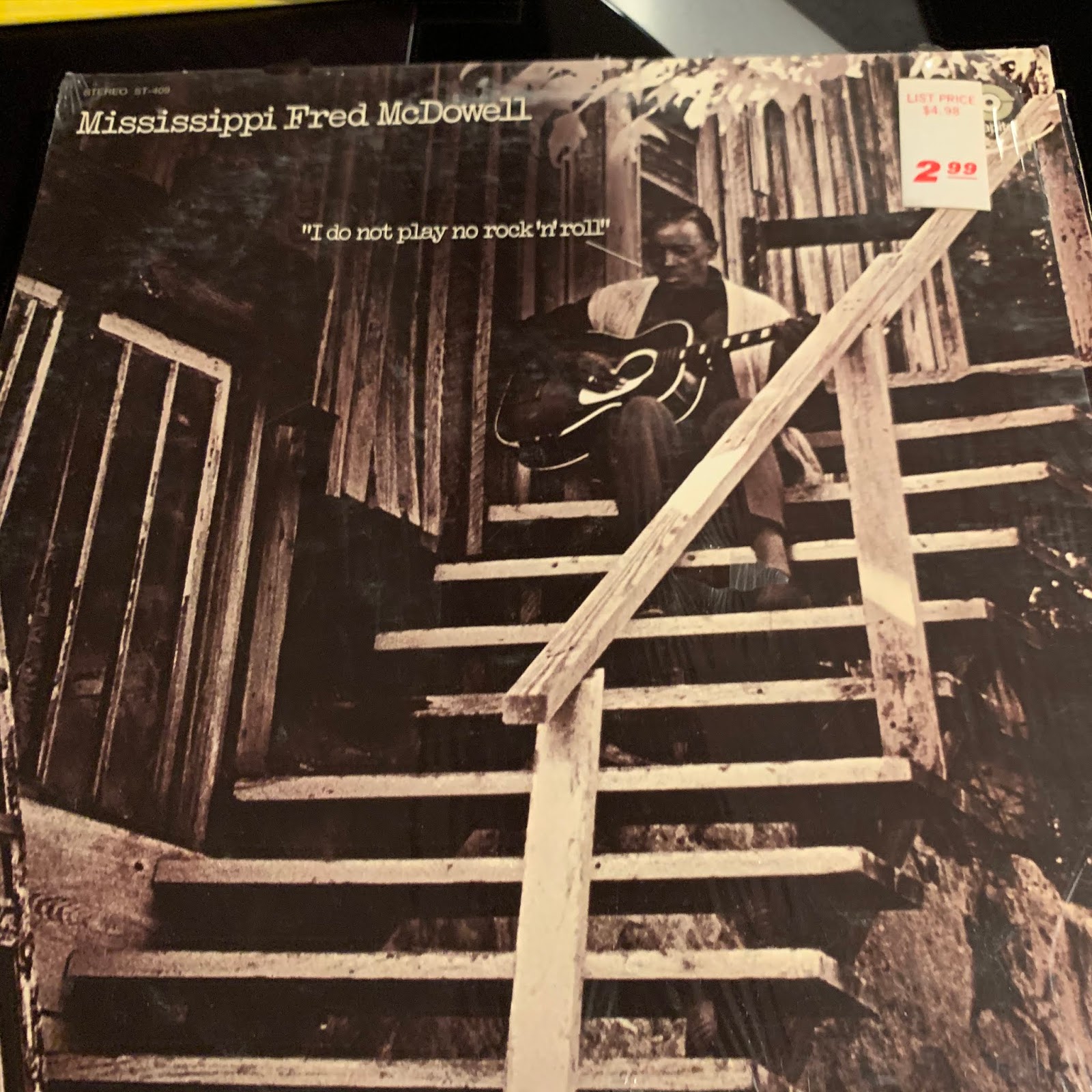
Three events in the early 2000’s helped keep my love alive. The first was release of the documentary Desperate Man Blues about 78 rpm collector Joe Bussard, a true curmudgeon and laser-focused aesthetician, which brought into focus my own beliefs about music before the age of mass media. Regionalism is what makes different kinds of music special. There are forces at play nowadays that make music an entirely different thing. Next was getting my 1946 Seeburg 78 RPM jukebox.
With this restored beauty in my life I had a vehicle worthy of taking those rare 78s out for a drive. Finally, it was the purchase of a large collection of 78s I did a few years ago. The records were amazing - all rare blues, gospel and r&b from the 20’s through the early 60’s. The only problem was they were soaked in urine and many of them were scratched beyond play. Still, I embarked upon cleaning and salvaging as many as I could. There were many surprises and lots of classic blues. About half way through the collection I got to the end of a stack and there it was staring back at me.
The Masked Marvel (Charley Patton) "Screamin’ and Hollerin’ the Blues" an incredibly rare 78 from 1929. With trembling hands I placed it on the turntable. It was so scratched, it sounded like Charley Patton was singing on Mars. But just the act of holding the record and letting the 80-year old grooves unwind in my presence was a moment of intense clarity for me. I realized how important the blues have been in my development as a music enthusiast, collector and retailer. Few things protect me from the effects of modern malaise more than the protection of The Masked Marvel.
- Paul Epstein


Monday, March 20, 2017

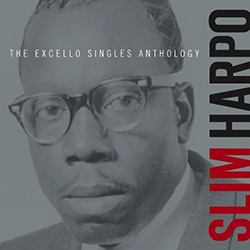
I'd Love to Turn You On #175 - Slim Harpo - The Excello Singles Anthology


So when did Rock And Roll actually begin? There are more than a few answers. Every couple of years someone comes up with a new discovery that seems to prove that some one-hit wonder was actually the first example of primal rock. It seems clear that it happened somewhere between the late 1940’s and the mid-1950’s, and, fueled by the excitement of artists like Chuck Berry, Little Richard and Elvis Presley, became recognizable as its own genre with a growing worldwide following somewhere in the mid-50’s. The very wide-ranging nature of that answer shows that there was no single song or artist who can take full credit, but rather that there was a gradual shift in sound and subject matter toward what we now understand as the ocean of Rock. The streams that ran into that ocean came from all over the place (regionalism) and represented a number of genres; Pop, R&B, Blues, Country, Jazz. Each of these genres had a number of artists who sounded like they were on the verge of breaking out and rocking! Slim Harpo (James Moore), was one such artist. Skirting the line between R&B and Blues in the late 1950’s, he is an excellent example of an artist breaking down the walls of expectation and creating something new.

Influenced himself by the urban blues stylings of Jimmy Reed, Harpo took the electric guitar and lead harmonica style into the stratosphere with the addition of his laconic, pinched vocals, reverb drenched guitar solos (usually courtesy of Guitar Gable, Rudolph Richard or Jimmy Johnson), and unfailing turn of a clever phrase. This 2 CD set contains all his singles (A&B sides). Every cut he recorded was worth hearing, but this set really covers the meat of his best material. And oh man is the good stuff good! I guess there’s an argument to be made that you could start and end with the first single and its fabulous flip. “I’m A King Bee / I Got Love If You Want It.” In these two songs, one can clearly hear what must have grabbed Lennon, Page, Jagger and Richards by their ears. Both songs have an almost alien-sounding vocal and guitar paired with a string of sophisticated yet suggestive amorous overtures which have become part of popular lexicon ever since. Think about that accomplishment alone - writing multiple songs that, 60 years later, are part of modern consciousness. The recordings themselves are that classic “stacked” sound of late 50’s recordings. The vocal, guitar and harmonica are directly in your face, while keyboards, bass and drums churn below, striving for attention. Occasionally an organ fill, slapping snare or tambourine rise to the surface, but for the most part the backing is like the ocean lapping on the shore. That lopsided sound is what gave so many of these early R&B singles such an exciting and dramatic feel. Harpo’s voice was already an amazing instrument, but when it is coming at you, claustrophobically on top of the mix, like a torpedo in a bathtub, you have to pay attention.

Harpo continued to release strong and distinctive singles for the next few years, which were all eclipsed by his 1960 hit single (even though it was originally the B-side) “Rainin’ In My Heart.” A melancholy masterpiece, it lives in a stylistic world of its own - floating somewhere between a country ballad and an R&B torch song. It is soaked in echoey guitar, a rolling rhythm section and Harpo’s world-weary vocal. A great song if there ever was one.

Harpo left Excello for a brief period in 1965 but returned later that year for another burst of fantastic late-career singles. “Baby Scratch My Back,” “Shake Your Hips,” “Tip On In (parts 1 & 2)” and the irresistible “Te-Ni-Nee-Ni-Nu” are all classics of the style that Slim Harpo shared with almost nobody else. The insistent rhythm of “Baby Scratch My Back” and “Shake Your Hips” find Harpo now clearly making Rock And Roll, or rather defining what that term would mean for The Rolling Stones and many others. It is insidious and more than a little dangerous. It also has a cool, slinky tempo that defines the restraint that Rock would start to develop as it matured. So, Slim Harpo not only helped define the original sound of Rock, he predicted where it would go in the future. Slim Harpo The Excello Singles Anthology belongs in the collection of any serious student of modern music and anyone who likes cuttin’ a rug.

-                     Paul Epstein

Monday, May 30, 2016

I'd Love to Turn You On #155 - Mississippi John Hurt Avalon Blues The Complete 1928 Okeh Sessions

71WLNaFucKL._SL1092_ This CD (originally released in 1996) contains the entire original recorded output of John Hurt, who, after recording these sessions (mostly in one day in 1928) returned to his home in Avalon, Mississippi and was not heard from again until he was re-discovered in the 1960’s. What he left behind is one of the most extraordinarily moving legacies in modern musical history. The 13 songs on this disc offer a perfectly clear window into the world Mississippi John Hurt occupied in a time that now seems impossibly far away. Possessed of an angelic voice and face and a soothing, smooth style of fingerpicked guitar, Hurt’s songs initially seem to bear no resemblance to the excited, rough playing of Charlie Patton, or the blinding speed and precision of Robert Johnson, but Hurt, who apparently had no role models or teachers, plays in a style that is as definitive as any of his peers. Primarily utilizing a three-finger picking style with his thumb providing an almost machine rhythm, the overall impression he leaves is of a Zen-like master of vocal and guitar technique. However, when one looks slightly below the surface, it becomes clear that John Hurt is as possessed by demons as he is by kinder spirits.

e8b1c1d65726096a31623e1c83677ef8Each of the first nine songs on Avalon Blues are, in one way or another, about either fightin’ or fuckin’- there’s really no other way to say it. Even though he sounds like a man in control, he finds himself on the wrong end of a bottle or a cheatin’ woman on each of these songs. The result, more often than not, is gun and/or knife play and someone ending up “six feet under the clay.” Within these tales are the genetic goo of all blues and then rock to come. “Frankie” and Albert are there. “Stagger Lee” (“Stack O’ Lee” here) who would become one of the most enduring popular culture myths makes his definitive appearance, the tragic “Louis Collins” is laid away by the angels for the first of many times. The Candyman, who would slip in back doors for the rest of musical history, shows up for the first time. It quickly becomes clear that Mississippi John Hurt is one of the founders and originators of all the music that would follow him into the 20th century and beyond. Not only did he write these songs and seemingly snatch this guitar style from the ether, his versions of what are now standards are by far the best.

MississippiJohnHurt-1024x761Then, at the end of his December 28, 1928 session in New York City, Hurt takes a left turn and plays four songs that show a much different side to the man. “Blessed Be The Name” and “Praying On The Old Camp Ground” show Hurt to be a man with heavenly concerns to balance his earthier tastes. His voice softens even more on these songs, and he coos and moans his way through two beautiful spirituals. Then, he ends with my two favorite songs, which show him as a real man of the earth - not a dangerous lothario, not a preacher, but a simple man who needs to work so he can live. “Blue Harvest Blues” is about a farmer facing a bad harvest (“harvest time is comin’ / will catch me unprepared”), who has no family, nothing. “Blues are on my shoulder / Blues are all around my head / with my heavy burden, lord I wished that I was dead” he sings, and anyone who has had a streak of bad luck can relate. The set ends with one of the greatest of all blues songs, “Spike Driver Blues,” which reads like the original “Take This Job And Shove It,” whereby Hurt compares himself to the story of yet another lynchpin of American folklore, John Henry, but in this case he says “take this hammer and carry it to the captain / tell him I’m gone tell him I’m gone, tell him I’m gone” John Hurt wisely takes the path of least resistance.

What makes Mississippi John Hurt’s early recordings so important transcends his wonderfully controlled and expressive voice, it transcends his groundbreaking and defining guitar style, it is that very modern mixing and mastery of subject matters which shows him to be an exemplar of the complex human spirit. Rather than being a museum piece, he is a beacon for how to behave in the future. Mississippi John Hurt’s Avalon Blues is an essential key to unlocking the modern psyche.

- Paul Epstein

Friday, April 8, 2011

I'd Love To Turn You On #30 - Professor Lonhghair - Crawfish Fiesta

This is a story about New Orleans: an amazing, singular, misunderstood city. There are a number of factors that make it a great city; the food, the architecture, the cultural heritage of which the music is its greatest ambassador. The misunderstanding sets in when people can’t separate the good from the not so good. Like any city there are less interesting neighborhoods and that’s the way it is with the food, architecture and culture in New Orleans. Is all the food good? Of course not, it’s the naturally occurring seafood that has been brought to a high art. It is those buildings that betray the French Colonial and plantation influence that really stand out and it is specifics that make New Orleans music great. It isn’t every funk or rock band that learns to yell “Les Bon Temps Roulez!” that defines the sound of the crescent city, rather it is those artists who, without pretense, innovate and perpetuate certain specific musical attributes that make the city’s music special.
To my mind, no artist in the post- WWII era embodies these attributes more than Henry Roeland Byrd, more commonly known as Professor Longhair. Fess’s performing life was almost entirely in New Orleans and his fame was small. He toiled in obscurity and poverty for much of his life and has really only received his due since his death. His recorded legacy is also spotty, hard to find and sometimes not representative of his greatness. The perfect way to introduce oneself to this important artist is his one and only record for the Alligator label called “Crawfish Fiesta.” Although recorded in 1979 long after his start in the late 1940’s and close to his death in 1980 the album is possibly the best recorded and one of the best performed of all his releases.  Backed by a sublimely tight, in-the-pocket band including Dr. John on guitar (!) and New Orleans legend John Vidacovich on drums the focus of everything is Professor Longhair’s masterful piano playing and his unearthly vocals. On both of these accounts he is without peer. When one talks about New Orleans style piano and the “second-line” sound there is nobody who does it better than Professor Longhair. Referring to the second line of observers and dancers who follow New Orleans musical parades, it is the footfall of this second line that creates the second line of rhythm. In Longhair’s style it manifests itself as a backbeat that is slightly behind the beat and produces a woozy, herky-jerky sound irresistible to dancers. Countless New Orleans piano players have tried (and failed) to approximate his style, but he remains stubbornly impenetrable. 
The same can be said of his singing. The first times I listened to Professor Longhair I thought he might be singing in some foreign language. The words, a combination of ethnic expression and street lingo tumble out of his mouth in a torrent, often not pausing in places grammar would suggest. The result is hypnotic. It is why there is such a fascination with the music of New Orleans; it really does sound like it is from somewhere you’ve never been. And the things he sings about! “Well the girls ‘round here gettin’ real real rough/calling for whiskey with a dip of snuff.” How the hell do I get there? I want to find that bar he’s singing about on the song “In The Wee Wee Hours” where the women behave that way. And when exactly are the wee wee hours? The professor tells us; “Between night and dawn.” When is that exactly? Like many great artists, Professor Longhair has created his own universe, populated by interesting people speaking a language that is somewhat familiar yet enticing and exotic with a touch of danger. 
It is the city itself that creates this state of being. Professor Longhair couldn’t be from anywhere else. He is such a product of his environment that his art becomes shorthand for  all the things that are New Orleans. His authenticity and natural talent are not the product of training, polish or production, they are the product of raw ability being honed in a blast furnace of hard-scrabble American street life. You just can’t fake that kind of stuff. Every second of Crawfish Fiesta is a joyous celebration of the street where Henry Byrd lived. It could be your street, but it’s not. The only map is in the grooves of the music.
Paul Epstein