
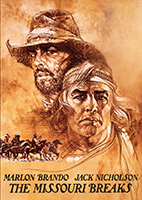
 Think about the
extraordinary turn Marlon Brando’s career was taking in the 1970’s. After stalling a bit in the late 60’s he
came roaring back in 1972 - jowly, greying at the temple and more potent than
ever in The Godfather and Last Tango In Paris. Two braver explorations of middle age could
not be imagined, then… silence, until 1976 when he returned – greyer still, jowlier
yet, but no less intense and seeming to have tapped into some sort of cosmic
awareness that made him a real-life cross between con-man, genius, artist,
shaman and fool. It was also impossible to take your eyes off of him in what
could be considered his last great role of substance in The Missouri Breaks (I
love Apocalypse Now, but it is hard to call what Brando
did in it as “substantive.” Memorable yes, substantive maybe less so.). Director Arthur Penn created a stylish western
in the classic mode, which is elevated to something truly memorable by Marlon
Brando’s inexplicable performance. From the moment he appears on screen as
Robert E. Lee Clayton he is magnetic - both compelling and terrifying at the
same time. He is a regulator (a legal
assassin) who has been brought from Wyoming to Montana to help rancher David
Braxton (John McLiam) and his attractive daughter Jane (Kathleen Lloyd) deal
with a band of horse rustlers (Jack Nicholson, Harry Dean Stanton, Randy Quaid
and more) who have been causing trouble. Brando enters the action as an exotic
swashbuckler; fringed leather jacket, long hair and an Irish accent. He
immediately shows himself as a man not to be trifled with, appraising Nicholson
as the thief and beginning to exact punishment on the gang. His speed and
deadly accuracy prove his reputation as an uncontrollable, but ultimately successful
executioner.
Think about the
extraordinary turn Marlon Brando’s career was taking in the 1970’s. After stalling a bit in the late 60’s he
came roaring back in 1972 - jowly, greying at the temple and more potent than
ever in The Godfather and Last Tango In Paris. Two braver explorations of middle age could
not be imagined, then… silence, until 1976 when he returned – greyer still, jowlier
yet, but no less intense and seeming to have tapped into some sort of cosmic
awareness that made him a real-life cross between con-man, genius, artist,
shaman and fool. It was also impossible to take your eyes off of him in what
could be considered his last great role of substance in The Missouri Breaks (I
love Apocalypse Now, but it is hard to call what Brando
did in it as “substantive.” Memorable yes, substantive maybe less so.). Director Arthur Penn created a stylish western
in the classic mode, which is elevated to something truly memorable by Marlon
Brando’s inexplicable performance. From the moment he appears on screen as
Robert E. Lee Clayton he is magnetic - both compelling and terrifying at the
same time. He is a regulator (a legal
assassin) who has been brought from Wyoming to Montana to help rancher David
Braxton (John McLiam) and his attractive daughter Jane (Kathleen Lloyd) deal
with a band of horse rustlers (Jack Nicholson, Harry Dean Stanton, Randy Quaid
and more) who have been causing trouble. Brando enters the action as an exotic
swashbuckler; fringed leather jacket, long hair and an Irish accent. He
immediately shows himself as a man not to be trifled with, appraising Nicholson
as the thief and beginning to exact punishment on the gang. His speed and
deadly accuracy prove his reputation as an uncontrollable, but ultimately successful
executioner. With the central
conflict established, Penn goes about turning the movie into a philosophical
treatise on the difference between being a thief and a killer, and if either of
those is morally worse than being a bad person on the right side of the law. David
Braxton, it turns out, is a world-class creep who deserves whatever he gets,
while Nicholson seems to be a more three-dimensional man than his designation
as horse rustler might indicate. He yearns for the honest life - or at least
the love of a woman who has lived the honest life - available in the person of
Braxton’s daughter. Brando’s character Clayton appears more and more like a
scorched earth psychopath, hell-bent on destroying his prey as violently as
possible, letting no one - including those who hired him - stand in the way.
His inhumanity grows with each scene as Nicholson becomes an increasingly
sympathetic protagonist. As Clayton’s killings take on greater cruelty with
each victim, Clayton’s personality takes on more complexity. He begins shifting
accents from Irish to Southern, to female (complete with unforgettable drag costume) and back to Irish. His performance is always on the edge of
hallucinatory, the cutting edge of menace and hilarity. In spite of it being
one of his least famous movies, I believe The
Missouri Breaks contains one of Brando’s most beguiling performances. By
the end of the movie, he is a truly frightening presence - unpredictable,
deadly and unstoppable - beyond the control of laws or bullets. The shocking
twist at the end remains a great cinematic trick, never failing to surprise.
With the central
conflict established, Penn goes about turning the movie into a philosophical
treatise on the difference between being a thief and a killer, and if either of
those is morally worse than being a bad person on the right side of the law. David
Braxton, it turns out, is a world-class creep who deserves whatever he gets,
while Nicholson seems to be a more three-dimensional man than his designation
as horse rustler might indicate. He yearns for the honest life - or at least
the love of a woman who has lived the honest life - available in the person of
Braxton’s daughter. Brando’s character Clayton appears more and more like a
scorched earth psychopath, hell-bent on destroying his prey as violently as
possible, letting no one - including those who hired him - stand in the way.
His inhumanity grows with each scene as Nicholson becomes an increasingly
sympathetic protagonist. As Clayton’s killings take on greater cruelty with
each victim, Clayton’s personality takes on more complexity. He begins shifting
accents from Irish to Southern, to female (complete with unforgettable drag costume) and back to Irish. His performance is always on the edge of
hallucinatory, the cutting edge of menace and hilarity. In spite of it being
one of his least famous movies, I believe The
Missouri Breaks contains one of Brando’s most beguiling performances. By
the end of the movie, he is a truly frightening presence - unpredictable,
deadly and unstoppable - beyond the control of laws or bullets. The shocking
twist at the end remains a great cinematic trick, never failing to surprise. In
the 34 years that have passed since I last saw this movie, I had forgotten
almost everything about it. So the panoramic cinematography, realistic take on
the Old West setting, excellent music and funny dialogue were all a welcome
re-acquaintance. It is Marlon Brando’s terrifying depiction which I had not
forgotten, and it was, in fact, even more potent than I remembered. He has had
one of the most terminally appraised careers in the history of film, yet his
depiction of Robert E. Lee Clayton does much to justify his genius reputation.
In
the 34 years that have passed since I last saw this movie, I had forgotten
almost everything about it. So the panoramic cinematography, realistic take on
the Old West setting, excellent music and funny dialogue were all a welcome
re-acquaintance. It is Marlon Brando’s terrifying depiction which I had not
forgotten, and it was, in fact, even more potent than I remembered. He has had
one of the most terminally appraised careers in the history of film, yet his
depiction of Robert E. Lee Clayton does much to justify his genius reputation.
-
Paul
Epstein


