Showing posts with label Sci-Fi. Show all posts

Monday, December 3, 2018

I’d Love To Turn You On At The Movies #206 - The Testament Of Dr. Mabuse (1933, dir. Fritz Lang)


Director Fritz Lang seemed to have an incredible knack for predicting the future, imagining modern cities ruled by technology in Metropolis, the era of media-driven serial murderers in M, and both the rise of fascism and the role terrorism would play in modern life in his masterful 1933 suspense film The Testament Of Dr. Mabuse. Lang began a series of Dr. Mabuse movies in 1922 with his silent Dr. Mabuse The Gambler. Mabuse was a “Moriarity” type evil genius character whose criminal schemes go beyond the lust for riches and veer into concepts of world domination and mind control. Mabuse uses telepathy and projection to control people, and while it doesn’t succumb to pure fantasy, there is an edge of the unreal to this film that makes it succeed as both mystery and science fiction.
The character of Dr. Mabuse and his nefarious abilities to bend people to his will and make them commit unspeakable acts is the secret to what makes the movie so compelling. Locked in a mental institution after the crimes he committed in the first movie, we come to understand that Mabuse has created a network of evildoers to do his bidding through the use of trickery and intimidation. Mabuse’s plot involves creating societal havoc - blowing up chemical factories, poisoning water, destroying crops - so that he can bend the populace to his will and rule the world. It doesn’t take a genius to figure out that a German director in 1933 sharing his fears about a violent dictator might be referencing the looming shadows of Hitler’s Third Reich, and everything that happens in the movie lends credulity to this theory as Mabuse rejects profit in exchange for sowing anarchy. In the midst of the growth of the Nazi party, the movie’s theme rings frighteningly true. Mabuse convinces common thieves and those he can blackmail to his side, convincing them that society must be brought to its knees so he can impose his vision of totalitarian rule. To the outside world Mabuse is a madman sitting in a padded cell endlessly scribbling his plans for conquest on pieces of paper. To those inside his cadre of creeps, he is an evil genius leading them to some unholy victory over the rest of mankind.
How Lang achieves the heightened levels of fear and paranoia we experience in this film are the secrets to his craft as one of the great filmmakers of the 20th century. Lang belonged to a rare class of directors who successfully made the leap from silent to sound film. Many simply could not leave the purely visual medium and incorporate sound and dialogue into their bag of tricks. Lang in fact used exactly those challenges to make his films so successful. His use of sound is overwhelming. It feels like a new medium to explore and that’s exactly what it was. The pounding of machines, the wailing of sirens, the relatively new mechanized sounds of the industrial revolution were the raw materials Lang forged into the glowing outline of his story. The same for visual effects and lighting; Lang beautifully predicts much of the lexicon and tradition of film-noir before it exists. His shadows have a life of their own, and unknown worlds lurk just beyond the saturated light of the frame. Few directors can move the viewer so completely with just the suggestion of emotion.
Perhaps no aspect of The Testament Of Dr. Mabuse rings truer than the chilling spectre of global terrorism that it raises. When we learn the entirety of Mabuse’s fiendish plot, it is not a stretch to imagine the same sentiments coming from Osama Bin Laden’s mouth. Mabuse’s nihilistic desire to tear the flesh of civilization away from the bones of society is remarkably on target and modern. Like Professor Moriarity in the Sherlock Holmes series, Mabuse seems to come to an end in each film, yet his brand of evil is not dependent on corporeal existence, he represents the evil in all men’s souls, a malignance we must fight every day.
-         Paul Epstein

Monday, August 27, 2018

I’d Love To Turn You On At The Movies #199 - Star Trek VI: The Undiscovered Country (1991, dir. Nicholas Meyer)


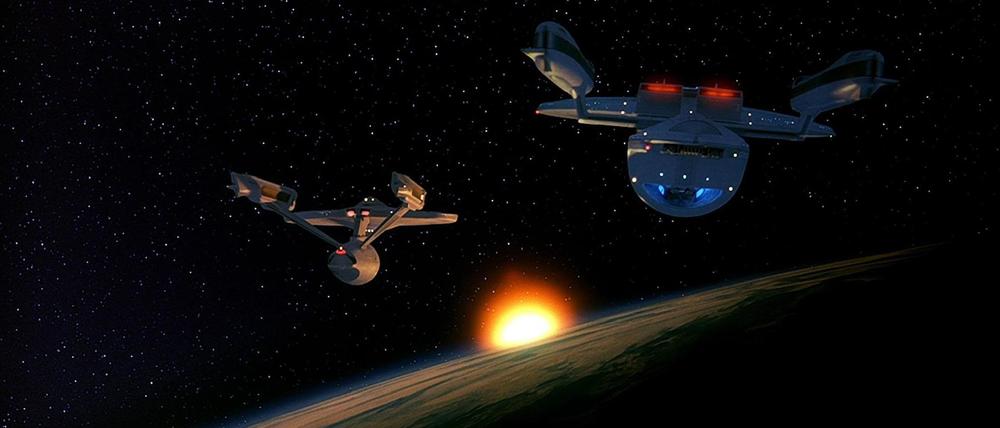
The summer of 1991 was a wonderful time to be a Star Trek fan. The franchise was celebrating its 25th anniversary, Star Trek: The Next Generation had completed its fourth season and was rivaling its predecessor in terms of popularity, and a new movie with the original cast was due in a few months. I walked into a theater that July to watch a movie I remember nothing about, but witnessed something I’ll never forget, the teaser trailer for Star Trek VI: The Undiscovered Country. Images from episodes of the original series and earlier films filled the screen in an overlapping, shifting collage while a narrator described the exploits of the crew of the Starship Enterprise over the last quarter century. Just as the narrator invited the audience to join the crew for “one last adventure,” the camera pulled back to reveal that the patchwork of scenes had been projected onto the hull of Enterprise itself, right before the ship jumped to warp speed!
I’ll be the first to admit that it’s not always easy to be a Star Trek fan because there’s so much inconsistency within a franchise that’s now over 50 years old. After a very uneven beginning with Star Trek: The Motion Picture in 1979, director Nicholas Meyer effectively restarted and rejuvenated the movie series in 1982 with Star Trek II: The Wrath of Khan, which has become one of high points of the entire franchise. The series expanded over the next few years and actor Leonard Nimoy, best known for his performance of the Vulcan science officer Spock, directed the next two installments and delivered another franchise high point with Star Trek IV: The Voyage Home (best known to the general public as “the one with the whales”). William Shatner, who portrayed Captain Kirk, nearly harpooned the series with the dreadful, bloated, and misguided Star Trek V: The Final Frontier, which he wrote and directed. After this low point, Meyer and Nimoy teamed up once more to craft The Undiscovered Country, one of Star Trek’s brightest moments, which just never seems to get enough credit.
The original television series in the mid-1960s established that Klingons were the primary enemies of the United Federation of Planets and served as stand-ins for Soviet era Russians in a loose parallel to the Cold War that ran through many episodes. Decades into the future, as depicted in Star Trek: The Next Generation, we know that hostilities have ended between the Federation and the Klingons, but we don’t know any of the details of how it happened. Meyer and Nimoy wisely seized the moment of current events with the recent collapse of the Soviet Union to illustrate how this peace was achieved. This story brings a logical conclusion to the series’ Cold War parallels, offers up one last great challenge for the original cast that allows all seven actors to shine, and merges the narratives of the original cast and The Next Generation (Nimoy also guest starred on a two-part episode of that series in a tie-in with the movie just weeks before its release). In addition to the seven original cast members, the movie features an outstanding ensemble of supporting actors including Christopher Plummer, Kim Cattrall, Brock Peters, Rosanna DeSoto, David Warner, and Michael Dorn (who plays the grandfather of his character, Worf, in The Next Generation). Yes, I could certainly go on about all of the fascinating minutiae connected to this movie, but I don’t want to distract from the fact that is an exciting sci-fi adventure with elements of a political mystery that’s well worth your time.
As a fan of Star Trek, there have been few moments that compare with the excitement and wonder I felt when I watched that teaser for The Undiscovered Country in the summer of 1991. The reason those feelings have stayed with me over the last 27 years stems from the fact that the movie delivered on the promise of that trailer as well as the entire series itself. When Gene Roddenberry created Star Trek in 1966, he wanted to present an optimistic view of the human race exploring the universe in the future. In a way that few other Star Trek stories have been able, The Undiscovered Country reconciles that positive outlook with a view of humanity with which the audience can identify. On the path to universal peace, Meyer and Nimoy were willing to reveal the flaws and prejudices of a noble group of heroic explorers. Traveling through this darkness allows the light of peace and reconciliation to shine with meaning and consequence. On the final voyage of the U.S.S. Enterprise, the veteran crew members show us once again how to meet the future (the undiscovered country) with courage, humor, and hope.

-         John Parsell

Monday, September 11, 2017

I’d Love To Turn You On At The Movies #174 - Big Trouble In Little China (1986, dir. John Carpenter)


“Like Ol’ Jack always says… What the hell.”

If you are looking for a deep art flick then this is probably the point at which you can stop reading this review. However, while John Carpenter’s 1986 Sci-fi Action thriller is certainly no art film it is one of the most enjoyable films of its niche genre. Starting from a western film style storyline, this film is a mish-mash of genre and style, and then ends up perfectly coalescing into an incredibly fun film. It has an intriguing plot, some killer star power, a stylish look, an amazing score by Carpenter himself (which if you know anything about horror film scores you know this is definitely a plus), and it has just enough of the cheese factor to make it completely enjoyable.

The plot surrounds Jack Burton (Kurt Russell) and Wang Chi (Dennis Dun) as they attempt to rescue Chi’s green-eyed fiancĂ©, Miao Yin, from an evil sorcerer, David Lo Pan (James Hong), who had been cursed to live disembodied until he marries a woman with green eyes. With the help of lawyer Gracie Law (Kim Cattrall) and bus driving apprentice sorcerer Egg Shen (Victor Wong) they battle through an array of obstacles in order to try and defeat Pan and rescue Yin, who was kidnapped upon her arrival in San Francisco from China. The film’s narrative is punctuated by battles with ninjas, monsters, gangsters, and an assortment of other nuisances. While it seems like a rather straightforward plot, it’s actually much more complex than I’m making it seem. While it is a pretty simple action film, the way that they splice different supernatural folklore-ish aspects (both rooted in ancient legend and some created for the film itself) creates an amazing narrative backdrop over which the story plays out. One of the most interesting examples of this interweaving/marrying of invented and existing myths is the unnerving concept of the underworld, which is a confusing, topsy-turvy descent into a crazed dimension with all sorts of fascinating elements in story for the characters. All of these Sci-fi and folklore aspects are then driven by the genre conventions of a traditional Western, creating an all-new type of film.

In addition to the complex and killer storyline, the film really plays with a lot of the different genre and gender conventions. Jack is kind of (well - totally) a blowhard, bubbling with massive machismo that doesn’t really do him any favors. He tends to fumble into action late and often slips up when he needs to shine (while this does sometimes work in his favor). So while he is a very traditional western “hero,” he’s much more flawed and human than the John Wayne characters that he was obviously modeled after. Additionally the supporting characters, while they are fairly conventional, also find ways to spin those conventions, and at times turn them on their head.

While there certainly are interesting and compelling aspects of the film, and as someone who tends to overthink even the simplest of entertainment I generally focus on those when writing these reviews, in the end this is simply just an amazingly fun and adventurous ride to take with Carpenter and the cast! I originally watched this film as a part of a film group that I was a member of and ended up falling in love with it, which has happened with a good number of other Carpenter flicks (Assault on Precinct 13 (1976) and Halloween (1978) being my personal favs). I would say that if you are looking to dig into an interesting thrill ride of an action film and you also enjoy a healthy helping of humor with your action, this is a perfect film for you, and you simply must pick up the especially awesome re-mastered blu-ray release of one of the best films of the genre (all of the genres that it embodies)!

-         Edward Hill

Monday, May 22, 2017

I’d Love To Turn You On At The Movies #166 - Zathura: A Space Adventure (2005, dir. Jon Favreau)


As a kid, I was drawn to science fiction like a moth to a flame. Star Wars premiered the same month I was born and my favorite after school entertainment in the 1980s consisted of reruns of the original Star Trek. In elementary and middle school, I scoured the shelves of my local video rental shops for science fiction movies I hadn’t seen yet. At the age of ten, I remember feeling caught between sci-fi kids’ movies like Flight of the Navigator, which left me feeling bored and unsatisfied, and classics of the genre like 2001: A Space Odyssey, which I knew I was way too young to appreciate or understand fully. A few years ago, I came across Zathura: A Space Adventure and suddenly felt like I had stumbled upon a secret portal to my childhood.

Opening on a sunny summer day, Zathura sets a brisk pace and introduces us to Walter and Danny, two brothers competing for their father’s attention and fighting against the ultimate scourge of childhood: boredom. Soon, the boys learn that they will have to spend the afternoon together and younger brother Danny discovers an antiquated board game titled, Zathura: A Space Adventure. Walter reluctantly joins Danny in playing the game and almost immediately the brothers find themselves navigating a realm in which the game’s dilemmas like meteor showers, defective robots, and alien attacks feel all too real. If the plot sounds more than a little bit familiar, it’s helpful to know that the author of the source material, Chris Van Allsburg, also wrote Jumanji. This adaptation of Van Allsburg’s work blasts off into an imaginative realm of palpable risk and excitement where the 1995 movie version of Jumanji gets mired down in a swamp of muddled computer graphics and flat performances. Director Jon Favreau brings Zathura sparking to life through a reliance on practical special effects, a focus on ensemble acting with a young, gifted cast, and a script crackling with snappy dialogue. Favreau began his Hollywood career as an actor in the 1990s with a breakout role in the indie hit, Swingers, but has since switched trades and established himself as a dependable director of distinctive, successful mainstream films like Elf, Iron Man, and the recent live action version of The Jungle Book. Just as Zathura the board game offers the boys experiences with which video games and TV cannot possibly compete, this movie provides visceral thrills that far outperform the scores of contemporary family movies that lean too heavily on weak narratives and computer generated effects. Favreau taps into the heart of Van Allsburg’s book, expands the scope of the original story, and delivers one of the most satisfying family-friendly sci-fi movies of this century.  

As a book, Zathura covers just thirty pages, but Favreau targets the key elements of why it has become a modern classic of children’s literature and embellishes this adaptation with style and substance. Favreau pulls off the tricky feat of taking a well-loved kids’ book and fashioning it into a funny, boisterous movie that packs an emotional punch and succeeds on its own. In 2009, Spike Jonze attempted something similar with his take on Maurice Sendak’s almost universally adored book, Where the Wild Things Are, but ended up making a movie that bewildered audiences and bore very little resemblance to the enchanting power of the original. Zathura was Favreau’s third project as a director, but with it he established the kinetic, vibrant, and irreverent elements that would come to define his work. By infusing Iron Man and Iron Man 2 with his stylistic trademarks, Favreau set the tone for the sprawling multi-media franchise known as the Marvel Cinematic Universe. A lot of people missed Zathura when it hit theaters in 2005, but now is as a good a time as any to take your chances and see where this adventure will take you.

-         John Parsell

Thursday, February 26, 2009

What's in the Bin? - February 26th, 2009

One of the sheer joys of being in an indie record store is browsing the bins. Just starting somewhere, flipping through things, pulling out items that catch your eye, giving a few of them a test spin. So in the seventh of a hypothetical series, I've browsed the "New Arrivals" bins here at Twist & Shout, picked out a few things, and gave them a listen. The nature of used record stores being what it is, I can't promise these items will still be in the bin by the time you get here. But hey, browse the bin anyway. You might find something else of worth.


CD - Rod Stewart - The Definitive Rod Stewart
There's a certain type of Rod Stewart fan. Those who, when they first hear the words "Rod Stewart", immediately flash onto songs like "Handbags and Glad Rags." Who still think of Rod as "that guy from the Faces."

Those fans probably don't need me to tell them this, but they're gonna want avoid this disc like the plague.

For the rest of us, this two-CD set is about as good a collection as you're bound to get. It obviously uses the pop singles chart as a basic guide, so there's a lot more MTV hits than "classic early sides." But I don't consider than necessarily a bad thing. Yeah, I understand that, oh, "An Old Raincoat Will Never Let You Down" is a "better" song than, say, "Some Guys Have All the Luck." Yeah, "Tonight I'm Yours (Don't Hurt Me)" is a really dumb song. The lyrics are horribly contrived even from a "let's have a one night stand" perspective, the weird high-pitched "whoo"s at the end sound like a four-year-old girl on a roller coaster, and the synth lines were already sounding dated back when the song came out in 1981. But you know what? I still like the damn thing. I recall watching the I-guess-this-is-sexy video back in the day, and wanting a neat shiny pink vinyl jacket and visor combo like Rod sported. And I wanted to have a fun bikini-clad party at a Best Western, too, culminating with me pushing my guitarist into the swimming pool at the end of the night. These are the sorts of weird but fun memories that "Raincoat" just can't deliver. Pile on top of that all the memories (or baggage) concerned with "Young Turks" and "Tonight's the Night (Gonna Be Alright)" and all the rest, and you might understand why I'd drag this CD off the rack more often than Every Picture Tells a Story.

No, of course the collection isn't "definitive." There's that obligatory "new" song at the end that isn't worth much. And even I think it gives the early years short shrift. And there's a lot of later stuff that I don't really need to hear. But then again, there's probably a guy about ten years younger than me who has similarly weird memories about "Rhythm of My Heart" and "Downtown Train" to those I have about "Passion." In which case, good for him.


LP - Neil Norman & His Cosmic Orchestra - Greatest Science Fiction Hits (Volumes 1 & 2)
Neil Norman has a pretty odd gig. Well, he's a bigwig at GRP/Crescendo Records (the home of these two recordings), but it's his other gig that's the real strange one. Imagine going to a science-fiction convention (or, if you've actually done this, think back to your last visit). Now imagine a group of people in silvery spacesuits, playing lounge-y/future-y versions of classic sci-fi themes. Well, the head guy in silver is Neil Norman. That's his gig. Playing sci-fi songs at sci-fi conventions, and anywhere else there's a market for guys in silver spacesuits playing sci-fi songs. And Neil's been doing it for almost three decades.

These two LPs are from the start of his career, and it pretty much set the stage for what came after. It was as the 70s gave way to the 80s, and Star Wars found a much larger audience for sci-fi than anyone thought possible. On each LP, Neil works this to his advantage, performing arrangements of various sci-fi tunes. The track selection is rather broad - it ranges from the obvious ("Close Encounters") to the obscure ("Phantom Planet") to the bizarre ("Can You Read My Mind" from Superman), and he even finds time to perform a couple of originals ("Not of This Earth," "Vampire Planet") that fit in quite well. The term "Orchestra" may be a bit of a stretch, but he does have fourteen musicians credited, so it's certainly more than just "a guy and his keyboard." And how does it sound? Well, as good as it possibly can, I guess. The band is quite good, the tunes are often deftly arranged, and Neil even adds some killer guitar solos here and there. But, you know, it still comes down to that basic fact - these are future-y versions of classic sci-fi themes. There seems to be some limit as to how high this stuff can climb. To his credit, Neil generally gets to that point, even if he can't transcend it. I think these albums would make great background music for a fun party. Assuming your friends have a bit of a sense of humor, anyway.


12" - Earons - "Land of Hunger"
The 80s nostalgia kick seems to be ending, which is fine. Not that I didn't love the 80s and all, but I've gotten to the point where my memories of the Flock of Seagulls are more of people talking about how dumb Mike Score's haircut in the "Space Age Love Song" video looked than they are of...well, "Space Age Love Song." And that's why it's fun to come across a song or band that really wasn't touched by the 80s nostalgia kick.

And yes, I'm totally aware that I'm about to ruin that for this song. Pretty meta. Anyway.

The Earons were yet another new wave band with a gimmick, but theirs was at least simple to set up and maintain. In the genre where image was at least as important as substance, the Earons went with a "non-image." The band only appeared in white jumpsuits and motorcycle helmets, and individual members were to be referred only by number. (The lead vocalist? 28.) The music's pretty good - a reggae-influenced synth-based dance song with "aware" lyrics. Three versions of that song might be a bit of overkill, but considering that this song isn't one you stumble across on "Best of the 1980s" albums, it's probably worth picking up. The song did hit number one on the dance chart in 1984, but the band was pretty well forgotten a year later. But that's what makes the song so fun. Everyone remembers "Come On Eileen," and not everyone is going to instantly remember the tune. However, this IS the sort of song that will make some people stop, open their eyes wide, and say "Oh YEAH!" And that's always a fun feeling.