Monday, June 1, 2015

I'd Love to Turn You On #130 - Fred Neil - The Other Side Of This Life

There is a pretty good argument to be made that Fred Neil is the quintessential, mysterious, cult figure in modern music history. Gifted with a most memorable and resonant voice, the ability to toss off masterpieces casually and a magnetic, yet unattainable poet’s soul, he was a profound influence on countless other musicians (Dylan, Stills, Tim Buckley, Airplane, Spoonful, etc.), and most amazingly, he only made four albums before taking his life into his own hands and backing away from stardom. He wrote a handful of standards: one, “Everybody’s Talkin’,” among the 10 most played songs on modern radio - a classic by anyone’s measure. His first three albums Bleecker and MacDougal, Fred Neil and Sessions are all out of print on CD, thus making The Other Side Of This Life the de facto choice for review. I highly recommend the first two albums as they represent Neil’s best work and some of the best American folk/rock ever recorded. Sessions shows Neil succumbing to the excess of the day, and while interesting, is just too scattered and stoned to be of much use.  Which leaves us with The Other Side Of This Life.

Side one is a live set comprised of his three biggest hits (“The Other Side Of This Life,” “The Dolphins” and “Everybody's Talkin'”) his hippest song (“That's The Bag I'm In”) and two blues covers all delivered in his laconic, yet authoritative manner. That is the secret to Fred Neil, he is always laid back in his delivery, but just below the surface are brilliant songs, an incredible voice and a jazzy twelve-string technique that put many of his peers to shame. Neil can be heard giggling to himself between songs and fooling around with the audience, but make no mistake, when he lets loose on “The Other Side Of This Life” or “The Dolphins” his vocal delivery still pins your ears back in awe. Neil is in relaxed mode, but the tunes and vocal delivery are life changing. Side two is more of a hodgepodge, gathering together a handful of interesting tracks highlighted by two incredible ballads. The first, “Ya Don’t Miss Your Water,” is a well-known gospel/soul standard, here played as a duet with another quixotic 1960’s figure, Gram Parsons. The combination of these two woozy voices wrapping around this great tune is irresistible. Parsons is the perfect tenor counterpoint to Neil’s elongated baritone, and they deliver it somewhere between St. Peter and Bacchus. The album ends with a stripped down version of another of Neil’s greatest songs, “Felicity,” which is both uplifting and heartbreaking; the very essence of the singer/songwriter tradition, and it embodies the duality that Fred Neil excelled at like nobody else.

If you haven’t yet, discovering Fred Neil is one of the great pleasures left in collecting 1960’s music. I was aware of Nilsson’s hit version of “Everybody’s Talkin’” and The Jefferson Airplane’s version of “The Other Side Of This Life” and of course Tim Buckley's haunted “The Dolphins,” but discovering the real item was one of the most thrilling revelations ever. Here was what seemed to be the Rosetta Stone of folk/rock music. Seemingly, every cool musician of the early 60’s either crossed paths with or was influenced by Fred Neil. He remained mysterious, staying out of the public eye for the last 30 years of his life, never succumbing to the siren call of comeback or tribute or tour, instead quietly living his life and letting his incredible legacy of song and performance speak for itself. How could there be no whiff of sellout whatsoever? How could such an important figure come through the 70’s 80’s and 90’s (he died in 2001) with his reputation completely untarnished and his public awareness so under the radar? I honestly don’t have an answer, but listen to him, love him, and then keep it to yourself. Some things are better kept just between you and me.


- Paul Epstein

Monday, May 25, 2015

I'd Love to Turn You On At the Movies #116 - The 39 Steps (1935, dir. Alfred Hitchcock)

“How old is Mae West?!?”

            The world may never know how old Mae West was (or rather they will, as this IS the age of the internet), but this film is packed with a wide array of other perplexing mysteries. Alfred Hitchcock’s The 39 Steps is widely considered to be one of the integral films that sparked the Master of Suspense’s career, and with good reason. While he had been making films for some time (this being his 22nd), The 39 Steps was one of the great films that catapulted Hitchcock into the spotlight and paved the way for his later masterworks. But that’s enough about the prophetic nature of the film. Let’s get down to brass tacks – this movie is fantastic! From the beginning of the opening sequence until the very end Hitchcock strategically places his audience in a tense state and he never fully reveals exactly what's going on (or does he...?).

            Put very simply the film’s plot is about a grave accusation of murder landing upon a completely innocent bystander. Hannay, played by Robert Donat, comes in coincidental contact with a mysterious female spy, "Miss Smith" (Lucie Mannheim). Providing her asylum in his apartment overnight he awakens to find her stumbling into his bedroom after being stabbed in the back and warning that he is next. After a brief commotion he realizes that he is now the target of her murderers as well as the police who have been alerted to the murder in his apartment. From this point, out of sheer necessity, Hannay himself becomes entangled in the espionage that got Miss Smith killed in the first place. Picking up where she left off he rushes to Scotland in an attempt to solve the mystery and exonerate himself. Along the way he runs into an obstinate yet beautiful woman on a train, Pamela (Madeleine Carroll), who turns him in to the authorities. After narrowly escaping the police at this turn, he seeks who he believes to be a friend of Miss Smith’s who as it turns out might not be so friendly. At this point in the plot everything becomes beautifully convoluted and the mystery enters its ascent to the climax. Needless to say much of what we know at this point changes and our obstinate beauty, Pamela, will certainly return to become an integral part of the film.
 
            While this is most certainly an early film for Hitchcock, originally released in 1935, it provides the viewer with a perfect roadmap into the mind of an amazing and enigmatic auteur. The viewer is left with a good number of questions at the end and spends the entirety of the film on the edge of their seats. Aided by the shadowy noir-ish cinematography, the use of odd close ups that seem to allude to something (dun-dun-duuuunnnn!), and the lack at any point of a FULL reveal, Hitchcock is able to build tension like no one else. In addition to the brilliant building of tension and the constant suspense, in true Hitchcockian tradition the director completely breeds a deep audience mistrust of all of the characters on screen (aside from the hero of course). These techniques, which will become vitally important to Hitchcock’s oeuvre, are perfectly demonstrated in this early classic.


            But what makes this film, as well as other early/early-mid Hitchcock films, so magnetically engaging is the fact that while he perfectly weaves tension and mistrust into the psyche of the viewer there remains a healthy dose of sly comedy. While we know very little about the hero of this story, Hannay, one thing is sure – he is a quick wit and an amusing gentleman. For example, as Hannay has been captured and rides in the back of the detective’s car, they run into a flock of sheep in the road at which point he quips, "Hello, what are we stopping for? Oh it's a whole flock of detectives." With such amazing and well timed sarcatic one liners the viewer is provided with just enough comedy to catch them off guard when the next plot twist drops (and there are more twists dropped in this film than bass drops in a Skrillex song).

            So what else can I say, you simply must take this ride for yourself. Ride the rails though every twist and turn and see if you can put together the puzzle that is The 39 Steps. What exactly is/are the 39 steps? Who is the real "bad guy"? Who can Hannay and Pamela trust? What will happen in the end? How old is Mae West?! What causes Pip in poultry?!?! These questions and many more are proposed by and possibly answered in this fantastic film from the mid 30's; do yourself a favor and check it out.


- Edward Hill


Monday, May 18, 2015

I'd Love to Turn You On #129 - Steely Dan – Countdown to Ecstasy

Once upon a time, there was a band called Steely Dan. A real band, with a regular lineup, they even went on tour. The era of Donald Fagen and Walter Becker crafting exquisite studio-only productions was just around the corner, but in 1973 they were as close to being a regular rock & roll band as they ever were. Though plenty of studio musicians still augmented the albums, the core was not just Becker and Fagen but guitarists Jeff "Skunk" Baxter and Denny Dias plus drummer Jim Hodder. This was the lineup that cut the second Dan album Countdown to Ecstasy. I'll say this is my personal favorite Steely Dan album but I won't say it's their best. That's because their initial run of 6 albums in 6 years, 1972-1977, from Can't Buy a Thrill to Aja, is absolutely perfect. Every song, every arrangement, every note played and sung, everything is exactly as it should be. Yet there's still passion, verve, and even soul behind the slick sounds and ironic detachment of the lyrics. The best is whichever one is playing at the time. But I can only write about one, so Countdown it is. 
The album starts off with what just might be the most kick-ass rock track in the Dan repertoire, "Bodhisattva." As Fagen croons cheesy westernizations of eastern philosophy, the band kicks up a blues-rock ruckus highlighted by some blistering guitar from Skunk Baxter. After that things quiet down a little bit for the jazzy "Razor Boy." This one takes on a more traditional feel than the smoothed out jazz that would dominate the group's later work. The pace is slowly built back up with the building climax of "The Boston Rag." More cryptic lyrics from Fagen, apparently chronicling some sort of drugged out debauchery, are married to a slow building rocker that leads to a great sing-a-long chorus. The bottom drops out for a piano break, then builds again to a dramatic finale. Next it's time to jam, with "Your Gold Teeth" providing a funky, latin-jazz dance party. The musicians have a chance to spread out on this one, keeping a loose vibe while still hitting all the notes like a Steely Dan combo should.

The second half kicks of with the slide guitar of guest Rick Derringer and another of the Dan's more rocking numbers, "Show Biz Kids." Fagen calls out the privileged and self-obsessed culture of fame while making self-referential mention of "Steely Dan t-shirts" and even dropping an f-bomb for added emphasis. On "My Old School," Fagen and Becker reminisce not so fondly about their days at Bard College. This is probably the best-known track on the album and with its jaunty horns and catchy chorus, it's easy to see why. "My Old School" is one of the best examples of Steely Dan's oft-noted penchant for melding biting lyrics to infectious tunes. Another breather comes with the gorgeous "Pearl of the Quarter." Could this actually be a straightforward love song? Is there something more going on that I'm missing? Either way, it's another brilliant, catchy song. The album concludes with "King of the World," as propulsive synths end things with a futuristic vibe. Of course, that future is surely of the dystopian variety.

  As previously noted, Steely Dan would continue their streak of perfection throughout the 70s. Yes, things would get a lot slicker but the quality of songwriting and performance were never overshadowed by the production. Cracks started to show with 1980's Gaucho, which still had a few great songs but also seemed to show Becker and Fagen running out of gas after their greatest success. Steely Dan would then disappear for a while with no activity at all throughout the super-slick 80s, an irony surely worthy of a Donald Fagen lyric. Then, miracle of miracles, Fagen and Becker reunited in the mid-90s and, in another great irony, turned Steely Dan into a touring machine who have been active ever since. They even played this year's Coachella festival. Yes, the strange and winding career of Steely Dan could all really just be the subject of a Steely Dan song. Chew on that for a little while. And listen to Countdown to Ecstasy while you're doing so.
            - Adam Reshotko


Tuesday, May 12, 2015

I'd Love to Turn You On At the Movies #115 - Fresh (1994, dir. Boaz Yakin)

Back in 1994, this film arrived with a bit of a buzz from the awards it won at Sundance. It was being marketed in the wake of gangsta films like Boyz n the Hood and Menace II Society (because that’s what distributors do with films is cash in on what’s popular), but, reviews noted, there was something different about this drama. True, our central character, nicknamed Fresh (played by Sean Nelson), is a 12-year old runner for drug dealers around town – particularly Esteban (played by Giancarlo Esposito), a heroin dealer who takes a nearly paternal interest in Fresh’s development because he can see his maturity and intelligence – but even so, this film has very different aims from the juiced up melodrama of the so-called ‘hood films of the early 90’s.
The film was the brainchild of writer-director Boaz Yakin, who, after working on mainstream Hollywood films (The Rookie and The Punisher, for example) for years, decided that he wasn’t doing what he wanted to in the industry. Instead of fighting in the system to scrape forward toward a compromised version of his vision, he moved to Paris, vowing to return when he had something to day and was able to exercise a reasonable amount of control over how it got made. And though maybe he wasn’t able to continue that principle later in his career (he’s also credited with writing Prince of Persia: The Sands of Time, which makes me sad), he got it right here for sure. The film constantly feels emotionally dead-on and has a great ear for street dialogue, both at the adult level and of the kids in the film.
Fresh is a smart kid alright, but he’s helped immeasurably by his alcoholic father (played by Samuel L. Jackson) who Fresh mostly finds hustling chess in Washington Square Park. He’s the anchor for Fresh, teaching him to think strategically, plan ahead, to watch and listen rather than leap into action. So when he has to make his own way because his aunt can’t handle raising 11 kids in her small apartment, when a friend is murdered in front of his eyes, when his sister’s drug habit starts to endanger her life, Fresh uses his dad’s lessons to try to extricate himself from the life he’s found himself stuck in.
In addition to Yakin’s terrific script, he’s gotten terrific performances from almost all the central kids in the plot, from Jackson, and especially from Esposito, who combines the right touch of human tenderness with his violent ruthlessness. And then there’s Sean Nelson as Fresh himself – a kid who seems wise beyond his years often from the simple act of keeping quiet, listening and letting other people (meaning the adults around him) show their hand. I’m not sure how much is the writing and how much is Nelson’s work, but the role is great.
The film is intelligent, tense, gritty, and sporadically violent (but not excessively or graphically so). It’s shot by cinematographer Adam Holender, who’s something of an NYC grit specialist, having shot Midnight Cowboy, Panic in Needle Park, Smoke, and Street Smart, to name a few. He knows the streets of the city from before the Guiliani whitewash of New York that makes it feel so different today compared to the era of this film. And at pretty much every level, it feels like the love and care Yakin took to make a film that meant something to him is shared by cast and crew alike, because all the participants turn in A-level work here.
If you feel like you’ve seen enough “hood” films but haven’t seen this one, make room for one more, because it’s not like any of the others. If you’ve seen it, but like me coming back to this, it’s been 20 years or so, it’s most assuredly worth revisiting – it hold up beautifully. A great, small, personal film of the type that made indie cinema such an exciting idea once upon a time.

- Patrick Brown


Monday, May 4, 2015

I'd Love to Turn You On #128 - Miles Davis - Agharta


The first sounds you hear on this two-disc live set are notes from Miles’s Yamaha electric organ before they’re joined by a dense, chugging, funky groove from the rest of the band until about the 1:30 mark when Miles blasts the sound with a dissonant cluster of notes on the organ. In this opening, a far cry from the delicacy of “So What,” the textured beauty of the orchestral albums with Gil Evans or even the fractured bop stylings of the second quintet, you get an immediate sense of what kind of sound you can expect from this record. Even if you’ve been following his notorious 1970’s electric period through to this point, this record still provides something new and challenging compared to the murky strangeness of Bitches Brew, the relentlessly nagging rhythms of On the Corner or the muscular bravura of Live-Evil. I own every record Miles released in the 70’s and I like this one better than any named above – and almost any of his albums of the electric era, period (though 1970’s Tribute to Jack Johnson or 1969’s In A Silent Way might give me some pause). Miles changed quickly at this time in his career and never looked back, so liking one record gives you no guarantee that the next one will be to your tastes. And that first couple minutes will let you know right away if this work is for you. It won’t tell you everywhere it’s gonna take you on the ride, but you know from the get-go that the protean Mr. Davis has changed his sound drastically yet again here.
As always, what Miles is doing is much more than just playing trumpet and writing or adapting musical themes – as much as any bandleader in jazz, he’s utilizing the unique skills of his players and “playing” the ensemble. So after he comes in and solos relatively quietly through a wah-wah pedal for several minutes starting around the 2:30 mark – hardly the delicate beauty of his 50’s solos or the robust open horn playing of only a few years before – he hands the reins over to Sonny Fortune’s alto sax. It’s something he’s unafraid to do throughout the record (and throughout his career, actually) – allow other players to take the spotlight even knowing that they may outshine him. And Fortune sounds great here, though after a bit Miles decides that his solo is done by signaling with another blast from the organ that tells Pete Cosey it’s time for his guitar to come in. Let’s talk about Cosey for a minute.
Prior to joining Miles’s group in 1973, Pete Cosey was a session man at Chess Records, playing on records by Fontella Bass, Howlin’ Wolf, Etta James, and Rotary Connection, among others. But the only one that really gives an inkling of the music that would start coming from his guitar under Miles’ tutelage is the much-maligned Muddy Waters album Electric Mud, where the untamed noise he’d soon be issuing started to peek its head out. Among Miles aficionados, the septet that Miles worked with from 1973 until his temporary retirement in 1975 is often referred to in shorthand as “the Pete Cosey Band” because of the prominence of Cosey’s scouring guitar solos, compared in one stroke by jazz critic Greg Tate to both Hendrix for his use of distortion and effects and Cecil Taylor for his harmonic construction and the “out”-ness of his soloing.
So Fortune comes in and solos, but not without Miles continuing to work with the rest of the group, shifting the dynamics behind him and pulling the rest of the musicians out entirely at one point, leaving Fortune solo in the truest sense of the word. And then Cosey comes in and something else happens. The dense funk behind him is suddenly on fire – if the electric sounds leading up to this point were operating at a strong 100 volts, Cosey pushes it to 500 – probably not enough to kill you, but enough to break the skin for sure. And his solo here is a marvel, a wild, bluesy, psychedelic, noise-drenched beast with the band tightly wound underneath him. Once his excoriating turn is done, a mellower groove kicks in, with Davis’s prickly keyboards shining out through the ensemble before he picks up his horn again.
After more of the lead cut, the band moves into “Maiysha,” a piece that first appeared on the 1974 album Get Up With It, and it lessens the intensity a touch as Fortune switches to flute – but Cosey still rips into it with a solo even more “out” than the freaky one he derails the studio version with. And even so, “Maiysha” provides a beautiful, laid-back groove over which Miles takes a more lyrical solo than on the previous track – before Cosey steps in, of course. The piece then tails off towards texture and quiet near the end of the disc.
Disc two – a continuous medley of music broken into two titles here – kicks off at a rocketing tempo with the “Theme From Jack Johnson” (mislabeled as “Interlude”) and shortly works into a Fortune alto solo. Percussionist Mtume is much more prominent here than the first disc, especially when Miles is soloing. The two had a close musical kinship and when Miles solos, it’s worth putting your attention toward how sensitive and responsive Mtume is to Davis’s playing. The beat unexpectedly changes to a shuffle behind a Cosey solo then cools down for Miles’ solo, probably his best and most lyrical on the record, a reward for those who’ve been waiting to hear him solo like this after so much sound and fury – including much interaction with Mtume up in the mix. Miles ends his solo a little after the 13-minute mark, when bassist Michael Henderson drops in the bass riff from “So What” as Pete Cosey takes on a milder and also more lyrical solo, proving that he’s not just a noisy effects man. “So What” is repeated more obviously after the 17-minute mark before Fortune starts a flute solo and the band moves into an eerie, slower part of the music full of jungle menace and weird synth sounds. (I listened to it once at the Tropical Discovery exhibit at the Denver Zoo and it was the perfect soundtrack!) As it gains rhythmic force, they hit a new groove, and there’s a brief guitar solo that may be rhythm guitarist Reggie Lucas (I haven’t been able to confirm this with any of the Miles scholars I know, but I believe it to be true). Things cool back down again for a textural interlude before a majestic, heavy, and melancholy Cosey solo. This corresponds very closely to one Cosey plays in about the same spot on Agharta’s companion piece PangaeaAgharta documents an afternoon concert, Pangaea was the evening show – and the Pangaea solo is probably the best bit of Cosey’s work of all four discs (followed closely by Agharta’s first disc one solo). The record mellows again after that, with Miles on organ getting funky for a little bit a little after the 44-minute mark until the band closes the whole thing on a mysterious fade out with Cosey’s sparking feedback, Fortune’s floating flute, and Miles having left the stage.
            I understand those who don’t like this music – it’s too noisy for some, too difficult to discern the structure of the long, loosely organized pieces for others. Critics at the time mostly reacted badly to it as well, though it’s gotten a reappraisal lately (even by some who initially trashed it) and is rightly seen as a highlight in a career filled with many transcendent peaks. But here’s the deal – it’s ensemble music, not necessarily soloist’s music, despite my descriptions above of many great solos. It’s a dense weave of sound that challenges the way we’re supposed to hear “jazz.” Is it even jazz at all? Who cares!? If there’s a problem there, it’s with the word “jazz,” which isn’t broad enough to contain music like this, not with the music herein.

            - Patrick Brown

Tuesday, April 28, 2015

I'd Love to Turn You On At the Movies #114 - Blackboard Jungle (1955, dir. Richard Brooks)

Blackboard Jungle is the first “teacher-with-a-heart-of-gold saves a classroom full of no-goodniks” film. It gave birth to an entire sub-genre of films such as To Sir With Love and Stand And Deliver. As I watched this movie, trying to determine what it was that struck me so when I was a kid, it occurred to me that Blackboard Jungle is the most compelling reason I can think of that explains why the 1960’s HAD to happen.   When it was made in 1955, one year before Elvis’ “Heartbreak Hotel” became his first major single, the entire societal apparatus turned on the thoughts and needs of “The Greatest Generation.” Within the next five years the world started to change. In 1955, the audience was expected to wink at the square, well-intentioned teachers and be horrified by the delinquent young men in the class, but from the opening notes of Bill Haley’s “Rock Around The Clock” (the first use of a Rock and Roll song in a major movie) at some level, we find ourselves rooting for the kids. The kids are led by two adult actors, Sidney Poitier and Vic Morrow, who, compared to the painfully stiff teacher (Glenn Ford) offer a much more compelling option. I guess that’s unfair. It is impossible to view this movie with the eyes of someone in 1955 now. So much has happened to both justify Glenn Ford’s desire for order and discipline and to explain the kids’ need to break out of the stifling black and white world of the 1950’s. With Kennedy, Vietnam, LSD, The Sexual Revolution and Martin Luther King right around the corner, the teachers’ point of view seems like a quaint, sad throw back to another time. This very fact lends great poignancy to a modern viewing of the film. Much like watching The Andy Griffith Show, one laughs both with and at the small-town rubes.

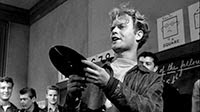
None of this is to suggest that watching Blackboard Jungle is anything less than totally enjoyable. Vic Morrow’s portrayal of a sadistic kid, bent on mischief and revenge and headed nowhere but jail is chilling, and Sidney Poitier might as well have been doing research for his role a decade later in To Sir With Love, when he, in the teacher’s role that time, was far more successful at relating to his students. But that brings me back to the main point, which is that this movie’s greatest achievement is to inadvertently illustrate the looming “generation gap” on the horizon. In its clumsy way, the film treats the youth as something less than human. They are the “other” and not what we fought to protect in WWII. It is not a gigantic leap to beatniks, hippies, yippies, punks and so on. As each generation feels its oats, the previous must take it on the chin. No scene illustrates this more perfectly than when one of Glenn Ford’s idealistic young colleagues brings in his prized collection of jazz 78 RPM records to share with his students. Instead of a Socratic sharing of his knowledge with his students, Vic Morrow leads his gang in smashing the records and mocking the teacher to his face. It is a painful scene (especially for a record collector) but ultimately it once again points to the widening gulf in the life experiences of those who lived through the Great Depression and war and those who were about to usher in the modern age.

Blackboard Jungle closes, as it opened, with the pulse quickening guitar and horn driven excitement of Bill Haley’s rock and roll masterpiece and as the credits roll, you can’t help but feel for the entirety of Glenn Ford’s generation. In the blink of an eye, they would go from being the heroes of the 20th Century to “never trust anyone over 30.” This movie is an important glimpse into one of the major turning points in modern history.

- Paul Epstein


Monday, April 20, 2015

I'd Love to Turn You On #127 - Amon Duul II - Tanz Der Lemminge

Tanz Der Lemminge, the third album by Amon Duul II from 1971, is, ridiculously, considered their first accessible album after two wildly freeform psychedelic freakouts. I say “ridiculously” because, while Tanz Der Lemminge may be a bit more conventional than the first two LPs, it is a far cry from normal. Split into four major side-long pieces, Tanz Der Lemminge embodies all the characteristics of the Krautrock movement; complex, long-form compositions punctuated by long stretches of wild improvisation, strange, sci-fi lyrical themes and no fear of playing what might be considered fairly extreme music. Musically, Amon Duul II shares much ground with both Can and Atom Heart Mother-era Pink Floyd. There are waves of organ, piano and mellotron, crashing on beaches of throbbing basslines, while reverb soaked guitars skronk like birds above the fray. This is cosmic music, make no mistake about it!

The thing that originally drew me to Tanz Der Lemminge was the amazing cover. I was actually at the store – Underground Records – that I would buy about 15 years later and turn into Twist and Shout, when I looked up at the wall and saw import copies of Can’s Tago Mago and Tanz Der Lemminge for what seemed like a lot of money at the time. The cover of The Amon Duul II album was irresistible to me. Even though I had never heard of the band or their music, I took all my spare cash out and forked it over for a completely unknown quantity. It wasn’t that I was completely unprepared. I was a veteran listener of Pink Floyd, Yes, King Crimson, even Brian Eno, Tangerine Dream and Kraftwerk, so the idea of long-form compositions and electronic improvisation was not something new to me. I was, however, unprepared for the sustained ferocity of Amon Duul II. Much like King Crimson’s attack, they just pounded away with abandon, but they were stylistically agnostic, slipping easily from highly arranged prog-rock, to totally free spacerock, to gentle acoustic freak-folk, but all effortlessly and with the group mind of the best west-coast American psych bands. At times, like “Stumbling Over Melted Moonlight,” they almost sound like Quicksilver Messenger Service, but then will morph into insectoid drone patterns as soon as you think you have a handle on where they are going. Over the years, I have never gotten comfortable with Amon Duul’s work in the sense that I know what to expect, or where it’s going. Even though I have owned Tanz Der Lemminge for decades, each time I play it is like a new beginning and a revelatory one at that. I am constantly searching for new bands that can take me somewhere I’ve never been. Bands like Amon Duul II.

- Paul Epstein


Monday, April 13, 2015

I'd Love to Turn You On At the Movies #113 - Mallrats (1995, dir. Kevin Smith)

Brodie: There is something out there that can help us ease our simultaneous double loss.
T.S. Quint: What? Ritual suicide?
Brodie: No, you idiot, the f*#@ing mall!
T.S. Quint: I'd prefer ritual suicide.
Brodie: Oh come on man it'll be great. They have these new cookies at the cookie stand, you have to try 'em. They're awesome.

When ruminating upon films to write about I initially skipped over everything by Kevin Smith simply because I assumed that everyone had already seen them, however when I thought about it a little more about it I decided it’s time for people take a bit of a closer look at Mallrats. If you have seen this film before then you probably know how quirky, quotable, and fun it is; if you haven’t seen it there is a chance that you were in a coma through the nineties and it is time you got caught up (apologies to anyone who actually was in a coma… my bad). The truth about this film is that it is a perfect distillation of a generation of mall-walking nerd scholars of the nineties, and the result is straight up enjoyable.

While I have had a tendency to try and turn you on to more obscure and often esoteric masterworks of cinema, I, like everyone else, have a soft spot in my heart for a well-crafted comedy. While Smith’s dialogue and the acting can be a little rough around the edges, on the whole the movie plays out like a crass, sophomoric version of a Woody Allen film. The central figures, Brodie and T.C., have just been dumped by their respective significant others. T.C. (played by Jeremy London) was dumped for being stubborn when his girlfriend Brandi (Claire Forlani) had to cancel their trip to Florida (he WAS going to propose when Jaws popped out of the water), and Brodie (Jason Lee) was dropped by Rene (Shannen Doherty) for simply being an aimless and oblivious nerd. Joining forces, the two of them convene at the mall to ease their heartache (“I love the smell of commerce in the morning”). The rest of the film follows these two characters as they meander through the mall and engage in witty, although often crude, dialogue and stumble into a number of slapstick happenstances.

As the plot ambles along our heroes both put into play different strategies to prove their love to their former partners and win them back. T.C. hatches a number of different plans to stop Brandi’s father’s dating game show that Brandi is now the reluctant star of, while Brodie takes the long road to realizing that he wants Rene back. Luckily for them, and the plot of the film, most everything in the mid-nineties centered on the mall, the game show is happening in the mall and Rene is currently on a date with Brodie’s unseemly arch-nemesis at (where else?) the mall. The film’s climax happens as everything comes together on the stage of the live screening of Brandi’s father’s dating game, but you will have to watch to find out how this film ends.

The key thing that makes this film so enjoyable is the fact that as the two main characters walk the mall they run across a series of crazy side characters that keep the plot moving and add a certain comedic charm. As this is the second film in Kevin Smith’s “View Askewniverse” series there are a number of connections to its predecessor Clerks (1994) – notably the fact that Jay and Silent Bob play a prominent comedic role (nooch!). In addition to the undeniably likeable stoner duo, there are a number of other reoccurring characters, most importantly a sloppy large man that can’t see the sailboat in the magic eye poster (“When lord! When the hell do I get to see the goddamn sailboat!”), Ben Affleck playing a deplorable manager of The Fashionable Male who has a hot temper and a penchant for a certain sexual deviation, and a number of quick but poignant cameos from none other than Stan Lee!

Taking a step back, and separating the movie from my nostalgic attachment to this quick-witted hour and a half, the cinematography is good but nothing to write home about (another connection that can be drawn to a lot of Woody Allen flicks) and the direction can be a tad lack-luster or a bit heavy handed. However, if you can look past its minor shortcomings, the charm and wit of the writing and the appeal of the naïve acting of the entire cast will certainly win you over. It has been a while since I have watched anything directed by Kevin Smith (and on a side note this film turns 20 this year… AHH!), so I decided to do it right, crack a cold beer, and sit back to see if I enjoyed it as much as I used to. And, of course, it was just as I remembered it - a quick amusing ride. Masterpiece cinema it may not be, but an extremely enjoyable popcorn flick it certainly is! So unless you have recently been screwed in a very uncomfortable place (like the back of a Volkswagen?) and lost your sense of humor you will most likely find yourself charmed by this super fun nineties flick, so, CHECK IT!

            - Edward Hill


Monday, April 6, 2015

Otis Taylor – Hey Joe Opus Red Meat

Want to be proud of something from Colorado? Check out Colorado’s real blues legend’s new album. Recorded in Colorado at Immersive Studios and mastered by David Glasser at Airshow, this 2LP, 200 gram, 45RPM audiophile recording is an absolute showcase of everything good about our music scene. Not only is Colorado exploding with young, fresh talent, but we also have world-class engineering facilities and a legacy artist who is legitimately one of a handful of REAL blues artists left on earth. Otis Taylor is the real deal in so many different ways; he is a fiercely independent musician who makes the music in his head come out in a totally unique way. He has no precedent or antecedent. Like any of the great bluesmen, one listens to Otis and has to wonder where this came from. Hey Joe might very well be Otis’ greatest album. It is singular in his catalog. It flows like one long dream sequence. Blues, rock, jazz, trance - it all appears from a boiling stew of angst and slices of the human condition. Somehow, Otis expands the basic plot and theme of the classic song “Hey Joe” into various meditations on everything from love to hate to tranvestitism. Yes, like all of Otis Taylor’s albums it is unpredictable. Just like the various guest artists who pop up; Ron Miles sounding like Miles Davis in a Sergio Leone movie, Warren Haynes plays a couple of scorching solos, Billy Nershi picks some sweet acoustic, Langhorne Slim adds subtle vocals, but the star remains the Cumulus Nimbus of emotion and talent that is Otis Taylor. He really is unlike any other performer alive and he’s ours. And his new LP is OURS. For the time being, Twist and Shout is the only place this beautiful and collectible LP is available. I cannot recommend this album highly enough. It is a superlative listening experience, and an important addition to the blues legacy.
- Paul Epstein

I'd Love to Turn You On #126 - Trans Am - Futureworld

Trans Am never seemed like a band built for the long haul, but here we are, 20 years and 10 albums later. Turns out that Kraftwerk-meets-Rush schtick wasn't really schtick at all. Yes, they've always had a tongue in cheek approach to their mix of krautrock, new wave, prog, electronica, and whatever else they've thrown into the mix, but the band is also super-talented and come up with some really great songs. Trans Am was initially pegged as part of the post-rock movement that emerged in the mid-90s, primarily due to their association with Thrill Jockey Records, which emerged as the center of the scene. However, they had little in common with post-rock giants like Tortoise and Godspeed You! Black Emperor. One the main features that sets them apart is the superb drumming of Sebastian Thomson. He can keep down a solid motorik beat in the manner of Klaus Dinger, handle quirky time signatures and fills a la Neil Peart, and just bash it out, John Bonham style. Multi-instrumentalists Phil Manley and Nathan Means are no slouches either, moving from keyboards and electronics to guitar and bass with ease.
The band peaked with 1999's Futureworld, which stands as not just their best but one of the very best indie albums of the late 90s. It was also their first album with vocals, though all are sung through a vocoder. After starting with the mood setting instrumental "1999" (not a Prince cover), Thomson kicks up a solid beat and the band launches into "Television Eyes." It's one of the more rocking tracks in an album that covers a lot of ground. The epic title track comes next and moves in quite a few directions itself. From a driving intro to a thrash-like chorus, everything suddenly bottoms out in the middle. After a spacey bridge, a funky bass theme emerges and they ride this out till the end of the song. "AM Rhein" ends the first part of the album with a building, anthemic slice of stadium rock. The second half of the album is mostly electronic oriented, starting with the retro-dance grooves of "Cocaine Computer." "Runners Standing Still" slows things down a little bit but still has a gorgeous melody. "Futureworld II" and "Positron" are the album's most experimental tracks providing a pair of electronic soundscapes. The band switches back into rock mode for album closer "Sad and Young." It starts out slow and quiet, yet slowly builds to a loud and dramatic climax. This is the closest Trans Am ever gets to a traditional post-rock sound, particularly that which Explosions in the Sky would have so much success with a few years later. Yet it sounds like Trans Am all the way and proves an epic conclusion to an epic album.
After Futerworld, Trans Am would expand their sound and ambition even further with the great double album Red Line. Other strong entries to their catalog include 2007's Sex Change and last year's Volume X. One of the great things about indie music of the past 20-25 years is that a support system exists for quirky, unclassifiable bands to have long careers where they evolve and change. Trans Am have gone in many different directions while still maintaining their unique sound and vision. Futureworld is both a classic for long time fans and great entry point for beginners.

            - Adam Reshotko


Monday, March 30, 2015

I'd Love to Turn You On At the Movies #112 - The Thin Man (1934, dir. W.S. Van Dyke)

Wait, you mean you haven’t seen The Thin Man? Seriously?  But it was one of the top grossing films of 1934! And it has huge stars in it! - William Powell and Myrna Loy as Nick and Nora Charles, a boozy, retired detective and his wealthy wife (also boozy). And though Nick would rather drink martinis – he’s given up detective work since marrying the wealthy Nora – everyone pushes him to investigate a murder/missing person case. But once he’s certain that the wrong man is begin framed, he takes an interest when everyone else thinks the case is shut. And let’s not forget Asta, the wire fox terrier who started his career here but went on to appear in such massive Hollywood hits as Bringing Up Baby and The Awful Truth (and one of the five sequels to The Thin Man). And how could you have missed their comic interchanges, which like so many films of the early sound era worked a quick wit and sparkling dialogue like very few films have since.
As an example, there’s a part in the film as they start to get embroiled in a murder case and a nosy reporter questions Nora:
Reporter: Say listen, is he working on a case?
Nora Charles: Yes, he is.
Reporter: What case?
Nora Charles: A case of scotch. Pitch in and help him.

Or when another reporter is grilling Nick about the case (murder case, that is, not the scotch) and it goes like this:
Reporter: Well, can't you tell us anything about the case?
Nick Charles: Yes, it's putting me way behind in my drinking.

You might have correctly guessed that this mystery-comedy leans pretty heavily to the comic side. Though there’s danger to the characters and suspense, it’s usually studded with bon mots like the above.
And it’s based on a hit novel by Dashiell Hammett, who also wrote the novel The Maltese Falcon, and surely you know that film, right? And like the earlier, 1931 version of The Maltese Falcon that people don’t know as well as the famed 1941 version, The Thin Man was knocked out quickly (shot in 12 days) and got into theaters a mere matter of months after the novel itself hit the stands. I mean, Hammett’s a great writer and even though other people adapted the screenplays, his work lends itself beautifully to cinema, doesn’t it? Especially when that film is photographed by one of the great cinematographers of old Hollywood, James Wong Howe, who makes both the shadowy suspense and brilliantly lit comic scenes work equally well.
I mean, it was nominated for four Oscars, too – surely you knew that, right? Didn’t win any, but it got the nods.
Well, maybe not. Maybe you’re more familiar with the great Oscar winner of 1934, It Happened One Night, instead. (You’re not? Man, we need to talk about some Capra then!) Maybe you weren’t born in 1934, and neither were your parents, and maybe not even your grandparents. I suppose that’s a perfectly reasonable explanation as to why you haven’t seen it. Maybe you knew about the sequels (quality films, too, not diminishing returns) that kept coming regularly up through 1947 and maybe not. Maybe, for some insane reason, you have an aversion to older, B&W cinema, no matter how entertaining and amazingly well written, acted, and shot it may be. Well, if that’s the case, maybe you can start learning with this film about why people considered the 30’s a big part of Hollywood’s golden age – you just don’t find dialogue like this, with completely non-P.C. alcoholics as our heroes played with brilliant comic flair by Powell and Loy, in today’s films. Or yesterday’s, or pretty much anything after the 1950’s. If somehow this little delight has eluded you until now, it’s high time you check it out. But be forewarned – it will not only lead you directly to the sequels, but will probably put you in the mindset to check out at least two of the other films above (though I’d recommend all four of them heartily)! Of course, there’s nothing wrong with that. But start here – it’s a gas.

- Patrick Brown


Tuesday, March 24, 2015

I'd Love to Turn You On #125 - Gilberto Gil – Gilberto Gil (1969)

Gilberto Gil’s 1969 album, which like his 1968 and 1971 albums is simply entitled Gilberto Gil, is a wild mélange of psychedelic pop, Brazilian sambas and bossa novas, guitar overload, and much more; hugely inspired by the rock movements taking place up north in the United States and across the pond in Britain, but delivered with a distinctly Brazilian spin. One key difference is that the music Gil and his cohorts (Caetano Veloso, the band Os Mutantes, Gal Costa, composer Rogério Duprat, and others) were making was being made under a military dictatorship, and while the young musicians keyed in on the transgressive and expansive possibilities of rock music, their government reacted harshly to the youth movement. One might draw a parallel to what musicians faced in the English-speaking countries, but no musicians I know of from the era were ever forcibly sent into exile out of their home country because of their involvement with the music scene, which happened to both Gil and Veloso in 1969.
            But back to this record. Gilberto Gil had been an active professional musician since the mid-60’s but began releasing solo albums with his debut in 1967. His debut is in a much more traditional vein than what followed because in the interim between that album and his 1968 self-titled release the Beatles released Sgt. Pepper’s Lonely Hearts Club Band, which several accounts say Gil listened to obsessively. The 1968 album features Gil in full faux-military regalia on the cover and couldn’t be a more explicit tribute to the Beatles, full of wild arrangements that jump from sound to sound (usually within one song) and keep the musical surprises coming, backed by the young band Os Mutantes and arranged by Rogério Duprat. But on this 1969 release, he pushed the experimentalism even further, this time with Stanley Kubrick’s landmark film 2001: A Space Odyssey as an artistic touchstone. In what I can make out of the lyrics without seeking online translations, I note references in two songs a row to astronauts, a song entitled “2001” and the lead cut called “Cérebro Eletrônico,” which translates as “electronic brain.” Note that these were all released the same year as David Bowie’s celebrated “Space Oddity” single and its attendant album, and were all recorded and done before Bowie’s tune had been released. And then there’s the closing track, “Objeto Semi-Identificado,” (English: “Purpose Semi-Identified”), Gil and his collaborators’ take on the Beatles’ “Revolution #9,” which is wild and out there, but still settles into musical phrases more regularly than the Brits’ track does. In fact, it’s not unlike the 1968 album’s experimentalism taken to further extremes – still listenable but jumping wildly all over the place.
And none of the space stuff and reckless experimentation touches on some of the album’s most notable virtues – Gil’s strong and sometimes slightly unhinged singing grounded in the rhythms that are the heart of the best Brazilian music, guitarist Lanny’s fuzzed out psych guitar work across the whole album (notable in the very first cut, but really, it’s everywhere), and Rogério Duprat’s better-integrated arrangements that don’t sound as much like separate ideas tacked together, but rather a way to augment the possibilities of Gil’s finely balanced pop sensibilities that lurk underneath that reckless experimentalism. And it also doesn’t note the album’s hit song and finest track, “Aquele Abraço” – an irresistible samba groove that is a love letter to Rio and an ode to joy, calling out samba schools, football clubs, street parades, etc. It’s so buoyant, joyous, and propulsive that you’d never know that Gil wrote the song while on house arrest awaiting exile. Or that on this song, like most of the album, Gil wrote and laid down basic vocal and acoustic guitar tracks at his home in Salvador, Bahia while Duprat made the musical arrangements for the album and recorded the other instruments in Rio and São Paulo. Back in February Gil and Veloso had been arrested by the military government, spent three months in prison and four under house arrest, and then were told to leave the country, living in Europe in exile until they were allowed to return in 1971. They were given no reason or charge for their arrest. If you think youth music can’t be a powerful force, think about that for a bit. And next time the cops bust up your party that’s too loud, think for a bit about how much worse off you could be.
The fact that Gil could make a record this delightful under these conditions is remarkable, thanks in no small part to Rogério Duprat’s sterling work in bringing its disparate ideas together. At least six tracks are delights, with two of the others fine enough and letting up the tension a little, and then the wild closing number of “Objeto Semi-Identificado.” But there’s a happy ending - on return to Brazil, Gil continued making music (obviously music that would be less offensive to the government) and contributing greatly to the artistic culture of his home country in spite of how he’d been treated. And from 2003 - 2008, under a new government, Gil served as Brazil's Minister of Culture, resigning only for health reasons after having his resignation rejected twice by the president. He left to have a vocal cord polyp treated and to return to music, which he continues to this day, having released four new albums since leaving his political career behind. But his landmark work from the late-60’s into the mid-70’s remains the cornerstone of his catalog, a catalog well worth perusing in its entirety.

- Patrick Brown


Monday, March 16, 2015

I'd Love to Turn You On At the Movies #111 - Cape Fear (1962, dir. J. Lee Thompson/1991, dir. Martin Scorsese)

Two movies, made twenty-nine years apart: same title, same basic plot, yet morally a universe apart. The original, starring Gregory Peck (one of the most likable actors in the history of Hollywood) as lawyer Sam Bowden and Robert Mitchum (one of the most menacing) as maniacal ex-con Max Cady, whose lives become intertwined when Bowden witnesses Cady assaulting a woman, testifies against him in court, and lands Cady with eight years of apparently very hard time. Cady has come from prison with one thing on his mind: revenge against Bowden and all that he holds dear. The original film, from 1962, is a classic noir, with beautiful use of shadow and light to illustrate the moods and advance the themes. The themes are also fairly black and white. Mitchum’s Cady is a tightly wound spring of a man. On the outside he is all smiling and laughing good old boy, but just below the surface seethes a dangerous, misogynist, predator. He has a history of violence and abuse to women, and shows no remorse or understanding of his actions. Mitchum was absolutely made to play this role, and all his greatest assets: the heavily lidded eyes, the deep, cultivated southern accent, and his entirely imposing physical presence work beautifully to assure us he is entirely below reproach. Peck’s Bowden is drawn just as broadly as Cady’s moral opposite: he is a good husband and father, an honest lawyer and a decent man. Cady’s animus towards Bowden seems random and inexplicable. Why not seek revenge on the judge or prosecutor? So the lines are clearly drawn for a clear-cut struggle between good and evil. And a gripping and tightly directed struggle it is, as director J. Lee Thompson skillfully builds Cady’s menace in the Bowden family’s life with escalating appearances in the personal affairs of Sam’s wife and pre-pubescent daughter. Events go from the murder of the family dog to an eventual appearance at Sam’s daughter’s school. At this point Sam Bowden has been pushed far enough. Fear and his protective instincts slowly challenge his core beliefs as he starts to try anything to stop Cady’s murderous revenge. Along with a friendly cop and a private detective he devises a plan to lure Cady to an isolated vacation spot called Cape Fear where he can be gotten rid of away from the eyes of society. While Bowden is clearly the morally superior man, we are forced to confront uncomfortable issues revolving around just what is justifiable in the name of self-protection.

Enter Martin Scorsese in 1991 with the same story drawn with a very different set of inks. In Scorsese’s film our protagonist, this time played with sleazy complexity by Nick Nolte, is not a clearly good guy. In fact he is a pretty lousy guy. He is a serial philanderer, his marriage on the rocks, and his fifteen-year-old daughter experimenting with sexuality and rebellion. In this version, Bowden actually was Cady’s public defender and intentionally hid evidence that could have exonerated Cady. It’s not that Cady didn’t deserve the jail time though; Robert DeNiro plays a Max Cady so beyond the pale of normal decency that he almost seems like a different species. In one of his most startling roles (and THAT is saying something) DeNiro channels every frightening, Pentacostal, woman-hating, backwoods, boogeyman stereotype you can imagine, and hones them into an almost unearthly, tattooed, bible-verse spewing, madman whose anger and desire for vengeance is demonic. The differences between this and the original film could not be any more starkly drawn. In Scorsese’s universe of the 1990’s, moral certainty no longer exists. Cady is a terrifying murderer, but his anger and contempt for Bowden seem far more understandable considering the lawyer’s own moral failings.

It is this very ambiguity that becomes the key to the latter-day Cape Fear’s greatness. The movie turns on the audience’s discomfort with Bowden’s own character flaws as they relate to Cady’s hostility. There is no question that Cady is evil, but there is a question about Bowden. Nolte’s performance is delicately nuanced as he goes from being annoyed by Cady’s appearance to furious and outraged, and finally landing at a near animal state as he locks into mortal combat with a human monstrosity.

Both movies ultimately belong to the antagonists. Mitchum beguiles us with his creepy southern charm, while DeNiro goes as far as he ever has in a role, offering up two of his most memorable scenes. In the most uncomfortable 10 minutes ever committed to film, he slowly and expertly takes the 15-year-old Juliette Lewis’ character into his confidence, exploiting her adolescent feelings of inadequacy and confusion to sexually advance on her. If you can watch this scene without discomfort, please see your therapist. In the final half hour of the movie, DeNiro’s performance defies expectation or category. The movie almost moves to the level of magic realism as Max Cady’s capacity for violence and pseudo-biblical narration take on nearly supernatural levels. I’ve seen this movie a number of times and I still scratch my head at that last scene. It is almost incomprehensible, except that it all feels somehow possible. Unfortunately, the real world has prepared me for this level of madness.

It is impossible to say which of these two thought-provoking thrillers is the more satisfying. The original offers the clarity of a black and white world. It has a beginning, middle and end leaving us with little uncertainty. Scorsese’s version is much more reflective of the modern world; it is a bleak look into moral uncertainty and unhappy endings. One film was much easier to watch, and provided a welcome sense of emotional closure as the credits rolled, while the other left me with deep, unshakable questions about the human heart. Now that is a good afternoon of film!
- Paul Epstein


Friday, March 6, 2015

I'd Love to Turn You On #124 - Paul Kantner - Blows Against The Empire

One of the more important figures in 1960’s rock and roll, Paul Kantner, the founder and idealistic heart of The Jefferson Airplane, has had his importance obscured in the shadow of ex-wife Grace Slick’s flamboyant personality. Yet, in many ways he was the architect of the Airplane’s sound and if you doubt that, listen to Blows Against The Empire, his first, magnificent solo album from 1970. The musical and spiritual twin to David Crosby’s If I Could Only Remember My Name, Blows Against The Empire gathers many of the same members of The Airplane, Crosby, Stills and Nash and The Grateful Dead axis to form a super group of like-minded, stoned, science-fiction loving, anarchists in search of the lost chord. In many ways they succeed. Blows Against The Empire is a heady, ecstatic musical promise to the entire 60’s generation. Kantner, the guy who said “up against the wall motherfucker” in The Airplane, continues his adversarial stance against the older generation, this time suggesting that all those who have turned on, board a starship and leave earth. Crazy, idealistic shit right? Yup, it is totally of another era. It is from a time when a large portion of a generation felt they could transcend the mundane realities of a Nixon/Reagan war cult by taking drugs and dropping out of society. In this case, boarding a spacecraft and “Carry 7000 people past the sun/ and our babes’ll wander naked through the cities of the universe.” Wow, really? Yes, really, and he sings this stuff with a totally straight face (one imagines). And what’s more, the musicians assembled make a sublime, skronky joy out of it. The core group is Kantner, Slick, David Crosby and Jerry Garcia, all flying high on their late 60’s success as well as LSD concocted by uber-chemist and cultural lynchpin Owsley Stanley (who is thanked in the liner notes along with a bunch of authors such as Vonnegut, Heinlein and Jean Genet.)

Understanding the political and cultural subtexts of the era is important, because once immersed into this album, there is no coming up for air. One has to give himself over to Kantner’s utopian vision. In 1970, for me, this was not a stretch. I was more than excited by these ideas. I was just entering my teenage years, and already a major fan of both science-fiction and rock and roll, so the idea of all the young people boarding a spaceship to leave earth and set out for some as-yet-to-be-determined Garden Of Eden sounded to me like a great way to get out of the pain and embarrassment of adolescence . Going to mars might actually be easier than asking a girl out. The album itself flows like a suite of songs. In spite of their being many styles represented, from the pure folk of  "The Baby Tree," to the anthemic sunshine of  "A Child Is Coming," to all of side two, which flows like a psychedelic space opera, sounding somewhere between The Airplane and Hawkwind, the music soars with Garcia’s guitar sliding between Kantner, Crosby and Slick’s perfectly blending voices, Kantner’s fantastic acoustic playing and all of it anchored by the lyrical and thematic ambition of the entire project. Side one closes with the tour-de-force, "Let’s Go Together," which perfectly sums up the magic of this album. Kantner sings his desire: “Wave Goodbye To Amerika/Say Hello To The Garden” while Garcia tastefully plays hide and seek with Airplane bassist Jack Casady’s fluid runs. It is the hippie dream personified and given flesh. On the inside gatefold cover of the album there is a foil-sheened painting of a planet surface with craters, pyramids, mutiple moons, and rising over the horizon is a depiction of Paul Kantner, his hair made of marijuana leaves, and a look of steely determination in his eyes. It is the Lewis and Clark adventure for the stoned generation.

Paul Epstein


Monday, March 2, 2015

I'd Love to Turn You On At the Movies #111 - Logan’s Run (1976, dir. Michael Anderson)

“Computer: Do you identify the word Sanctuary?
Logan 5: Negative.
Computer: Sanctuary is a pre-catastrophe code word. Used for a place of immunity.”

Released in 1976, the year before Star Wars, Logan’s Run provides a very interesting and somewhat disturbingly dystopian vision of the future. At the age of 30 everyone in this fantasy world submits to Carrousel in order to be renewed - or do they?!? The first time that I watched this poignant yet entertainingly campy film was in a literature class in my freshman year (of my first bachelor’s in 2005). The class was early and I was often prone to nodding off. However when I got to class and found out that we were watching a science fiction film my interest was piqued and I had no trouble staying awake for the rest of that class. Somewhere in my mind (and in my heart) between my love for fun science fiction, like The Fifth Element and Star Wars (to name a few), and my adoration for campy genius, such as Buffy the Vampire Slayer (movie and TV show) and the original Star Trek TV series, lies my obsession with this cult classic film.
In order to prime you for this film there are a few tidbits that I should probably fill you in on. First and foremost, there is no voice over or omniscient recap text scrolling across the screen. This film assumes that its audience will get quickly caught up in its future world. But for good measure I will touch on a few things about the future you are about to enter. First and foremost, in this world pleasure reigns supreme, meaning that everyone is selfish and the pursuit of happiness (in all aspects of life) is the only thing that matters. Secondly, all (or at least most) of the citizens have and know their place and are complacent in their positioning, as determined by an all-knowing, computer-centered governing force. Thirdly, (as mentioned above) at the age of 30 everyone willingly submits to their own public ‘death’ at Carrousel. This needs a tad bit more explaining: because of their belief in the system and everything that system has told them, they trust that at the age of 30 they have come to the end of their life cycle and if they have lived their life correctly they will be renewed. However not everyone has been drinking the Kool-Aid, hence some people run from this fate. These people are called Runners and there are certain people, Sandmen, whose job it is to eradicate these runners for the good of society.

This is where our story begins. Our hero, Logan 5 (Michael York), is a Sandman. When he meets an intriguingly odd woman, Jessica 6 (Jenny Agutter), who questions the status quo it sparks a series of events that will change his world. Just prior to meeting Jessica, Logan had successfully taken down a runner and pulled an ankh off the body. When he checks in with his computer overlord boss, the computer recognizes this symbol as signifying sanctuary, possibly a safe haven for runners. Without a moment’s notice, and without Logan’s agreement, the computer changes Logan’s status from having 4 years of life left to ready for renewal. The only assignment he was given was to become a runner and find and infiltrate the sanctuary. Remembering that he had seen this same ankh symbol of Jessica’s necklace he seeks her out in order to attempt to figure out what is happening to him and find sanctuary. Is he trying to execute his orders or at this point is he merely attempting to escape his fate. What follows is a psychological journey to a ‘renewed’ vision of life.

So other than the obviously amazing storyline that I have set up for you, why would I want to turn you on to this film? Well, the brilliantly campy portrayal of the future and characters, the costume design, special effects, and set designs are as the kids say, ‘next level.’ In our film culture today all of these aspects that we take for granted were meticulously put together either in detailed models or in intricate set design and this movie doesn’t merely utilize these elements but beautifully harnesses the power of this strategy. There is a certain authenticity to the obvious artifice and an undeniable charm to the imagination behind the story and the concept of the future. If you are anything like me, while you enjoy the special effects in films of the present, you can’t help but love stepping back in time and watching a simpler attempt at practical special effects (which are rooted much more heavily in reality).
In the end if you are inclined to enjoy cerebral science fiction, but also drawn to the appeal of campiness, this film is for you! Let yourself fall back in time in order to spring forward into a strange new future world. Since that first time watching this film in class, I have owned several copies and watched this movie more times than I’d like to admit. So joint the cult, and discover this somewhat unknown old school science fiction film.

            - Edward Hill