Monday, October 22, 2012

I'd Love to Turn You On #67 - Stiff Little Fingers - Go For It


Let’s just start with “Silver Lining.” This song has everything a punk rock song should have. It comes galloping out of the speakers with a heroic drum riff and perfectly skanking horn section (courtesy of British band The Q-Tips) like the national anthem of Punktopia and levels a series of socially conscious, class warfare lyrical accusations at the listener ultimately offering hope and a silver lining (get it?). Upon first hearing this song I felt like there was more to punk than just The Sex Pistols and The Ramones. This was substantive, hard-hitting commentary played with absolute punk authority. Coming out of Belfast, Ireland in 1977 Stiff Little Fingers really hit their stride with this, their third album in 1981. They claim they were trying to produce an album of all singles, and in a perfect world, every one of these songs would be a chart smash. Stiff Little Fingers never made much of a dent on the charts Stateside, and, truth be known, they were never a first tier band in the U.K. as history would have it. Damn though, listening to Go For It now it is hard to understand why this band didn’t rule the earth.

Much of the difficulty with punk (and rock in general) sustaining itself is that so much of the driving force is based on youth and dissatisfaction and any band that hangs around long enough to get good at songwriting and performing loses that angry spark that was the genesis of the whole thing. Stiff Little Fingers have, to this day, toiled in a kind of working-class netherworld of pubs and gigs that has kept them remarkably focused on their original sound. Go For It is just brimming with great, anthemic songs. Opening with “Roots Radicals Rockers and Reggae,” their revved up version of a Bunny Wailer song, it is obvious that this was the very punky reggae party that Bob Marley sang about on his hit; a group of working-class white kids turned on by the elevated consciousness of the exotic Rastaman. They follow with songs about relationships (abusive and otherwise), politics, homesickness, pissing off the neighbors and many of the subjects that informed Irish youth culture at the time. Songwriting mainstay Jake Burns is an insightful yet self-deprecating songwriter with the common man’s touch. Although they have been compared to The Clash for many years, in American terms they have the urgency and writing chops of bands like X or The Blasters. There is something comforting about listening to a band with something on their mind.

Musically, Go For It betrays a group of seasoned and skilled musicians making highly energetic and catchy music in an era when punk was fading and new wave was ascendant. Like their contemporaries The Saints, Television or Magazine, Stiff Little Fingers were making music for a thoughtful world audience, yet they remained a relatively regional phenomenon true to their punk-rock roots.
            - Paul Epstein

Thursday, October 18, 2012

I'd Love to Turn You On At the Movies #50 - Drugstore Cowboy (1989, dir. Gus Van Sant)

For several days after I first saw Drugstore Cowboy I was high with fantasies about being a junkie. Which is weird because on the surface it’s a bleak film about addiction: Matt Dillon plays a dude named Bob who runs a little two-couple crew that robs pharmacies across the Pacific Northwest and shoots their loot into their veins. It’s 1971, cloudy pretty much all the time, and during the first act the protagonists stumble into a bit of bad luck that gets worse and worse. But still the film is beautiful, and when it ends I want to escape back into it and live it. It’s Gus Van Sant’s second film, but his first to reach a real audience, and it showcases his style as well as anything else he’s ever made; he’s one of the best of the slow, subtle story tellers, and his cinematography is art gallery caliber. What got me jonesing after Drugstore Cowboy was how he zooms in on the whole ritual aspect of addiction, so close that at times the screen fills with nothing but the tip of a needle drawing liquid out of a spoon, or a streak of blood coiling into the chamber of a syringe, or the sizzling end of a cigarette, all of these edited together in rapid-fire succession. It’s just plain gorgeous, and seductive.
            There are also super-high/dream sequences where cows and hats and bubbles float across the screen and Matt Dillon’s face, and there are time lapses of clouds and the moon. But it’s not a pro-drug movie any more than an anti-drug one. The story is too cool and detached to take a moral stance one way or the other. Bob is a philosophical junkie with a talent for spinning far-out aphorisms like, “You can buck the system but you can't buck the dark forces that lie hidden beneath the surface,” and, “Most people don't know how they're gonna feel from one moment to the next. But a dope fiend has a pretty good idea. All you gotta do is look at the labels on the little bottles.” He sees the world as a game of chance, and the druggie adventures form an allegory for an indifferent universe where good forces and bad forces rule in equal degree, where good and bad are interchangeable depending on the angle from which they’re viewed. He’s a great character, and the script and the pacing of the plot make for a contemplative viewing experience that, like the beauty of the images and the editing, leaves you wanting to come back for more.
            The acting? It’s not bad, but it’s not the movie’s strong suit. Dillon is good, but not at the level of skill he’s brought to other roles. He has moments, usually when he’s alone on screen in stoned-out reverie. But his co-star, Kelly Lynch, never seems like quite the right match for her role as an addict, and she seems to throw him off his game. The supporting roles, on the other hand, are quite well-acted, especially the character of Nadine, a young, innocent-looking girl played by Heather Graham in one of her earliest film parts. And then there’s William S. Burroughs, who appears late in the film as an aging junkie priest. He’s just great, with his weird, high-pitched, raspy voice, and his bony, hunched-over back. He brings the specter of religion into the story’s mix, and subtly pushes the story beyond the high and lows of a drug life to something that represents life itself. So maybe that’s why the movie left me craving something I’ve never even tried. It’s not the pharmaceuticals and needles I wanted, but rather that something, as Bob said, that people reach for “Something to relieve the pressures of their everyday life, like having to tie their shoes.”
            - Joe Miller

Tuesday, October 16, 2012

Ron Miles - Quiver Review


When you say the three names of Ron Miles, Bill Frisell, and
Brian Blade the ears of jazz fans are going to perk up. Bill Frisell
has been the biggest jazz guitarist in the genre for the last 10 and arguable longer years. In terms of tone and style he has been monumentally influential. Brian Blade has made a name by drumming with his band the Brian Blade Fellowship, he has also played with Daniel Lanois, and has recently been earning critical acclaim with the Mama Rosa singer/songwriter project. All bring a serious reputation, but that alone is not always enough. They also have the key ingredient of
chemistry and a unified conception of how this music should sound and feel. Ron Miles has worked in Frisell's groups and the two also made a
duet record called Heaven in 2002. Their relationship has deepened, and
they have added Blade to the mixture. He brings a wide range of feels and
a synergy to the openness that the group is establishing. The trio lit up Dazzle last September, and some of these album tracks are taken from live recordings of those sets while others are studio recordings.There is a wide variety of tunes on the new record including swing/bop, blues, folk, and country. Along with a great version of "The Days of Wine and Roses" there is a couple of other tunes that come from
the older canon of Jazz tunes like "There Ain't No Sweet Man That's Worth the Salt of My Tears." and "Doin' the Voom Voom". What makes the record a success is how flexible each of the players are. This is evident from the first track "Bruise" in which the rhythmic head is repeated by Frisell on guitar while Miles solos and repeats the
bass parts under Frisell. Really exercising his ability to change roles
and timbre in the piece.
A direct compare and contrast can be made on "Just Married" to figure out what kind of dynamic Brian Blade adds on the drums, since it
first appeared on the duet album Heaven. "Queen B" will make you
recall Frisell's quartet album, not that it belongs on that record, but
tonally something about the opening strains are familiar. When everyone
has ears this big and facility to pull off whatever they might want to do
we are the beneficiaries. Some of the best moments are the individual spaces that each player gets a chance to explore. The album does not have a rushed feel to it, the musician's take time developing each song and pick no fruit before it's time, as is especially evident on the elegantly paced "Guest of Honor". From the post bop of "Rudy-Go-Round" to the lovely solo trumpet opening strains of "Mr. Kevin" this record has a little bit of everything. Chip Stern has done a great job with the liner notes. He talks about the album as a whole, and really dives into the specifics of some of the songs and the concepts behind the playing. It is a brave group of men that draw back the curtain and say "look, this is by design." In an age when a drum machine can set up something that can pass for music to cut back the veil and make bare every choice is brave. To have such great success is ever rarer. In all the players you can hear the tradition, individual style, and respect for melody and the moment. We are reminded by this record how lucky we are to hold among us Ron Miles in the Mile High Jazz Community.
-Doug

Friday, October 12, 2012

Several Species Of Small Furry Thoughts


I had a great weekend last week. I went to Cleveland and saw The Rock and Roll Hall Of Fame. It is hard to describe what a powerful and exhilarating experience this was. Two things made me want to go in the first place. Fist was I recently read the late Harvey Pekar’s chronicle of the history of Cleveland and found it fascinating. I also noticed that the Rock Hall was doing a major exhibit on The Grateful Dead that was ending in January. I wanted to see that, and when I saw Neil Young and Crazy Horse had a date in Cleveland in October I decided it was time to do it. The Rock and Roll Hall Of Fame is something that every one of you should put on your list of things to see. If you are a Dead Head make it quick before their exhibit ends. The Dead Exhibit had all kinds of stuff you’ve never seen; Jerry’s stage outfit from Monterey Pop, handwritten lyrics of the unreleased song “Equinox,” four of Jerry’s guitars, the original paintings used for the covers of Live Dead, “Tiger Rose” and the back cover of Workingman’s Dead, the poster from the first show of The Warlocks, the Ampex Reels of 2-14-70 - and on and on- two whole rooms dedicated to rare and unseen memorabilia. And the rest of the Hall was, for me, the experience of a lifetime. I’m not going to bother telling you about individual displays (well John Lennon’s Mellotron was pretty special), but after walking around for over 6 hours I felt like I did when I was first discovering Rock music. It was amazing to see all the stuff that means so much to me being presented in a completely respectful and adult fashion. From the I.M. Pei building, to the interactive displays, to the thoughtful movie presentations in the Hall’s three theatres to endless amounts of historic, cultural and fetishistic artifacts, it was one gigantic hug and thumbs–up to music fans. It was like the real world saying - “Yes, you were right, Rock and Roll IS here to stay, and here’s the proof.” I just can’t recommend it enough.
 
 Next up, it was Neil Young and Crazy Horse. I was curious how the show would compare to his masterful set at Red Rocks in July. I also had just finished Neil’s autobiography Waging Heavy Peace so I was extra psyched-up to see him again. The show was musically very similar to Red Rocks, with a few new songs from his forthcoming album Psychedelic Pill (out October 30th) replaced with different new songs, but overall it was another feedback-drenched electric fest that largely revolved around the half-dozen or so new songs he was obviously excited to play. The big difference was the stage setting, which incorporated oversized props from the Rust Never Sleeps, Weld and Rusted Out Garage tours to lend the proceedings a surreal, childlike ambience. These new songs are some of his most autobiographical and heartfelt in a long while. The process of writing the book obviously had a big effect on him, and the album almost seems like a companion piece, or an illustration of the things he talks about in the book.

As for the book, I found it to be one of the most enjoyable rock books I’ve read. Not because it was a shocking tell-all or because it revealed so many facts about Neil Young I didn’t know, but rather because it is told in such a straight-forward and clear narrative voice. No doubt Neil wrote every word of this book. There are two major take-aways from Waging Heavy Peace; Neil Young is a very uncomplicated guy, and Neil Young is a very complicated guy. Yes - his actions are sometimes hard to understand, but through the clear prose and emotional directness of his writing, Neil takes the reader on a trip through his own hobbies, obsessions, regrets and joys (all of which are pretty direct) and draws a picture of a thoughtful, brilliant, stubborn, eccentric but ultimately normal guy. Early on he realized he was serving the music not vice-versa and this realization and his ability to hold on to that thought seems to explain his remarkable career. He is an ordinary guy with average guy desires who has forged an extraordinary life of above-average dreams. He has stuck to his guns and as a result he is the envy of almost every other musician. Every musician wishes they could dictate their own career the way Neil Young does, and almost none have matched his sustained genius at making records and mounting tours. He is singular in his achievement, yet he seems just like you or me when he talks about his joys and sorrows as a working man, a family man, a nostalgic man, bound and determined to move into the future with purpose. Like almost everything he has done in his career, Waging Heavy Peace does not fully represent Neil Young, or explain what makes him so magical, but it is one more piece of the puzzle to an endlessly fascinating man.
Paul Epstein

Thursday, October 11, 2012

I'd Love to Turn You On #66 - King Crimson - Red


Let's talk about this thing called "progressive rock" for a moment.  Like "alternative" and "jam band," it's a term that has lost any real meaning and has come to describe a very particular type of music.  There are plenty of prog bands but how many are truly progressive?  King Crimson was one of the first wave of prog bands whose debut album, In the Court of the Crimson King, practically invented the genre.  Yet Crimson actually progressed throughout the years, often the result of an ever-shifting lineup.  Guitarist Robert Fripp has been the one constant and his distinct playing ties the many eras, sounds and lineups together. 

1974's Red is often cited as a highlight in the Crimson catalog and for good reason.  At this point, the band was officially down to a trio of Fripp, bassist/vocalist John Wetton and drummer Bill Bruford, though the recording is augmented by several additional musicians.  This lineup had developed a sound much heavier than most other prog bands of the time and was also prone to extended improvisation of a sort few other bands of the era would attempt.  Red opens up with the heavily stomping instrumental title track.  While this song was never performed live by this incarnation of the band, it would become a staple of the band's repertoire in the 80s and 90s and is one of the all-time Crimson classics.  This is followed by two relatively straightforward rockers, "Fallen Angel" and "One More Red Nightmare."  Odd time signatures keep them slightly off-kilter as even when they're rocking out Crimson will toss in unusual elements.

"Providence" is the most challenging track on the album, an excerpt of a long improvised piece recorded live in, where else?, Providence, Rhode Island.  This comes from the time when violin/mellotron player David Cross was still in the band and his presence is definitely felt.  The piece moves from a moody, ambient soundscape into a full band rock jam.  While many bands of the time were playing extended jams and prog bands were writing long compositions, Crimson were one of the few, along with the Grateful Dead and Can, who were taking improvisation to such levels, actually creating new compositions out of thin air.  The album concludes with the epic number "Starless," which had been a live staple for well over a year at the time of this release.  While it’s a 12-minute track that moves through three distinct phases, it's very different from the composed, multi-part epics that most prog bands of the time were producing.  It starts off as a nice mid-tempo number with Wetton giving one of his best vocal performances.  Next comes a long passage built around an infectious, repetitive bassline and Fripp's minimalist guitar "solo" where he essentially plays the same note over and over.  Bruford increases the tension by amping up the percussion till it all explodes in a hard rocking frenzy that repeats the musical themes of the first segment.  A pair of former Crimson members, Mel Collins and Ian McDonald, contribute some great woodwind solos.

After the release of Red, Fripp broke up the band and claimed he was retiring from music.  This retirement lasted only a couple of years before he came back with a variety of projects, all of which eventually led to the return of King Crimson in 1981.  Again, there was a new lineup and a new sound.  The band would split up and reform several times throughout the years, but was always moving forward and always progressive in the truest sense of the word.

            - Adam Reshotko

Tuesday, October 2, 2012

I'd Love to Turn You On At the Movies #49 - Top Hat (1935, dir. Mark Sandrich)


            The fourth Fred Astaire/Ginger Rogers pairing is justifiably the most famous, because it’s their best. But today, in this age of “romantic comedy” being used as a term of dismissal and contempt by cinephiles and the movie musical barely alive as a popular form, it may be a hard sell. But I would hope that watching the first few scenes of the film would convince even the most cynical viewer otherwise. After a credit sequence introduces us to Astaire and Rogers’ feet and legs dancing as their names appear on screen, the action moves to a silent and stuffy London smoking parlor where American dance star Jerry Travers (Fred Astaire) is waiting for his show-producing friend Horace Hardwick (Edward Everett Horton), who’s running late. And from this mostly wordless opening scene of Astaire thumbing his nose at the stuffed shirts we can see the subtlety and humor that Astaire brings to the performance with his discreet looks and movements – both of which extend to his dancing as well as to the film’s dialogue and situational humor.
            The next scene finds him dancing a tap routine in his friend’s hotel room and awakening the downstairs neighbor Dale Tremont (Ginger Rogers) and then apologizing with a shuffling lullaby, followed the next day by a room full of flowers, a stolen cart taking her to ride horses, and a dance in the rain. And it’s here, with the dance during “Isn’t It A Lovely Day (To Be Caught in the Rain),” that the famous Astaire-Rogers chemistry – evident from their first scene together – enters its full blossom. It’s also where the plot – an extended riff of mistaken identity – takes off, as she mistakes Astaire for the husband of her best friend Madge (Helen Broderick), who happens, in fact, to be married to Jerry’s manager Horace. And though the plot seems absurd, the cast makes the most of it; knowing full well that they’re skirting the edge of ridiculous, they have fun with it rather than trying to sell the audience on the dramatic tension. And they’re free to do this because they know that they’re all in a musical comedy-romance, after all. And like the best musicals, the songs and dances emerge from the narrative, even if they are really just there to be extravagant set pieces.
            And luckily they’ve got the finest on all counts helping bring this fantasy to life. Choreographer Hermes Pan, who worked with Astaire throughout his career and on all 10 Rogers-Astaire collaborations, helped the star to bring to life all his ideas here and elsewhere; designer Carroll Clark put his visual flair to use designing gorgeous Art Deco sets that, like the plot, never work too hard to be taken seriously, but still look just great; composer Irving Berlin, one of the most renowned composers of popular American song, contributed a fine batch of songs, most notably the indelible classic “Cheek To Cheek,” a song that would long be associated with Astaire; screenwriter Allan Scott, whose sharp dialogue is humorous and quippy in the way of many of the best films of the early sound-film era of the 1930’s; director Mark Sandrich fell in with the team on their previous collaboration The Gay Divorcee and fit so well with Astaire’s ideas that he continued on to make several more films with him. And of course tying it all together is Astaire, a star given nearly complete creative control, who worked tightly with director, cameraman, and scriptwriters to help decide the overall flow of the film. It was Astaire who decided to make dancers the stars of his films, encouraging longer takes taking in the whole scene and having the camera follow the dancer, not performing some sleight of lens with quick cutting that makes anyone look like a good dancer. Even when there are Busby Berkeley-esque geometric patterns of dancers in “The Piccolino” it’s never taken to the abstract level that Berkeley is known for, the dance ensemble is shown in full bodied shots. And of course it’s Ginger Rogers, keeping pace with him tap for tap and nuance for nuance, joke for joke, making sure that acting remained at the fore of what the couple did to hold the audience with their romantic travails. And of course it’s also the supporting players - Edward Everett Horton and Helen Broderick are both superb comic foils to the leads, while even the third string players here – Erik Rhodes as dress designer Alberto Beddini and Eric Blore as first-person-plural manservant Bates – get their scene-stealing moments. And then again it all comes back to Astaire and Rogers – to their dance in the rain, however preposterous the circumstances that put them there together, to their feather-laden “Cheek to Cheek” dance, to their show-stopping dance emerging from the ensemble of “The Piccolino,” to their simple good humor and grace together. Katherine Hepburn once reportedly said of the pair that “He gives her class and she gives him sex appeal.” Find out here, better than anywhere else, how true that is.
            - Patrick Brown

Friday, September 28, 2012

Interview with the Epilogues


The Epilogues have been called the hardest working band in Denver. They've played almost every venue in Denver and have put their foot down solidly in the local scene. Earlier this year they were signed by a local label and shortly thereafter got national attention with the debut single, “The Fallout.” We are lucky enough to have them come perform for us, here at Twist & Shout on October 2nd, and they were gracious enough to answer a few questions for me.

 
Who or what got you into music to begin with?
I think most of us grew up with music in the house. Both Nate and I (Chris) had mothers who sang, and I know Jason’s dad played the drums. I’m not sure about Jeff’s family, but I do know there was A LOT of pop punk in his upbringing. We don’t hold it against him, but we do tease him about it from time to time.

What is it that first drew you to the synthesizer?
I remember buying my first real synth. It was like 2000/2001 and those stupid all-in-one workstations were a huge craze at the time, but they sounded like complete shit. I remember trying out about 15 different keyboards until I came across a Roland JP-8000. At the time I was listening to NIN’s The Fragile and Moby’s Play. Again, it was the year 2000, haha. But I finally found a synth that spoke to me, and was tonally comparable to the style. In the long run, I’m really fortunate that I chose the JP-8000. The synth itself has like 40 knobs and sliders on the front. At the time I had no clue what the hell I was doing, but it forced me to learn about synthesis from the ground up.

Who were you inspired by growing up?
I listened to a lot of The Beatles growing up. There was a good amount of Billy Joel and George Michael as well. I know Nate listened to a lot of Soul/R&B. Jason listened to pretty much anything. I think mainly punk and other rock music. But Jeff, pop punk all the way!

What have you taken with you into who you are now from those inspirations?
I put a lot if stock into our songwriting. There are so many bands out there that I call “soundchasers.” They put so much focus into their sound, but there isn’t much going on with the song itself. Ultimately, once the trends change, they’re left with nothing. I definitely appreciate good songwriting. If the song is good, it doesn’t really matter how it’s produced. It will always be good, and it can always be re-recorded/produced to sound a specific way. I think the Beatles are a perfect example.

The Epilogues have been called the hardest working band in Denver; you guys have played every venue in town. What are some of your favorites?
Red Rocks was hands down the most impressive. However, we probably played 30+ shows at the Marquis Theatre. That place will always be a home to us.

How do you feel the band has grown since its inception in 2004?
Considerably! We started out right around the time The Killers blew up. At the time, they were really the first band that used synth in dance/pop. We listened to bands like NIN and the Prodigy, but this was the first time that synths in indie rock made sense. I think we latched onto their sound as a starting point, and grew from there. Granted, we were just awful when we started out, but we were passionate and driven. Over time we learned to refine our sound, and it eventually became what it is today.

In April 2012 the band was signed to the Greater Than Collective label and in July got “The Fallout” accepted by MTV and VH1. How has this changed The Epilogues’ vision of themselves as a band?
It’s a great feeling having the resources and support to follow our passion. We’ve been DIY for most of our careers, and to finally have a team as involved and supportive as Greater Than is absolutely incredible. I think “The Fallout” was just a stepping off point – we just premiered our first single, “Paradigm Shift,” in Rolling Stone - and I can’t wait to see how the rest of the album is received.

The video for “The Fallout” is beautiful. Where did the idea come from and who worked on it with you guys?
Dillon Novak was the brainchild behind all of our videos. Dillon came to us a few years ago needing a band to fill in for a video shoot. We actually missed the opportunity and Brightwood got the video. However, it gave us the introduction we needed. I remember we wanted to film a video for “Hunting Season.” So we (Dillon included) literally scrapped together all the cash we could. We had about twenty people on crew volunteering their time, and we shot the video in one day. It was one of the best times we’ve had in this band. After that we followed up with a video for “The Fallout.” We brought on Greg Ephraim as cinematographer and had a considerably larger budget thanks to a successful Kickstarter campaign. Dillon drew up the treatment again and we shot in two days. Despite the cold, it was a great experience!

As often as you guys play how hard is it to find time to sit down and write?
That’s actually one of the hardest parts about being in a band. It’s a full time job keeping the business side thriving, so it can be tricky keeping up on practicing. We’ve had to become more diligent about fitting in practice, despite our hectic schedules. When we don’t practice, we tend to lose focus and forget why we enjoy this in the first place.

What's your process for songwriting at this point?
Typically I (Chris) do the initial songwriting. It’s more like giving the band a roadmap. From there, everyone gives their input and it usually takes on a new sound or direction.

It's been a little while since The Epilogues have released a full album. Can we expect one soon?
Yes, our new album, Cinematics, will be releasing in Denver Oct 2, 2012 at Twist and Shout. We’re playing our release show on Oct 6, 2012 at Summit Music Hall. Cinematics will release nationally on Nov 6, 2012.

            - Natja

Monday, September 17, 2012

I'd Love to Turn You On At the Movies #48 - Hard Boiled (1992, dir. John Woo)


Some exercises in genre simply transcend the genres they are part of – such is the case with John Woo’s 1992 action-crime film Hard Boiled. The story is pure pulp, modeled after your standard issue American cop-buddy films. On the one hand we have our loose cannon cop who plays by his own rules and gets results but is constantly at odds with his supervisor who has assigned him to a gun-running gang case, on the other an assassin working for an established crime family under siege from a ruthless up-and-coming crime boss who wants all the gun-running business in Hong Kong for himself. Our loose cannon is a cop named Tequila, played with inimitable cool by Chow Yun-Fat, introduced in the opening scene in a raid on the up-and-coming gun-running gang. The raid goes horribly wrong and turns into a civilian massacre in which his long-time partner is killed. Before this 10 ½ minute scene is over, the body count in the film (which is probably impossible to accurately keep) already exceeds that of most full-length action features. Our cunning assassin is Tony, played by Tony Leung, introduced in the next scene in a flawlessly and soundlessly executed hit in a library that Tequila is then assigned to as part of his work with the gun-running case. And we’re off!
            Hard Boiled works with many of the clichés of macho action-thrillers you’ve seen before, but there’s no film I’ve ever seen that pushes everything to the extreme – and even beyond to the point of almost comic absurdity – the way this one does. Sure, you have your codes of honor binding both cops and criminals (except for the really bad guys with no honor whatsoever), you have your jokey camaraderie (except when everyone suddenly gets deadly serious), your endless supply of bullets and no stops for reloading (except at crucial moments when someone’s empty chamber is needed for dramatic effect), and you’ve seen those before, but the combination of the constantly roving camera, the basic goodness and likeability of the heroes, the pure, non-stop kinetic energy of the film have no parallels I’ve ever seen – outside of John Woo’s catalog, anyway. Or perhaps since the release of this film and Woo’s other masterpiece The Killer (also starring Chow Yun-Fat in the title role) action movies have changed. The kind of crazy, stylized violence on display here has raised the bar for what can be done in action films, and just how intense they can be. And despite the intensity, there are still moments of humor throughout – though sometimes you’re chuckling because it’s a release of tension as much as actual humor. But you know there’s some tongue firmly in cheek when one gun-runner complains about another with “His low prices are killing my market, I’m losing out.” Or when Chow Yun-Fat, in a raid on an arms arsenal, shoots a motorcyclist speeding toward him with gun drawn, then leaps over that cyclist’s skidding bike to shoot yet another cyclist in midair (that bike explodes) then lands on his feet to dodge the flaming remains of the second motorcycle, it’s clear that Woo and company know when they’re skirting the edge of the ridiculous – that it’s simultaneously exciting and chuckle-worthy is one of the great accomplishments of the film. It’s also worth noting that the stunts throughout – especially the many shots done in close quarters with explosions or shattering glass – are hair-raising and I hope these stuntmen were paid extremely well.
The film comes charging out of the gate with scene after scene of action until it hits its middle. At this point it slows down just long enough to shift our perception of who are the good and bad guys and to set up the rest of the plot, then it shoots forward into its final set piece – an assault on an inner city hospital that lasts about 45 minutes. It’s the culmination of everything the film – and additionally John Woo – has been working toward to this point and it’s a remarkably sustained bit of tension, humorous bits notwithstanding. Especially notable is a virtuoso continuous shot that must have been a nightmare to choreograph – a 2 minute and 40 second sequence that travels with our heroes from floor to floor while they work out dialogue, have a sustained shootout with the bad guys, and move around the hospital chasing one of the toughest and most violent members of the gang. Everything that’s been set up to this point from the opening shootout and the iconic imagery throughout is merely leading up to this closing sequence and it’s worth every second. The whole film is a thrilling, exhausting, extremely violent ride, but it’s also one of the best and most exciting action films you’ll ever see.
- Patrick Brown

Tuesday, September 11, 2012

Fables of the Reconstruction: Hawkwind

In 1977, NASA launched a pair of LPs made of copper and gold into space. Both were attached to the Voyager I and II, a couple of spacecraft that examined Jupiter, Saturn, Neptune and Uranus and are now drifting past the outer reaches of our solar system, and they’ll continue doing so, presumably forever. The records are for whoever or whatever finds them. They contain images from earth encoded into their grooves and about 90 minutes of music that was chosen to give a sense of what humankind is like. There are Western masterpieces by Mozart, Bach and Beethoven, of course, and prime examples of music from the Far East, Middle East and Africa, and Chuck Berry’s “Johnny B. Goode”. As wonderful as this gesture was, I can’t help but believe that they made a grave error by not including any Hawkwind. I think that of all the music from our little blue ball in space, Hawkwind’s would best speak to the souls of extra terrestrials, because they were the lords of Space Rock.

            Other fans might argue with me, but the Hawkwind record I’d choose for inclusion on the interstellar comp would be In Search of Space. It’s their second album, released in 1971, and the first where they fully embraced the sci-fi aesthetic. When the aliens figure out how to play the golden record with the diamond stylus that comes with it, they’ll hear familiar cosmic sounds: the light ticking of radar signals, blobular pulsations like those from a vast cloud of cosmic dust, the built up pressure of pent-up nuclear energy, a metronomic countdown and then, blast off! Their ears will be rocketing though space like intergalactic bandits on a star-faring hot rod. In earthly terms, the opening track, a 15+ minute epic called “You Shouldn’t Do That,” has an early heavy metal/proto-punk feel -- a couple of chords played fast and hard, but all throughout are strange oscillations and vibrations of space tones, like the sound effects from movies where little green men shoot laser beams and photon waves. And all these sounds weave and meld together into a singular force of forward momentum that’ll likely please the ears and minds of whatever ultra-intelligent beings happen to find them.
            I’d caution against including Hawkwind’s third album, though. Upon listening to the 1972 release Doremi Faso Latido, they might think we mean them harm. The punk and heavy metal elements are more pronounced here, so it’s much darker, more sinister (though the flying saucer sounds remain). To my ears, it’s like the soundtrack of an interstellar warlord civilization on a mission to conquer the universe. The vocals remind me a bit of Ozzy—high-pitched but flat, and shouted. The heavy guitar riffs pulsate and drone like a lot of metal and hardcore, but there’s enough variance across both sides of the album—a bit of acoustic guitar and saxophone and some shifts in syncopation—to keep it from feeling monotonous and redundant. In fact, there’s so much going on in the music, between the pulse and drive of the songs and the weird noises that float around it, that it starts to form aural moirés that are so intense they set your head to spinning. Fun for a wild night on earth, to be sure, but probably not appropriate as a greeting to fellow space beings.
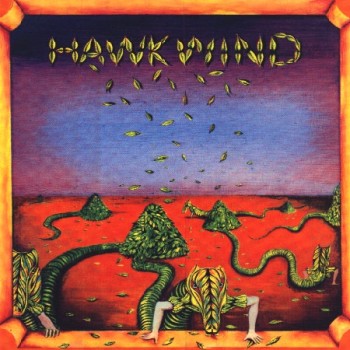
            I definitely do not recommend sending Hawkwind’s first self-titled record, though in some respects it’s my favorite. I vote against it only because it reveals the band in their pre-space days, when they were more of an acid rock group. Pondering the heavens, to be sure, but still lacking the wherewithal to fully escape the earth. The opening track, “Hurry On Sundown,” has a bluesy/folksy feel. It begins with a bright riff strummed on an acoustic guitar, then a blaring harmonica kicks in and dances along with the melodic vocals. On the second track, they venture a fair distance into space, but it’s a feedback-based approximation of space that’s still rooted in earthliness. There’s less artifice; you can picture ragamuffin stoners making the music in some groovy pad somewhere, tripping out. The shape of some of the songs is less streamlined and symmetrical than on their later records, too. The third track, “Be Yourself,” for instance, has an odd three-beat form that’s kind of arty in a punk-rock sort of way, the punkiness due mainly to shouted lyrics. Side two has a similar form, only in reverse, going from off-centered, dark melody and rhythm, through several interludes of guitar-and-amp cosmos (with a touch of crazy saxophone from the gates of hell thrown in), and it ends with another down-to-earth tune, “Mirror of Illusion,” which verges on pop, in a hippy sort of way. It’s a great album, but probably not the best hello for whoever might be out there, millions of light years away. Better to wait to play the space creatures Hawkwind’s first record when they finally arrive at our home planet, where we can have them over for supper and wine and maybe even some of our precious herbs for a long night gathered around a real turntable.

Monday, September 10, 2012

I'd Love to Turn You On #65 - Hüsker Dü - Zen Arcade


Now is a good time to talk about Hüsker Dü. Well, I think any time is a good time but they seem especially relevant these days, maybe even more than when they were actually making music.  Bob Mould has just released a new solo album that's the best work he's produced in nearly two decades.  This follows up his autobiography of last year.  The influence of the band on rock music in the years since their demise seems to grow all the time.  So why not take a look at what is arguably their masterpiece, 1984's epic, double album, the semi-conceptual Zen Arcade.
The idea of a hardcore punk band doing a double album, much less a concept album, was somewhat revolutionary back in those days, yet it was also inevitable.  Punk and hardcore in their purest forms are both fairly simplistic musical styles.  In order to stay relevant, artists must push the limits of the genre.  The Clash realized this five years previous when they shook up the world with London Calling.  Now it was time for the next wave of punks to make the leap.  It made sense that it would come from one of the bands on SST Records, the label founded by Greg Ginn of Black Flag.  The artists on SST, such as Meat Puppets, The Minutemen, even Black Flag themselves, never tied themselves to punk rock orthodoxy and were always open to experimentation.  Hüsker Dü took the lead, for a time anyway, with Zen Arcade.  It claims to be a "rock opera" in the mold of Quadrophenia or The Wall, telling an angst-filled personal story.  The "plot" is not easily deciphered, something about a computer hacker whose girlfriend OD's, but the amazing collection of songs takes listeners on a journey through their sheer power and creativity.
The main strength of Hüsker Dü is that they had two outstanding songwriters in Bob Mould and Grant Hart.  In fact, I believe it's the rivalry between the two that pushed them to such great songwriting heights.  Each was always trying to outdo the other and both produced outstanding work as a result.  The album kicks off with two Mould classics, "Something I Learned Today" and "Broken Home, Broken Heart" followed by the first real change-up, Hart's acoustic "Never Talking to You Again."  This awesome 1-2-3 punch establishes the tone right off the bat.  The harder rocking numbers stand with the best hardcore of the era, but there's a lot more going on.  Hart's psychedelic "Hare Krishna" closes what was side 1 back in the vinyl days and establishes the band's penchant for being both trippy and noisy at the same time.  Side 2 opens with a blast of four Mould short/fast/loud numbers, then Hart's sing-a-long anthem "What's Going On."  Album 1 concludes with the haunting "Standing By The Sea," a song anchored by the repetitive bass line of Greg Norton.  Norton is often the forgotten member of the band but his musical contributions are just as essential as Mould and Hart's.
Album 2 is a mix of interesting instrumental interludes and classic anthems from both Mould and Hart.  Hart delivers "Pink Turns to Blue" and "Turn on the News" while Mould counters with "Newest Industry" and "Whatever."  For a band to come up with just one of these amazing tunes is achievement enough.  But all four, on top of all the great songs that came before, is truly a remarkable accomplishment.  The whole thing concludes with the 14 magical minutes of "Reoccurring Dreams," an instrumental number built on a fairly simple riff, jammed out with intense power.  It’s the perfect conclusion to an epic album.  Zen Arcade was a very important album to me in my youth and still resonates with me today.  More important than the lyrics or concept, it’s the variety and creativity of the music that inspires.  It seems various music scenes, already fragmented back in 1984, become moreso every year.  Zen Arcade is a reminder to always look beyond labels and genres.  When you do, whole new worlds of sound and experience await you.
- Adam Reshotko

Friday, September 7, 2012

Review of the New Bob Dylan Album "Tempest"


I got an advance of Tempest and here are my immediate thoughts after one listen

There’s no doubt it is modern Bob Dylan. The music hearkens back to some indeterminate point in American history. Part blues, part folk, part jazz, part some hybrid feeding trough of all roots music filtered through the sensibilities of someone who was there for all of it, every moment of the last 50 years Bob both reveled in and created. He has never been a nostalgia act, he has been his own act; making his own music that encompasses everything that came before and predicts all that is to come. Tempest will not divide fans. I believe if you are a believer in Dylan, all of it - the old, the middle the new - you are going to FLIP FUCKING OUT over this album. It has everything you want and a level of lyrical density that has been gone for a long time. If, on the other hand, you find the modern Dylan to be an impenetrable frog’s croak compared to Blonde On Blonde look elsewhere. You will find this to be the same. It is worth noting that his voice is actually less rough than it has been in recent years, and the musical accompaniment (his touring band with the addition of Los Lobos’ David Hidalgo) is as lightly sweet as Love & Theft but it does not sound like a man in his 20’s.

That aside, I am swooning after only one listen. Dylan’s lyrics are as intense as evocative as they have ever been. They are poetic, historic, intelligent and informative. It is Bob at his best. The album is beautifully produced by Dylan himself and shows a man so comfortable with his own musical skin that “fashion” isn’t even a consideration.  I can’t wait to listen to this album obsessively for the next few months to unlock all its mysteries, but here a few immediate impressions.


1) “Duquesne Whistle” - upbeat tune. Impossible to think of it now except in terms of the amazing, weird video that accompanies it - watch it HERE. Nostalgia and dread mix nicely to form something like…Dylan’s version of normal. Would have fit nicely on Love & Theft. A very pleasing musical arrangement hides a viper’s eye.

2) “Soon After Midnight” - slow, lots of pedal steel. A lonesome cry for companionship.

3) “Narrow Way” - repetitive, guitar driven tale of weary resignation and retribution with the ominous chorus. “If I can’t work up to you, you’ll surely have to work down to me someday.”

4) “Long and Wasted Time” - an embittered cry for lost love, and lost everything else. So many great couplets: “I wear dark glasses to cover my eyes, there’s secrets in ‘em I can’t disguise.” An amazing vocal performance.

5) “Pay In Blood” - “I pay in Blood, But not my own.” Wouldn’t have been out of place on Infidels musically. But a deep set of ominous lyrics.

6) “Scarlet Town” - Lyrically, this one is so deep, I can’t even begin until I’ve heard it more. Clearly he is under the influence of another poet here. A vision of the natural world gone mad under the influence of a corrupting mankind? I don’t know - this is one heavy song.

7) “Early Roman Kings” - a groovy, stone blues. One of his best modern lyrics. There is so much going on here, I can’t begin to pick my favorite of the amazing lines that crash the modern condition head on with the ancients.

8) “Tin Angel” - A tale of corruption and betrayal. John Ford meets John Dos Passos.

9) “Tempest” - it sounds like a Stephen Foster epic, but it is pure Bob Dylan. History unravels and spills over the floor like so much unspooled film as Leonardo Dicaprio rubs elbows with the real participants in this tragedy that seems to never lose its appeal. Yes, Bob examines the sinking of The Titanic in 14 minutes of hypnotic storytelling. Getting lost in the dream-like lyrics and lovely musicianship it might be easy to miss the fact that Dylan’s voice is more compelling on this song than it has been in years. As fascinating as the actual story and twice as revelatory. James Cameron eat your heart out. Dylan tells the story with such comparative brevity and absolute poetic superiority, it seems like HE should get the Oscar.

10) “Roll On John” - A tribute to John Lennon. Bob is openly broken-hearted about the senseless loss of one of the few people on earth who could have really understood what it was like to be Bob Dylan.

- Paul Epstein

Monday, August 27, 2012

I'd Love to Turn You On At the Movies #47 - Joe Cocker - Mad Dogs & Englishmen (1971, dir. Pierre Adidge)


Normally we don’t review rock docs in this column. However Mad Dogs & Englishmen feels like cinema to me. It watches more like a movie than a documentary. There are good guys and bad guys, a beginning, middle and end. The story has a heroic arc that finds our protagonist, Sheffield born R&B singer Joe Cocker, embarking on a long and dangerous journey across country with a band of friends and strangers to find the origin of his musical soul. Sounds dramatic right? Well it really is. This was probably the 4th or 5th time I’d watched Mad Dogs & Englishmen and I’d always found it very compelling, but I didn’t quite “get it” if you know what I mean. This time I got it. Fully! The reason it doesn’t feel like a bunch of concert footage is because it isn’t. It is a fully realized movie about a huge undertaking involving over 40 musicians and fellow travelers careening around North America creating something unique and special every single night. Along the way, we get a primer on the highs and lows of the music business circa 1970.

For the most part Joe Cocker comes off a genuinely talented, nice, inarticulate guy who is just kind of going with the flow. He has a tour of America booked after his triumphant performance at Woodstock with The Grease Band. Unfortunately, shortly thereafter The Grease Band went their separate ways and Cocker was left with his name on the dotted line and a North American Tour to mount. He called his friend, Leon Russell and within a day or two Leon had assembled a huge band that included the cream of the L.A./Oklahoma axis of musicians. Names like Rita Coolidge, Jim Keltner, Bobby Keys, Don Preston, Carl Radle and at the center of it all Leon and Joe battling for supremacy. For at the center of this movie is the subtle, dark, controlling, svengali-like personality of Leon Russell. Russell is the obvious musical director of this huge and supremely talented assemblage, as well as the social director and spiritual center of the whole affair. His image and musical fingerprints are everywhere. As stated Joe seems somewhat inarticulate which is never better illustrated than the scenes where he is taken around to radio stations to promote himself. Most painful is a stilted meeting with Bay Area legend Big Daddy Tom Donahue who comes across as overbearing and out of touch as Cocker does timid and hung-over. It becomes clear almost immediately that Cocker himself is like a wind blown leaf in hurricane gale wind, burned out from a couple of intense years of touring and a rocket ship to fame, he is hollow-eyed and lost. Until he gets on stage that is. After all, the reputation of this movie rests on the electrifying performances. And they are. Cocker becomes possessed by the music and delivers a series of electrifying performances. The band is unbelievably funky and tight, yet the arrangements of the familiar material are open-ended and loose allowing for breathtaking improvised ensemble moments. That looseness and amazing arranging can be laid at Leon’s feet. His musical contribution is as important as his emotional impact on the proceedings.

As the tour winds from coast to coast all the excess of the late 60’s is on full display; you got your sex (groupies everywhere including a weirdly dated encounter with “the butter queen,)” drugs (everything, all the time, non-stop) and of course Joe’s form of soul revue Rock and Roll. Interestingly, with over 40 years hindsight we can almost see the misguided idealism of the Woodstock experience unwind before our eyes. As the tour builds momentum the performances get better and better, the party gets longer and stranger and the entire proceeding looks to be heading for some kind of psychic cliff. Then...there is a moment of calm as the touring party lands in Oklahoma on someone’s farm for a down home picnic. All the schizophrenic impulses of the 1960’s are in full effect; the pastoral vs. the city, the family unit vs. rugged individualism, the traditional vs. the avant garde. It is all there as a large bunch of hippie musicians slowly unwind into the sunny grass fields of the American heartland. You can see the yearning for it to last forever, cut with the reality that this fragile ecosystem had to eventually crumble. Before it does though, it produces one hell of a great musical ride.
 
- Paul Epstein

I'd Love to Turn You On #64 - Rahsaan Roland Kirk – The Inflated Tear


Rahsaan Roland Kirk was many things, but let’s clear one thing up first – he was a genius. There are those who would tell you that because he sought to entertain as well as enlighten that his art is somehow lesser than the intensely serious music of a John Coltrane, a Miles Davis, a Cecil Taylor. But really, he’s in a line with Duke Ellington, with Charles Mingus, with Louis Armstrong – not exactly bad company to keep. He was also a remarkable jazz saxophonist (and player of other reeds as well), on a level with any of the greats you’d care to name, often using two or three (or more) horns simultaneously to create his own horn section. You can hear that right off the bat here with “The Black and Crazy Blues,” or most spectacularly on the title cut, where he contributes a gorgeous, tender solo interspersed with a gripping, multi-horn fanfare. And if you want to check out one of his tricks of technique that allowed him a unique approach to his soloing, listen to the extended improvisational line he lays down on “Many Blessings.” He just doesn’t stop to take a breath, because he uses a technique of circular breathing to draw in and exhale air at the same time. It’s not the first time he does it here, but it stands out here because the song is a more straightforward blowing tune. He’s also a traditionalist. You can hear that here most readily in his elegant reading of Duke Ellington’s “The Creole Love Song” and in the relatively restrained quartet music that makes up the bulk of this album, which ranges from light and lovely to the emotional intensity of “The Inflated Tear” itself.
But Rahsaan was also an avant-gardist in the sense that he was always pushing boundaries to find new ways to express himself; a surrealist joker always tweaking the noses of those who thought he could or should do things one specific way; a vaudevillian who knew how to elicit cheers of delight from audiences while still staying musically interesting. And that’s where the second album here comes in. Atlantic Records, Kirk’s musical home for many years, encouraged his experimental bent – the producer of The Inflated Tear even reports being a little disappointed when Kirk turned in the first album that didn’t showcase his wilder, woollier side. But after a string of great (and mostly out of print) releases for the label, Kirk fulfilled the experimental side of his destiny with Natural Black Inventions: Root Strata. At first these two albums – one of his nicest, cleanest, and best and one of his weirdest – seem to be strange bedfellows, but after a few listens, even the oddness of the later album just seems like Kirk’s quirks applied to a great set of songs, and the underlying eccentricities of his personality shine through on the seemingly “normal” earlier album. And what’s so weird about the second album? Well, excepting some mostly percussive support from a couple friends, Kirk plays every single instrument – and he’s credited with 18 plus “bird sounds” (including the “black mystery pipes” which he describes as “a piece of bamboo and a yard long metal tube – two pipes are played simultaneously.”) – by himself, live in the studio, without overdubs. It must have been the most amazing one-man-band show ever seen, and the fact that he actually made a terrific, albeit odd, album out of it just goes back again to show the level at which his genius operated. Mostly he’s recording his own tunes, again working the serious, the funny, the surreal, and the sentimental right alongside each other, and again he uses Duke Ellington as a touchstone, employing another non-percussive instrument (a piano) for the only time on the record, and creating a gorgeous duet that contextualizes the rest of Kirk’s songs on the album within a larger continuum of jazz and other black music and culture, one in which he’s not the sideshow figure he’s sometimes made out to be, but one of the true giants of the music.


The Inflated Tear is certainly the place to start with Kirk – it’s one of his best recorded, best conceived and loveliest album, but time has shown that even if Natural Black Inventions: Root Strata sold poorly in its first run, Rahsaan Roland Kirk was absolutely right in his conception, and created a really brilliant work there, even if it leaves some listeners in the dust. They’ll catch up one day.
- Patrick Brown

Friday, August 24, 2012

Fables of the Reconstruction: Gunn-Truscinski Duo

Steve Gunn is the best guitarist that no one has heard of. He’s not a blazing-guitar-solo great guitarist, though he’s such a master of the six-string that I suspect he could be if he wanted to. His music is mellower, richer. Much of it he performs on acoustic guitar. If I were to pin his style down, I’d say he plays in the tradition pioneered by John Fahey: highly skilled explorations of deceptively simple melody, rhythm and chord themes that reside somewhere between jazz, classical and blues, with a whole world of international sonic spirituality mixed in. When he does plug into an amp it’s not to blast out power chords and screeching licks, but to add a layer of electric resonance to his intricate tapestries of sound, vibrations along the lines of those conjured in a good raga. Gunn started out in a virtually unknown Brooklyn drone trio called GHQ, and in 2007 he began releasing music of his own, on CDRs at first and then on vinyl with a tiny label based in North Carolina called Three Lobed Recordings. These records are rare from the get go: Gunn’s 2009 LP debut, Boerum Palace, had a print run of just 823. Which might explain his relative obscurity. He’s clearly not trying to be famous.
In 2010 Gunn teamed up with drummer John Truscinski to form the Gunn-Truscinski Duo, and they’ve released two records, Sand City and Ocean Parkway, both with Three Lobed, both on limited edition vinyl—624 and 777 copies respectively. The musical relationship between Gunn and Truscinski feels similar to the way Bill Evans and Paul Motian played together, two stellar musicians playing improvisational lead simultaneously within highly structured themes. The result is something that’s at once expansive and contained, tunes that feel simple enough to relax the mind at the end of a long, hard day, but full of complicated waves of notes dense enough to yield surprises across many, many listens. And it sounds so good on vinyl. It’s the kind of music that begs for the warmth and physical texture of an LP, partly because of its simplicity, but mostly because it’s music rich with handmade qualities and textures—the scrape of Gunn’s fingers across the strings, the woodenness of his guitar, the lo-fi hum of a small amp, the tautness of the snare drum, the uneven brassy sheen of cymbals. It’s like wood grain and unpolished stone. It’s something real in a world that seems to be fading into bits and gigabytes.
Frankly I can’t understand why Gunn and Truscinski are not superstars, at least among the millions of quality-music lovers who tune in to NPR’s All Songs Considered to be turned on to new aural art, because they’re just so good. In fact, Gunn has received some NPR attention with a fascinating interview from July of last year (in which he confessed to being a Dead Head). But the surreally small pressing of their latest release suggests that either the interview drew too few new fans or they don’t care and they want to keep things small. I’m not complaining. I like being one of the few people on earth who knows about such a good thing.

Monday, August 20, 2012

I'd Love to Turn You On At the Movies #46 – People Will Talk (1951, dir. Joseph L. Mankiewicz)


Cary Grant was the coolest, most suave dude to ever walk across the silver screen. It’s like he wasn’t even human, he was so perfect in posture, manner and good looks and good taste. Watching him act is like watching Michael Jordan on a basketball court or Jimi Hendrix with an electric guitar; he was one of those one-in-a-billion-billion people who was such a genius at what he did that he transcended even our notions of what is best, seemingly without effort. You really can’t go wrong with a Carey Grant film, and quite a few of them are essential viewing for any self-respecting cinephile – North By Northwest, An Affair to Remember, The Philadelphia Story, to name a few. I’m not sure if I’d add the 1951 comedy People Will Talk to this short list, because it’s not important in the way that those films are. But I’d still recommend highly, especially for people who like old movies for the way they offer a glimpse into the values and beliefs of bygone times, and for those who appreciate plotlines that are unwittingly, but undeniably, weird.
            Grant plays a young doctor named Noah Praetorius whose methods of medicine and style of teaching are unconventional but highly effective. He’s adored by his students and hailed as a hero in the larger community. But his success has made him the target of a jealous colleague, Dr. Rodney Elwell (Hume Cronyn), who is everything Dr. Praetorius is not – short, balding, undistinguished. Elwell hires a detective to dig up dirt on Praetorius in hopes of ruining him. Meantime, a student named Deborah Higgins (Jeanne Crain) faints in Dr. Praetorius’s class, and he examines her and determines that she’s pregnant. She’s not married, though, and the father of the child has died. This was, of course, a huge problem in 1951, and sparks a delightful chain of events between doctor and patient, professor and student, toward the inevitable romantic conclusion. The two stories converge in what is one of the most peculiar climaxes I’ve ever seen in a movie, a story within a story that’s so odd it makes the film worth more than the cost of admission for its oddness alone.
            As time capsules go, People Will Talk is better than most because it shows a period of transition. The tension that drives the romance plotline is borne of the social mores and taboos of the time: the shame of a pregnancy out of wedlock. Yet Higgins and Dr. Praetorius are clearly the protagonists, despite Higgins’s supposed sin and the good Doctor’s aiding and abetting. So you can only conclude that the audience at the time – society as a whole – possessed a degree of acceptance for the whole situation. Otherwise the film’s producers wouldn’t have been able to pull it off, especially not in a romantic comedy, a genre that has natural limits on how far it can push viewers out of the confines of societal norms. So it’s weird because it’s OK that Higgins had sex and got pregnant, but, at the same time, it’s not OK, and the plot rides on the pressing need to suppress the facts at hand. Watching it in the 21st Century, when the choices for women are, thankfully, far greater in number, you find yourself perplexed to the point of fascination as to why it’s an issue at all. But that makes the whole time-travel all the more interesting.
            As for the story within the story, I’ll say no more. I probably shouldn’t have even mentioned it at all, because part of the thrill is the way it comes so unexpectedly and feels so outrageously out of place. But here, too, we get a snapshot of a period of time. People Will Talk is based on a play by German playwright named Curt Goetz, who was a relative of George Bernard Shaw, with whom he was often compared. Both were stalwarts of modern theater, and one of the hallmarks of modernism in drama and literature was the move away from strict chronological flow in story telling. So this film is a stark example of this, made all the more stark by virtue of its being a movie, which we tend to expect to unfold sequentially. So it gives you a satisfying aesthetic jolt that you ordinarily get from the escapist delights of a funny Hollywood romance, and this lifts the movie higher up the list of Cary Grant’s must-sees.
            - Joe Miller