Monday, May 26, 2014

I'd Love to Turn You On At the Movies #91 - Barton Fink (1991, dir. Joel & Ethan Coen)

Every film in the Coen oeuvre is undoubtedly best experienced with no previous knowledge of what is about to unfold. There is, however, one film of theirs that simply demands to be seen in such a way; Barton Fink. Even knowing a basic plot outline spoils so much of the pitch black fun in store. With that in my mind, I am going to attempt to convince you all to watch this film by offering nothing but semi-personal vagaries, allusions, cast members and metaphors.

Barton Fink remains a go to favorite for film buff debates whether it be waiting in line at a film festival or shouting louder than any of you realize at a bar as things escalate. Why you ask? Because damn near every single person (or at least those that like to dive a little deeper with their film viewing) that watches this film leaves with a wildly different interpretation of exactly what it all means. Is it a clear cut Freudian metaphor as we watch Barton work to keep his incessant subconscious, sex-obsessed mind at bay whilst exhaustively stretching his conscious self paper thin attempting to understand what exactly a boxing film might look like? Is it a vicious satire attacking the likes of William Faulkner and his notorious flings with many ladies who were not his wife while he penned ineffectual screenplay after screenplay in Hollywood? Is it a goofy, oft-too-literal descent into a hellish nightmare being led by the sweatiest John Goodman we’ve ever encountered? Is it (as the Coens would like you to believe) a simple story of one man trying to write a screenplay in a visceral hotel that is probably the best written character in the film that means absolutely nothing apart from what you’ve seen? Is it empty vapid pastiche to Hitchcock’s Notorious? Is it an allegory of the continuing persecution of Jews under the ever-punishing thumb of Nazi Germany? I give a resounding ABSOLUTELY! to every one of these theories and every other one I will assuredly encounter.
 
Barton Fink ranks as the funniest, meanest, (maybe excluding the outright sadistic hilarity that the Coens enjoy when torturing their protagonists in Burn After Reading and A Serious Man) most dense, most impenetrable, easiest to access, most intelligent and blah blah blah that this infuriatingly talented duo has plopped in our brain space. Will many a film buff, casual viewer and even my Mom argue with me on this point? Of course they will and they are completely right. And so am I. The Coen Bros. have a distinct ability to encourage (or outright demand) that every person watching bring every bit of their baggage, life experience and self-indulgence inside the theatre. A Coen Bros. film is interactive (excepting of course those perfect, cold films that exist so we are in awe of their talent; No Country For Old Men and Inside Llewyn Davis. But wait, what does the ending to either one mean?) and really wants the audience to lend their messy selves to the stories unfolding. Perhaps this explains my fiercely personal reactions to the films that leave me feeling closer to these fabricated, often overly esoteric creations than I do to many humans I’d call friends. While at the same time, many of those close friends feel nothing but cold and amoral distance when watching the same films.

What does this endless babbling all mean? Why should one film cause such a stir amongst all that see it? You tell me. Watch it and fight with me. Join the conversation. Watch with the knowledge that this won the Palme D’Or, Best Director and Best Actor in 1991 at the Cannes Film Festival. Then watch it without that knowledge. Realize that with every single viewing, you are experiencing a very different film. Does it go so far as to be an ever-shifting Rorschach test? Of course it doesn’t. But, also of course it does.

            - Will Morris, House Manager, Sie Film Center 

Monday, May 19, 2014

I'd Love to Turn You On #106 - Blind Willie Johnson - Praise God I’m Satisfied


One has to wonder how much longer people in the modern age will be able to listen to music from the last century and even understand the context or significance it holds. When one considers the realities of an internet driven world - the instantaneous connectivity to all corners of the earth and the inhabitants and customs of those corners, access to all information and culture in the blink of an eye - it is hard to imagine what mystery or lesson music from early in the last century can bring us. Or is it? From the second Blind Willie Johnson’s frog-croak of a voice and liquid quicksilver guitar technique comes over the speakers, the listener is taken to a time and place where the racial, regional and spiritual differences between men determined not only the music they made and listened to, but their fate in life as well. In the late 1920’s when most of the recordings on this essential CD were made it was still possible to experience parts of the country that felt and sounded like different countries altogether. Today, the world shrinks daily as mass marketing, social networking and the acceleration of culture has flattened our horizons and our expectations. Blind Willie Johnson’s songs come from a long gone rural America where the course of human events were slow-moving, distant and seemed to be surely directed by the hand of the almighty. The enormity and uncontrolled nature of historical events and the mysteries of life live vividly in these songs.

Most of Blind Willie Johnson’s songs are either retellings of historical events like “God Moves On The Water” which chillingly tells of the Titanic sinking, or others when he remembers the 1918 flu epidemic that killed thousands, or they are profoundly moving religious exhortations. Like a preacher, the blind singer was able to convey his fervor and belief like few others. His vocals are loud and direct and his guitar style is miraculous even by today’s standards. Like his more historically famous contemporaries Robert Johnson and Charlie Patton, Johnson’s playing betrays some conventional technique but also hints at some divine inspiration. It is so accurate and personal it simultaneously shows him to be part of a great tradition and stamps his unique individuality on every phrase.

Also like Robert Johnson et al, Blind Willie Johnson’s style and repertoire are direct antecedents to everything that is rock and roll. You will recognize a number of songs on this disc like “Nobody’s Fault But Mine” (Led Zeppelin),  “Keep Your Lamps Trimmed And Burning” (Hot Tuna) and “Motherless Children Have A Hard Time” (Richie Havens, Eric Clapton) as familiar rock standards and crucial building blocks to everything we consider modern. Possibly most interesting is Johnson’s unexplainable composition “Dark Was The Night - Cold Was The Ground.” Like no other blues song I can think of, or any song of any genre for that matter, “Dark Was The Night” is a shivering formless slide guitar piece punctuated by Johnson humming and moaning over his own playing. It is haunting and beautiful and unlike anything else you have ever heard. When its sheer beauty and otherworldly nature are paired with the knowledge of Johnson’s limited options, education and lifetime experiences it adds up to one of the great musical mysteries. Or perhaps there is no mystery. The explanation was that beauty lurked around every corner before we knew what lay there ahead of time.
- Paul Epstein


Monday, May 12, 2014

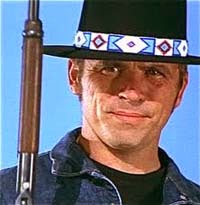
I'd Love to Turn You On At the Movies #90 - Billy Jack (1971, dir. Tom Laughlin)


It’s strange that a film like Billy Jack would qualify for “I’d Love To Turn You On.” This is supposedly the highest grossing indie film of all time, not a well-kept secret. But even by the time I first saw it, in the mid-eighties, barely a dozen years after it came out, it had become an obscurity. I caught it after school one day when I was flipping through channels. The screen filled with wild horses galloping in slo-mo, desert dust all around, through it all a woman sang: “Go ahead and hate your neighbor, go ahead and cheat a friend.” Not your usual daytime TV fare.
            I set down the remote. The horses were fleeing white men who aimed to sell them for dog meat, six cents a pound. Among them, a lawman and an elected official, the boss of the town, the Establishment. They cornered the horses and raised their rifles. But before they could fire a wind blew through the brush, and from the brush a man emerged, in a black hat, sitting high on a white horse. Billy Jack.
            Every time I’ve seen this film it’s been a different trip. I’ve laughed all the way through and I’ve written screeds in my head, like when Tom Laughlin, the guy who plays Billy Jack, who dreamed up this fading icon, says: “An Indian isn’t afraid to die; don’t ever expect a white man to understand that,” because Laughlin is Wisconsin-born white man, and that’s just plain wrong, isn’t it?
No, it’s not just wrong, it’s over-the-top wrong. In one scene Laughlin’s taking part in a completely fictitious snake ceremony, a tradition of a fake tribe called the “Nishnobie,” and as he emerges from his snake-venom daze he declares, “the whites do not know how to reach through that veil, they do not have the belief.” And in another he’s railing against his white-woman lover, telling her “your people” killed the Kennedys. It’s so wrong that it’s almost wonderful. And apparently I’m not alone in my esteem for Laughlin’s twisted character. “Back in the day, Indians worshiped Billy Jack,” Sherman Alexie has written about the 70s icon. “That Tom Laughlin may not be Indian, but he sure should be."
The first time I saw Billy Jack I thought it was badass. Cheesy, but badass. I was an aspiring punker and these were the Reagan years; I thought anything that showed America’s dark side was radical and cool. And there was plenty of that here: The little girl who sings a song she wrote about her brothers, “Going off to war tomorrow, going off to die tomorrow”; the corrupt officials and lawmen; white children holding up their fists in Black Power salutes; the improv theater scenes that devolve deep into the leftist muck; Billy Jack’s rants against the war and the Indian Bureau—it was all new and amazing to me.
When I watched it most recently, I was struck by the rage in it. Happy moments are few and far between, and it breeds a persistent sense that the world is evil and that those few who aren’t evil—the children, the hippies, the Indians—are all holding on by a thread. And what better platform for a hero like Billy Jack? A man who carries always a calm demeanor, with just a touch of fatalistic humor, perfectly collected in phony Native American pacifism, right up until the split second he lifts his leg and swings it around in a high hapkido kick to the side of a bad guy’s face and all kinds of martial arts ass kicking ensues. Billy Jack was a perfect icon for that time, and like the rebellious spirit that was still burning back then, his hold on the popular imagination has faded. Too bad. We could still use a man like that, in Washington, on Wall Street, anywhere the forces of injustice march on.
- Joe Miller


Thursday, May 8, 2014

Esme Patterson, In Her Own Words

Esme Patterson’s new album Woman to Woman will be released on CD and LP by Greater Than Collective this coming Tuesday the 13th. The album finds Esme writing songs from the perspective of women who’ve been sung about in other tunes – her “Valentine” tells the story from the point of view of Elvis Costello’s famous “Alison,” the Beatles’ “Eleanor Rigby” and so forth. She’ll also be playing a live in-store performance here at Twist & Shout on Friday the 23rd at 6PM. Twist’s own Natja Soave sat down with Esme to ask her a few questions about the new record, the tour, and other subjects.

Twist & Shout: Why did you decide to do a response album?

Esme Patterson: My last record was autobiographical to a fault, and it felt great on this record not to write about my own life for a bit, to write about someone else's problems.

T&S: What made you choose to respond to the songs you did for the album?

EP: The songs I responded had to be titled a woman's name, they had to be a song that I liked, and they had to have some room for a response. For example, I love the tune Mustang Sally, it fits the first two criteria, but there isn't much room for a good response. What would she say? “Yeah, I've got a car, pretty nice-looking, huh?”

T&S: What was your favorite part of this process?

EP: I really loved this whole process. It was a lot of fun, and kept being surprising and interesting to write as well as record. I love having limitations and structure with expression; paradoxically, it can be really freeing.


T&S: How are people receiving Woman to Woman?

EP: The reception of this album has been really amazing. When I wrote it, it wasn't necessarily meant to be a feminist work, although I consider myself a feminist and a lot of the work I do is colored by that, but a lot of feminist media that I deeply respect has praised this album, as well as media that focuses on the craft of songwriting, and if those two camps dig what I'm making, I feel like I must be doing something right.

T&S: How’d it feel to have Elvis Costello post “Valentine” on his Facebook page?

EP: I felt like bathwater must feel when a radio falls into it, but in a good way.


T&S: You recently did a video with Extra Kool for the song “Cape & Cowl.” Most people couldn’t imagine you in a hip-hop video, how did that collaboration come about?

EP: Extra Kool is a good friend, I love his stuff. When I worked at the Tattered Cover on Colfax he would come in and order a chocolate milkshake and we would kick it. I love singing hooks on hip-hop songs, it's a lot of fun, and Extra Kool asked me to come up with a hook for a track of his and I jumped at the chance.

T&S: When you tour will it be with a full band or just you and your guitar?

EP: The nice thing about touring with my solo project is having the freedom to do either. I do love playing with at least a drummer, though, since I've switched over to electric guitar, I'm having a lot of fun playing loud and rocking out, and that's harder to do alone.

T&S: Where will your tour lead you this summer?

EP: All over. As long as there's a bowling alley or a swimming hole nearby I'll be happy.

- Natja Soave


*More about Esme performing live at Twist and Shout here


Monday, May 5, 2014

I'd Love to Turn You On #105 - Prince – Around the World in a Day

The massive success of Purple Rain made Prince a superstar.  He was in as rare an air as there is, with only Michael Jackson on the same plane commercially and no one in his class creatively.  Yet Prince was a restless musical genius, bursting with new ideas he just had to get out.  He was not about to coast on the success of Purple Rain, releasing single after single to keep the hit machine rolling.  A new album was about to be unleashed on the public while Purple Rain was still topping the charts.  However, this new album was to be a completely different animal.  Many artists have attempted to follow a smash commercial hit with something more experimental and challenging but no one who ever done it was as big as Prince was in 1985 and no album was as different from its predecessor as Around the World in a Day.

The album isn't talked about much these days, but at the time the public's appetite for new Prince music was such that even this left field excursion would get several tracks played on the radio and sell a whole bunch too.   The press dubbed it Prince's psychedelic album and compared it to Sgt. Pepper.  It certainly does have plenty of psych flourishes and Prince was almost certainly aware of the Paisley Underground scene going on in Los Angeles (more on that later).  But what the album shares most with the Beatles' classic is the attempt to sneak underground and experimental elements into the pop mainstream.  The mass public of the sixties was ready to accept the Beatles' experiments because they loved the Beatles.  They felt the same way about Prince in the eighties and while Around the World in a Day hasn't become a lasting classic like Sgt.
Pepper, the mere fact that it was successful and kept Prince in the spotlight is testament to Prince's talent, charisma, and popularity.

The album kicks off with the title song and immediately challenges its pop audience with eastern textures and percussion.  Slightly more familiar ground comes with the infectious melody of "Paisley Park."  Here, Prince taps into the mid-60s pop-psych vibe that L.A.’s Paisley Underground bands like The Three O'Clock and The Dream Syndicate were also hitting.  The song is important enough that he named his studio and record label after it.  Another psych-pop masterpiece is "Raspberry Beret," the album's biggest hit, with a trippy video to go with it.  It's also the most joyous song on an album that can get a little dark at times.  "Tambourine" ends side one with a bit of stone cold funk, a reminder that gettin' the dance floor movin' is still a top priority.  Side two (yes I'm still thinking in vinyl terms, though the CD is what we're selling here) opens with a blistering critique of "America," a particularly bold statement right in the middle of the Reagan 80s.  No less relevant, yet cloaked in another infectious melody, is "Pop Life," a critical look at modern stardom and the state of the world.  If any tune on the album deserves to be considered an all-time Prince classic, this is it.

Around the World in a Day stands as his greatest creative achievement.  At the height of his success he followed his muse and we all reaped the rewards.
For the last two songs, Prince turns to his two favorite subjects, God and sex.  While these twin obsessions are often painted as a contradiction, Prince knows full well that religious devotion always contains a strong sensual element and erotic revelry often becomes quite spiritual.  "The Ladder" has a strong gospel vibe with a spoken parable even, yet it builds to a fervent climax just as strong as any bedroom jam.  "Temptation" is the album's epic closing track and starts off with pulsing funk jam and the erotic lyrics Prince has always been known for.  Then, a little over the halfway point, the bottom drops out.  We've suddenly entered a morality play where Prince struggles with his urges and desires in the face of a judgmental higher power.  A brave and challenging album ends with its bravest moment yet.  Prince would continue to challenge the public's notion of pop, soul, rock and funk throughout his career, but
            - Adam Reshotko


Monday, April 28, 2014

I'd Love to Turn You On At the Movies #89 - Criss Cross (1949, dir. Robert Siodmak)

Surprisingly, we’ve never reviewed a single film noir for our I’d Love To Turn You On at the Movies series, so it’s high time we got started. For those unfamiliar, film noir is a hotly debated category amongst film scholars even 70 years after the fact (just ask your favorite two film snobs what the first real film noir is and when film noir ended and watch the fireworks!), so maybe that’s why we haven’t hit it yet. In a nutshell (though some are sure to disagree on the details), the genre emerged in the early/mid-1940’s in Hollywood and ran through the late 50’s. It is generally characterized by a gloomy outlook on the world, by dark, foreboding black and white visuals, by out of control passions, by a femme fatale drawing our central character into a web of danger, and by sleazy characters on either side of the law, usually with few morally redeeming characteristics. It’s doubtful that the people making these films noir were consciously deciding to follow such a set pattern, but that most were responding to the uncertainty in the air that most of America felt during WWII and its immediate aftermath. You can see the style in such great 1940’s films as Double Indemnity, The Postman Always Rings Twice, Out of the Past, and Murder, My Sweet. And you can see it in spades in the 1948 classic Criss Cross.
            Criss Cross – as perfect a title for a film noir as there ever was, beaten only, perhaps by Kiss Me Deadly – is rife with paranoia, double and triple crosses, and a grim fatalism in its story of an armored truck heist and its aftermath. The film opens with a nighttime aerial shot cruising low over L.A. with a doomy Miklós Rózsa score coming in from the first frame. Eventually we focus on a non-descript parking lot by a nightclub and the action moves down to the ground, where we find a cheating wife Anna (Yvonne De Carlo) in a passionate embrace with her boyfriend Steve Thompson (Burt Lancaster) and them trying to find a way to get away from her husband, the dangerous gang leader Slim Dundee (Dan Duryea). Thompson takes a hike after she warns him how dangerous Dundee is and they enter the club separately, where Dundee has been waiting impatiently for her. A tense, jealous exchange follows between husband and wife and Thompson enters the club, getting into it immediately with Dundee. The smart, tight script sets its plot and a thicket of character motivations and relationships in motion within ten minutes, jumps immediately on to setting up the heist our main characters are engaged in, then jumps to flashback to give us the back story that lead everyone here. Turns out Steve and Anna used to be married, but now she’s married to Dundee, only Thompson doesn’t get over things so readily – he’s still head over heels for Anna, despite the warnings from his detective best friend Pete Ramirez that she’s bad news and to steer clear of her.
            The film is helmed by Robert Siodmak, known for a great batch of noirs and other crime films, and also for discovering Burt Lancaster who had his first Hollywood role in Siodmak’s earlier The Killers. In his earlier work in Europe before emigrating to the States and in Hollywood since, Siodmak had refined his technique to the point where he knew how to construct an airtight thriller. There’s an episode in the flashback part of the film when Lancaster’s character goes back to the club he and his ex-wife used to frequent and in an amazing, dialogue-free scene in that’s all smoky ambience, shadows thrown on the wall, and the intense, driving rumba of the band playing, he sets up everything we need to know about how obsessed he still is with her just from his body language and longing looks across the club, highlighted by the ever-tightening intensity of the editing in line with the music’s rhythms. And as we get back to “real time” and the heist, it’s again a masterful display of technique as the gang’s robbery is executed in a haze of smoke, and afterward as paranoia sets in deeply with more and more skewed angles and shadows making the most mundane settings feel fraught with peril. The film is also rife with references to being ruled by fate, by circumstances rather than their own wills guiding the characters, and this too is echoed in the film’s visuals, with many shots of frames within frames (doorways, windows, stairwells, etc.), suggesting that the characters are trapped in their circumstances. But it’s not as arty as all that; that’s just a film student admiring the work of a master. Despite the web of conflicting motivations and desires, there’s never a moment when the art of what Siodmak is doing overwhelms the story, which is always at the forefront.
            Fans of film noir will readily recognize this is a great one, those unfamiliar with the genre are in for a treat – and also probably about to go on a long road down the seemingly endless path of film noir. It’s a pleasurable road to travel for sure, and one that all film fans find their way to at some point. And it’s a lot safer to view from the sidelines than it is for the people in the films themselves.

            - Patrick Brown

Thursday, April 24, 2014

I'd Love to Turn You On #104 - Duke Ellington – The Afro-Eurasian Eclipse


A lot of people associate Duke’s music mainly with the 1920’s up through the WWII era, but there is no point in his 50-year career where he was not refining and advancing his music, right up until his death in 1974. From his Cotton Club “jungle band” of the 20’s through his redefinition of big band swing in the late 30’s to his dance bands of the 50’s to his senior patronage of the stars of 60’s New Thing jazz, he changed his approach, constantly absorbed the newest styles and continually retained his own sound – and his big band – through every change. The late 60’s and early 70’s brought a renaissance in his music, leading up to a great series of albums of which 1971’s The Afro-Eurasian Eclipse is one of the finest – and my own personal favorite of the later period, even over the renowned The Far East Suite (though maybe I’d have to think long and hard about whether I like it better than And His Mother Called Him Bill).
            The album kicks off with a spoken introduction by Duke, who explains the title concept – a phrase coined by Marshall McLuhan – and lets us know that the band (featuring “our piano player” as he was wont to refer to himself) is going to display it musically by playing music inspired by the many countries they’d visited – Asian and African primarily, but without ever losing its roots in blues and jazz. And then things kick right into the big band taking on one of the album’s best tunes, “Chinoiserie” a blistering, riffing complex of catchy, interlocking horn parts that features the propulsive rhythm that runs throughout the album.
The song – and the album – also prominently features Ellington’s piano playing, which is always a treat and sometimes takes a second seat to Duke conducting his band. It also features several long time Ellington regulars, including saxophonists Paul Gonsalves and Harry Carney, and trumpeter Cootie Williams, who tie the music back to classic Duke bands all the way to the end of the 1920’s, but also makes space for important new members of the band – notably saxophonist Harold Ashby (who joined a few years prior in 1968), and the killer rhythm section of Rufus Jones on drums (who’d been with Duke since The Far East Suite was recorded in 1966) and bassist Joe Benjamin (who became part of the band only a year earlier with New Orleans Suite in 1970). And it’s this combination of Ellington’s history, classic elegance, and (there’s no other word) genius tying together the older and younger generations to make music of the highest caliber, but also music that’s simply fun to listen to.
“Didjeridoo” follows on the heels of the lead track, showing Duke’s spare rhythmic displacement that lead him to say once upon a time that Thelonious Monk had stolen his style, and it’s followed by the best thing here – the drum-heavy “Afrique.” It’s a showcase for Jones’ huge drums, but also Duke’s interaction with them, which feels nearly like a duet though the whole orchestra is used. Horns create subtle lines that build to huge climaxes in the song, but the stars here are Jones and Ellington. “Acht O’Clock Rock” takes down the intensity a bit after the heavy drama of “Chinoiserie” and “Afrique.” “Gong” is another Rufus Jones showcase which moves from the intensity of the opening into a more delicate feature for Duke’s piano, then “Tang” highlights Duke’s chips-of-ice style with a modern jazz feeling opening that settles into the riffs and rhythm style that characterize the album. The record moves on to “True” – the most old-fashioned thing here, hearkening to a classic 50’s swing style – and closes on “Hard Way,” a bluesy closer that is the mellowest cut on the album.
It’s a great record, one of the finest full-lengths of the career of a man whose work spanned every recording technology and musical innovation of the mid-20th century. While the focus on Duke’s work tends to shine a spotlight on the work up through the War period, his later works are in need of a serious reassessment, as this great one is only one record of many that could be pointed to to make a strong case for his late-period brilliance. On Tuesday the 29th, Duke would’ve turned 115 if he was still alive. Let’s take a minute to celebrate his accomplishments and his genius with a listen to this album. And then others as well.
- Patrick Brown

Monday, April 14, 2014

I'd Love to Turn You On At the Movies #88 - Wizards (1977, dir. Ralph Bakshi)


There was the 60’s, and there has been an interminable “now” that started sometime in the late 70’s and will apparently last until the oceans rise enough to wipe out any memory of Justin Bieber, Twitter and energy drinks. But for a very short historical moment in the early to mid 70’s Hollywood made a kind of last-ditch effort to hold on to some sort of originality and idealism. Ralph Bakshi’s Wizards, which was released two weeks before Star Wars in 1977, is one of the last great examples of that beautiful childish idealism. Being that director Ralph Bakshi is the guy who created the edgy animated films Fritz The Cat, Heavy Traffic and Coonskin, it is a childishness cut with gritty realities, sexy heroines and a real sense of moral outrage and philosophical clarity.

Wizards takes place in the distant future, when a post-nuclear apocalypse has returned the Earth to a more primitive state, and divided people into the good - represented by conventionally drawn, cute, round fairies and elves - and the evil - mutants, goons and all sorts of bio-mechanoid beasties who carry weapons, dressing and behaving like Nazis. In fact the evil leader, Blackwolf, has dug up all sorts of buried badness from the past. Most importantly, he has stumbled upon a movie projector and footage of Adolph Hitler and the blitzkrieg and has used it to not only bring his mutant hordes together as an army, but also to terrify and ultimately defeat and enslave the elves. He is determined to rule what is left of the world. Conversely, his brother, Avatar, is an old-school, cigar chomping, boozing, lusty old wizard who is all things good but would rather be left alone to spend his retirement among the succulent female fairies. OK, enough about the specifics of the story, because they can make Wizards sound like a conventional family, fantasy film. And it is certainly not that. It is enjoyable for both kids and adults to watch, but at the heart of this unique animated work is a dead-serious polemic about the dangers of technology and how easily it can be used by the dark side.

Using the Nazi imagery makes for a very understandable antagonist, and casting Avatar and the elves as long-haired, lusty earth children lends a post-60’s wistfulness to their plight. The story rolls through journeys and battles that bring about a redemptive and enjoyable resolution, but the real focus of Wizards is the constantly unexpected and innovative animating techniques employed by the fearless director Ralph Bakshi. Combining his years of conventional training at Terry Toons with the psychedelic consciousness of the times and his own frightening and forward-thinking fear of fascism and over-reliance on technology, he creates a universe where, McLuhan-like, “the medium is the message.” It is in the very swirling, mixed-media originality of his animation techniques that Bakshi most eloquently makes his case. When contrasting a kaleidoscopic freak-show of drooling, skeleton nazi monsters and stock footage of Hitler’s minions goose-stepping their way to hellish infamy with a pastoral animated world of busty hippie chicks flying around a “Garden Of Eden” on gossamer wings, one didn’t need to be a genius or on LSD to make the right choice.

It is because Wizards is so clearly directed, and that the groundbreaking animation techniques are so vivid and so powerfully reinforce the moral tone of the script that it has lost none of its greatness in the almost 40 years since its release. It feels as fresh and fun as the first time I saw it, and it has lost none of its punch.
- Paul Epstein


Tuesday, April 8, 2014

I'd Love to Turn You On #103 - Emmylou Harris - Wrecking Ball

We were 8 years into owning Twist and Shout and I was finally starting to feel like I was part of the music scene. We started out so completely unconnected to the industry. I was a customer of the record stores in town and I filled many seats at local concerts big and small, but essentially I was an outsider. That night in 1995, I remember being at a show downtown. There was a year or two where a series of shows was put on outdoors in a very urban location. I think the band playing might have been Los Lobos but I’m not sure. Either way one of my ex-employees came up to me and said “you should come over to The Bluebird Theatre after this show. Emmylou Harris and Daniel Lanois are going to play a private late night show.” !! I was very excited. These were two artists I loved dearly. Emmylou since her days with Gram Parsons and her early solo hits. I saw her in the mid 70’s with her original Hot Band and was blown away by how effortlessly she straddled the fence between country and rock. She brought down the house over and over. Daniel Lanois had been a growing obsession through his work with Brian Eno, Bob Dylan, Neville Brothers and more recently his first brilliant solo album Acadie. The idea of seeing them together was tempting. I had no idea how tempting.

Harris and Lanois perform "Wrecking Ball" in 2012
When we got to the Bluebird it was packed with hipsterati and music industry insiders. I felt like this was possibly the best place in the universe to be that night. There were candles around the stage and the house lights were dim. They walked onstage and for the next hour and a half we were collectively lulled into a state of euphoric devastation. That seems like two unlikely emotions to work together, but that is the exact effect this music has on the listener. Wrecking Ball is musically euphoric while the lyrics and overall effect are devastating. Finding beauty through melancholy is something that Emmylou Harris has always done well.

Wrecking Ball consists of 12 songs carefully chosen by Emmylou and Daniel, which through a combination of the emotional impact of the lyrics, the perfection of Ms. Harris’ delivery and the utterly unique and sympathetic production and musical style achieved by Mr. Lanois produces one of the great albums of my lifetime. Lanois’ musical fingerprints are everywhere, as he not only creates a swampy, mysterious atmosphere but adds musical touches throughout, playing on every song. He never loses sight of the mission, and this is ultimately the secret to this album and all Lanois’ great production work: he keeps Emmylou’s voice and interpretive skills at the very center of the mix, crystalline perfection – nothing distracts from the miracle that is her voice. And her voice never found a greater group of songs to perform. Except for Hendrix’s “May This Be Love” all the songs were fairly contemporary to the album. Emmylou was trolling the best of the current crop of writers – Steve Earle, Lucinda Williams, Gillian Welch, Dylan, Julie Miller, Anna McGarrigle, Neil Young, Rodney Crowell, Daniel Lanois and herself – and she came up with a magical collection of songs. It’s not a bunch of happy ditties, in fact the running order reads like a litany of human loss and sorrow. Take as an example her version of  “Sweet Old World,” Lucinda Williams’ song of losing a friend to suicide, Already a powerful statement, Emmylou takes this song to such an incredibly heartbreaking place with a quavering voice and Neil Young harmonizing the chorus and adding a plaintive harmonica wail. Or the aforementioned “May This Be Love;” Emmylou brings her gentle calm to the vocal and Lanois doubles her vocal while bringing forth Hendrix’s spirit with a squealing guitar solo. Each song is set, jewel-like, into the perfect setting to show off the lyric and to keep Emmylou’s voice the center of attention.
 Lanois may have reached his zenith as a producer with Wrecking Ball, which could be selling the rest of his career short (after all he did pretty well with U2), but with this album he seems to have found his sweet spot as both producer and collaborator. He enhances all Emmylou’s natural gifts and together, they delivered the album of her career. I’ve wanted to do this review for a while, and it was a happy coincidence that when I
finally got around to it, there was a deluxe version of it being released. Paired with a disc of demos and outtakes, including Leonard Cohen’s “The Stranger Song” and Lanois’ excellent “Still Water” as well as a DVD documentary on the making of the album, this package gives the album the special treatment it deserves. I was thrilled that the documentary contained not only footage of the band making the album - Neil Young in the studio playing second banana to Emmylou - but also has some footage of that special show at the Bluebird Theatre. Seeing it, took me right back to that wonderful night, and re-ignited my burning love affair with this album.

- Paul Epstein

Monday, March 31, 2014

I'd Love to Turn You On At the Movies #87 - Tetro (2009, dir. Francis Ford Coppola)


"You can't look at the light. Don't look at the light"

As I stare into the black light of my computer screen after watching Coppola’s Tetro I again find myself at a loss for words (I seem to choose films for these write ups that leave me speechless). However once again I’ve chosen a film that floods my mind with a barrage of reasons to turn you on to this recent masterwork from a proven master of cinema. While the film is story of the dysfunction and rivalry that resides at the core of family, the film unfolds like the petals of a blooming flower. With each moment and each line of dialogue Coppola is strategically dropping puzzle pieces that work together to scoot your rear to the edge of its seat.
The film begins with a series of artfully blurred lights, the starkly contrasted black and white photography brilliantly immersing the viewer in the world in which we are about to spend the next two hours. Out of the sound of moth wings beating toward and against an electric flame we meet our first character, Bennie. The story then proceeds as we follow Bennie arriving at his brother, Tetro’s (Vincent Gallo), house in Buenos Aries. After a brief time with Tetro’s wife Miranda (Maribel Verdú) and a cold closed door from his brother, Bennie lays on the couch and pulls out a well worn letter from his brother Angelo (Tetro’s name from another life) and the scene fades as he falls into a tearful sleep. With a door slam in the morning Gallo brings Tetro to life with cold nonchalance and a volley of brotherly wit and sarcasm as the journey of familial discovery begins. To attempt to boil the plot down for you would be a tad asinine; instead I feel I can only allude to the virtuosity of this film’s Shakespearian plot.
Aside from the maze of story luminously woven together to create a nearly perfect tale the film is graced with fantastic acting that truly brings the narrative to life. Vincent Gallo brings his abrasively subtle style to yet another stunningly complex character (see also my review of Buffalo 66 which he wrote, directed and stared in). Newcomer Alden Ehrenreich kills it as the young naïve brother looking to find himself and the meaning behind his family’s turmoil. His playful demeanor and puppy-like exuberance develops throughout the film coming to a powerful and formative fruition in the end. The magnificent Maribel Verdú provides amazing support as the two immensely different brothers hurl through this tale of self-discovery. The entire cast is exceptional, however these three remain the rock upon which this film is firmly and captivatingly anchored.
Turning to the all-important and incandescent visuals, working with the relatively young cinematographer Mihai Malaimare Jr. (who also shot Coppola’s Youth Without Youth (2007) and Twixt (2011)) Coppola transports the viewer into a poetic black and white film noir fantasy. While the film is ambiguously set in modern times, there is no mistaking the beautiful light, shadow and reflective play that is most definitely an homage to the stark films of the fifties. There are a few flashbacks and surrealistic ballet sequences, which are all letterboxed and shot in rich nostalgic Technicolor. These scenes littering the aesthetic of vivid black and white photography serves to strengthen the entire look of the film.
Now to tear through all of the big words (which I felt necessary when talking about such a nuanced and meticulous film), this is truly one of the most beautiful and intriguing stories about family I’ve seen in a long while. The acting is spectacular, the story is complex and consistently compelling, and the images are simply stunning. I don’t know how else to put it – this film is flat out rad in every important category in which I can assess it. Why should you buy it? You really need to have this movie in your possession, you need to watch it, re-watch it with others, put it away and re-discover it later (as I just did this evening), I’ve tried hard to convince you without giving away any of the twists and turns of the narrative and now I believe that it’s time for you to turn down the lights pop in the DVD and see for yourself. If you need any further convincing feel free to find me here at Twist or head over to the Sie Film Center and ask Will (who occasionally writes for this movie blog) as he and I were both drooling over the prospect of writing about this film.
            - Edward Hill


Monday, March 24, 2014

I'd Love to Turn You On #102 - Cornershop - When I Was Born For the Seventh Time


Cornershop are a band that have always seemed a little out of place, as much by design as anything else.  The brainchild of leader Tjinder Singh, Cornershop combined pop and rock, funk and hip-hop and a whole bunch of other sounds and styles with an undercurrent of traditional Indian music that occasionally makes its way to the top.  Seemingly as an answer to the massive Britpop scene, Singh sought to add his own ethnic heritage to the mix and came up with a sound that transcends any particular trend or time period.  After the independently released debut Hold On It Hurts and major label debut Woman's Got To Have It, Singh and company put it all together for third album When I Was Born For the Seventh Time and the result was one of the best albums of the late 90s.

"Sleep on the Left Side" opens the album with a laid back funky groove and poppy melody.  Things really pickup with the undeniably catchy "Brimful of Asha," an infectious pop song with sitar strumming courtesy of Ben Ayres, the only other constant in the band besides Singh.  A remix by Fatboy Slim got some attention a few years later but even that can't beat the charm and bounce of the original.  The album contains several instrumentals that provide short blasts of hip-hop inspired funk.  These aren't just filler though.  They help tie together the various strands of the album and the best, like "Candy Man" and "Butter the Soul," stand out on their own.  The album hits its peak with "We're in Yr Corner," as a hypnotic beat backs Ayres’ sitar and Singh sings in Punjabi.

The band scores a major coup in getting legendary beat poet Allen Ginsberg to contribute a spoken word piece "When the Light Appears Boy."  It was one of the final recordings Ginsberg made before his death and works well with the worldly feel of the album.  Another infectious pop moment comes with "Good Shit" (retitled "Good Ship" for radio play).  The song features a great example of the clever word play Singh often employs, as well as being a great feel-good jam. Cornershop takes what may actually be its most surprising turn with the country flavored "Good to Be on the Road Back Home."  Singh duets with Paula Frazer and comes up with another great set of lyrics married to a catchy tune.  It doesn't seem at all out of place, fitting in nicely with the album's eclectic vibe.  The album concludes with a little wink, a faithful cover of the Beatles' "Norwegian Wood" sung in Punjabi.  It's a clever way to end an album that takes listeners on a journey through the sounds and interests of its creators.  Cornershop and Singh have been up and down in the years since When I Was Born For the Seventh Time, but the album remains one of the finest of its era.  It may not have been a big hit, but it certainly deserves to be discovered and appreciated.
            - Adam Reshotko


Friday, March 14, 2014

I'd Love to Turn You On At the Movies #86 - The Three Amigos! (1986, dir. John Landis)


The Three Amigos! Is like comfort food to me. I first saw it when it first came out, when I was in high school, when I was going through a particularly tough stretch, and I went back to see it two more times. Since then it’s been one of the most reliable go-tos on my DVD shelf during times of frustration, anger, whatever. For me, it’s the simple, uplifting, melodramatic plot, the endearing dumbness of the three main characters, played by Steve Martin, Martin Short and Chevy Chase, and the music. It’s a quality comedy from the mid-80s, a feel-good time.
            So what sets it apart from other such films? Historical significance, at least to fans of Randy Newman. The Three Amigos! Is the only screenplay Newman ever wrote (co-wrote, actually, with Martin and SNL creator Lorne Michaels), so the humor carries some of the biting wit of his his funnier songs, those sung in the voices of hapless, lowlife characters, who do and say things that are at once absurd and brilliant. The best examples in this film come from the bad guys – a hideously surly bandito named El Guapo (trans: The Handsome) and his yes-man sidekick, Jefe (Boss). At one point El Guapo asks Jefe, “Would you say that I have a plethora?” Jefe immediately and wholeheartedly agrees, “Yes, El Guapo, I believe that you have a plethora”. Of course, Jefe doesn’t know what plethora means. (Neither did I at the time.) In another scene at El Guapo’s birthday party, in the middle of the scorching northern Mexico desert, Jefe and his crew give their boss a sweater of the hideous late-80s variety, and El Guapo is most pleased. It’s silly, yes, but weird in a kind of smart way.
Newman also wrote three songs for the film, "The Ballad of the Three Amigos", "My Little Buttercup", and "Blue Shadows,” all of which are great songs that suit the story and characters well. The first provides one of the best gags in the film, an improbably long, sustained note sung by the three main characters as they ride their horses across the horizon. During “Blue Shadows,” adorable creatures come out of desert darkness to sing along. And Newman even plays a role, the voice of a singing bush the Amigos find in an arroyo. The idea is taken from the Bible, of course, but the songs the bush sings are old 19th Century ditties, and it’s voice is nasally and hilarious.
            This film was the first I knew of Newman doing film work. His songs had appeared in earlier films, but almost all of those were ones he’d already recorded on an album. So this marks one of his first significant forays into Hollywood, for better or worse, the beginning of a shift in his career, coming between Trouble in Paradise and Land of Dreams, the last record he would release for another seven years, and arguably one of his darkest and most personal. He’s said to have been going through a divorce at the time, and his mother died, so I like to think this project became like comfort food for him, too and in this way maybe I share something in common with one of the great singer songwriters. 

- Joe Miller


Monday, March 10, 2014

I'd Love to Turn You On #101 - Franco & Rochereau - Omona Wapi


In the Democratic Republic of the Congo, formerly known as Zaire (and before that, the Belgian Congo), a style of music known as soukous originated. It’s a popular dance style that emerged from African rumba and infected and influenced music all over West Africa from the 1960’s up through the 80’s (and beyond) with its sung intros and lengthy, danceable guitar segments which could stretch upwards of a half hour in live shows. The two undisputed giants of the music are Franco and Rochereau. Franco is the leader of the group T.P. OK Jazz, known as the “Sorcerer of the Guitar” for his seemingly effortless, fluid, hypnotic guitar lines, while Tabu Ley Rochereau is the leader of Afrisa International, the great rival band to OK Jazz, and Rochereau’s high, sweet singing is the expression of one of the most renowned and distinctive voices in all of 20th century African music. Their career trajectories are both detailed on a series of superb 2-disc collections released by Sterns Music – Franco’s on Francophonic Vols. 1 & 2, and Tabu Ley Rochereau’s on The Voice of Lightness (only the second volume is currently in print). But this intersection of both of their careers is one of the high points of either one.
This collaborative effort makes the most of what they both do, merging Franco’s rougher, rawer style with Tabu Ley’s slicker, more plainly lovely version into something unique in both their catalogs. To this end, they’re helped considerably by guitarist Michelino, who defected from Afrisa International to OK Jazz in the late 70’s but plays with both of his bosses here, and Matalanza whose terrific saxophone is given some leads, but is heard mostly as part of a great horn section.
            The record kicks off with killer groove, “Lisanga Ya Ba Nganga” a highlight in the extensive body of work of either of the artists. It finds both of them doing what they do best, with lyrics that call out nods Franco and Rochereau, but also to Michelino who interlocks with Franco here to create a shimmering dance groove that’s irresistible, while Rochereau’s sweet voice mixes with Franco’s rougher, lower one up top. The next track, “Ngungi” features less guitar, and provides more of a vocal showcase, an interesting turn for Franco who, while no slouch in the vocal department, is best known for his guitar and who often hired the best singers around to take the vocal spot while he concentrated on the rest of the music. Rochereau is of course resplendent again in the vocal department. Third cut is the title song and it’s another uptempo slayer to get you on your feet. Franco again earns his title as Sorcerer and Michelino is again called out in song to weave intricate patterns against the Sorcerer’s work. It’s also the only cut on the album clocking in at under 8 minutes, tagged at a mere 7:58. The record closes with “Kabassele in Memoriam” a heartfelt tribute to Rochereau’s former bandleader and the spiritual father of all rumba/soukous, Joseph Kabassele, who died shortly before the recording of this album. He is known more widely by his recording name Le Grand Kallé and has been called the "Father of Congolese Music” for his innovations, his patronage of the country’s music, and his broad influence, and the song is a gorgeous farewell and a spiritual passing of the torch from his works to those of successive generations. He himself is the tributee of yet another great two-disc collection recently released by Sterns: His Life, His Music.
            Franco himself would be dead of AIDS within six years of the making this album while Rochereau went into exile in 1988 in France (and later California), only returning to Zaire after the dictator Mobutu Sese Seko was deposed in 1997. But though he kept recording, his career never again reached the heights of popularity or artistic integrity that he enjoyed from the 60’s through his exile. This album stands as a monument to the amazing and enduring powers of both musicians, and hopefully as a starting point to exploring the works of both of them (and their godfather, Le Grand Kallé as well).
            - Patrick Brown


Monday, March 3, 2014

I'd Love to Turn You On At the Movies #85 - Caché (2005, dir. Michael Haneke)


The plot of this film is so simple that it can be boiled down to one sentence on IMDB: “A married couple is terrorized by a series of surveillance videotapes left on their front porch.” But what the film does is hardly covered by that synopsis, because it takes off in so many unexpected ways from conventional suspense films that it turns into something totally different by the end of the film, and it can be a frustrating experience for many – but I love it.
First off, let me note that prior to seeing this in the theater, I had seen only one Michael Haneke film, the original Austrian version of Funny Games, and I hated it - HATED it. It made me angry in a way that very few films have. I suppose that means that it worked on some level, but it made me make sure that I didn’t watch any more of this director’s films – for a while anyway. But then in 2005, this one made the rounds of the art theaters and a friend invited me to it. “Oh no, that’s by the guy who made Funny Games, right? No way!” I said. “Trust me, I think you’ll like it.” She said. And she was right (thanks Yvette!). But I also saw some affinities with the earlier film that made me know it was by the same guy – a cold, almost clinical tone watching the gorgeously photographed proceedings, abrupt violence coming up unexpectedly, another theme of a family falling apart, and an ambiguous ending that hardly resolves anything, it just stops. And when I saw it, and reading about it since, I find that a lot of people don’t like it like I do. The comment from a woman in front of me in the theater then sticks with me “Did I miss something?” – and the answer is probably no, it’s just that the film didn’t do what most people expect it to do.
Daniel Auteuil is a well-liked and popular entertainer in France, having won a couple Cesars (their equivalent to the Oscars) and starred in several major French films. All the better to have him play the popular TV personality Georges Laurent, who, with his wife Anne (played brilliantly by the great Juliette Binoche), tries in vain to figure out who is sending the anonymous tapes, crude drawings, and postcards that at first seem vaguely menacing but begin to imply violence, possibly toward their son Pierre (Daniel Duval) – or possibly not. After a while the tapes and drawings begin to suggest things about Georges’ past so that he starts to suspect that he knows who has sent them – a man named Majid whose immigrant parents worked on his family’s farm. And that’s where we must diverge from discussion of the plot.
And it’s not because I would give anything away necessarily – as noted, Haneke has something else in mind with this film. He hasn’t wrapped up a mystery in a neat little bow that careful observers will solve by weeding through red herrings and catching hidden clues (the title, incidentally, translates as “Hidden” and it’s as apt a title as any I could imagine, echoing out to many levels of the film, which leaves much hidden). The film is more about playing with viewer’s expectations about what a thriller should be. In that it’s like Hitchcock, who knew exactly what effect he wanted to have on audiences in his films by what he chose to show and not show with tightly controlled camera work and framing. But Haneke doesn’t lead you by the nose in the same way, he drops you into a scenario and gives enough clues to make it menacing and then lets you sit there and experience the tension, knowing there’s a lurking menace out there but never making it plain. Eyes scan the many long shot frames for clues and come up empty because the tension is built around what you’ve seen in a thousand other suspense/mystery films and what “should” happen, not what the film is doing – but there are no “jump scares” to be had here, just a continual increase of pressure. It’s slowly digging deeper and deeper into Georges’ past, uncovering things he’d rather keep hidden, and by extension – perhaps, if I’m not stretching things too far – things France might rather keep hidden in its past treatment of its Algerian immigrant population.
The film implies much and asks a lot of questions without giving any easy answers. There are implications of subtle racism in the lead character early on that may or may not be relevant. There are plot points that could be taken one way or another – like Kurosawa’s Rashomon this is an exploration of several truths, each contradicting the other and making none of them ultimately feasible. Roger Ebert, in his review, mentions a “smoking gun” at one point in the film that he feels solves the riddle, but I beg to differ. The film instead puts viewers out of their comfort zones, out of their expectations, and into a shaky territory where terrible things happen in beautiful settings and cinematography, where motivations aren’t clear and there are no easy answers. Sometimes, he pushes people too far – Funny Games pushed my buttons hard when I saw in 1998 and the 2007 U.S. remake he did didn’t fare any better with me, though at least I knew what to expect. But generally speaking Haneke is asking the right kinds of questions and pushing things in the right direction. And Caché proved to only be the first evidence I saw of how good he could be – the other non-Funny Games films I’ve seen have been great as well, and more recently he’s won the Palme d’Or at Cannes for his two most recent films: The White Ribbon and the unironically-titled Amour. But with Caché, you’ll know if he’s for you or not. And I understand if he’s not for you – after all, that’s how I started off with him.
- Patrick Brown


Monday, February 24, 2014

I’d Love To Turn You On 100th Episode - Sun Dial - Other Way Out


Oozing into the aural field like high tide imperceptibly covering land, the first song “Plains of Nazca” off Sun Dial’s debut masterpiece Other Way Out leaks paisley gauze from your speakers and crawls up your leg, covering you in the strange yet familiar warmth of genuine psychedelia. This obscurity was first released in 1990 as an import-only limited edition on the excellent Tangerine label. It is hard to know if anyone who didn’t work in a record store even knew about it. I saw it on one of my weekly import sales solicitations described as “indescribably heavy psych.” I liked that idea and I loved the name of the band. I don’t know why but it conjured up all sorts of good associations. As the British say, I was gob-smacked the first time I played Other Way Out. With modern technology and a doctorate level understanding of what made 60’s music great, guitarist/vocalist/songwriter Gary Ramon carves a brilliant post-script to that decade of music which adds to the legacy, honors it and in some ways betters much of it.

Ramon is clearly in thrall of early Pink Floyd, Hendrix, Love, The Beatles and the hundreds of curios (July, Arzachel, etc.) who populated the bottom of the British charts in the 60’s but he is also an accomplished songwriter and arranger in his own right. In addition the contemporary Manchester scene growing up around the Stone Roses sound at the time is clearly also an influence. The result of these factors is an album that sounds classic and new at the same time, and one that defies age because 24 years later it still sounds classic and new. This is no easy trick. It is because Ramon executes each discipline (writing, performing, producing) with such finesse and maturity that the result is timeless.

Every song is a monolithic slab of psych confection allowing Ramon ample room for his masterful guitar soloing. He pulls out all the stops on every solo, never letting up. It’s hard to not compare it to Hendrix, who was the same way: just immediately identifiable and always going for the jugular. Ramon has perfectly sympathetic partners in Anthony Clough, whose melodic bass lines and sheets of heavenly organ strike the perfect balance to Ramon’s ballsy guitar and fuzzy vocals, and drummer Dave Morgan whose Nick Mason inspired drum fills propel things forward constantly. And that is ultimately one of the best things about Other Way Out; it is an exciting sonic blast from start to finish. Ramon lavished great care into every track - whether it’s the upside down and backward guitar solos on the beautiful “Poster Painted Skies,” the start/stop surprise of “Lorne Blues,” the Beatles-ish exuberance of “Exploding In Your Mind” or the MC5-like post punk of the soaring instrumental “Slow Motion,” each song is a thrilling trip through the past and straight into the heart of the now.

I feel it is safe to assume you probably have not heard or even heard of Sun Dial before this, so it is safe to say that Other Way Out perfectly represents what we hoped to accomplish with this I’d Love To Turn You On column. Working in a record store, we spend our days being exposed to more music than the average person would ever be able to take in. It’s more than any human can take in, but it means that you do get exposed to things that are way below the surface of the mainstream, and some of these things truly deserve to have a larger audience. Through the vagaries of the music business, the fickle nature of public taste or just “the breaks,” things get lost to history and popular attention. Our antidote to this is I’d Love To Turn You On. Hopefully over the last number of years this column has done just that and turned you on to or reminded you of some great albums. To me Other Way Out is the perfect candidate for this column because it is probably unfamiliar to most listeners, it is probably something you will be glad you know about once you hear it and it appears as a deluxe reissue on the extreme-metal label Relapse, so it is possible most stores wouldn’t know about it, or categorize it correctly - or even bother to order it. It is one of the true high points of 90’s indie rock, an indispensable continuation of the 1960’s psych legacy and a damn fine rock and roll album, and you know what…?

I’d Love To Turn You On

- Paul Epstein