Showing posts with label 1980s. Show all posts

Monday, March 2, 2020

I'd Love to Turn You On #251: Rupa - Disco Jazz (1982)

            Rupa’s Disco Jazz didn’t gain a ton of traction upon its initial release in 1982. Born as the brainchild of the now Grammy Award-winning musician Aashish Khan, the record sold very few copies in its native country and was quickly forgotten about as the weeks passed. Rupa Biswas, the record’s titular and charismatic vocalist completely put the memory of recording the album in the rearview as the years went on. It was only after her son rediscovered the album in his mother’s attic that the family would go on to find out Disco Jazz had become a grail item for record collectors across the world. While its grooves are oriented in something that could feel dated to the average listener, its instrumental and vocal idiosyncrasies make the album an enjoyable and impactful listening experience. It’s for this reason that Disco Jazz not only stands as a testament to the talent of Rupa and the collaborators that made this record possible but also to the strange relationship of the album format and time itself.
            Disco aside, there seem to be both spiritual and psychedelic influences at play across the album and musician Aashish Khan is likely to thank for this. Khan’s performance on the sarod as well as his credits as both the producer and arranger of the record suggest he had strong creative influence over Disco Jazz’s four tracks, each of which makes an impression on the listener. His expertise on the sarod, which makes an appearance on every track, is the glue that holds the charm and beauty of the album together. The opening cut “Moja Bhari Moja'' borrows the core of its elements from standard late seventies and early eighties disco, but one doesn’t have to listen too long to be sucked in by the stark contrast of its transcendent breakdown, which slowly and brilliantly melds the sarod and Geoff Bell’s tremolo-drenched synthesizer in beautiful harmony. “Aaj Shanibar,” perhaps the album’s most well-known track, also dabbles in the realm of psychedelia with its sleek bassline and near jam-band guitar solo. The highlight of the track is the falsetto vocal from Rupa as she sings along note for note with Aashish Khan’s rhythmic, instrumental triplet. Aashish’s brother Pranesh Khan makes an appearance on this track as well as the album’s closer, complementing the track's lush production with his table playing.
            The album has its fair share of floor killer elements as well. “East West Shuffle,” the album’s bounciest and funkiest cut, is carried by the booming drum sound of percussionist Robin Tufts, whose polyrhythmic tendencies keep the track's repetitive and hypnotic bassline moving through its duration. The rock-inspired chorus of “Moja Bhari Moja” somehow fits just as much on the dancefloor as it would on any Yes album before 1972. “Ayee Morshume Be-Reham Duniya,” the album's sprawling, 15-minute closing cut, wraps up the listening experience perfectly, bringing together the best elements of side one into one epic mega track. Rupa's vocal melody over the Western funk of the Khan brothers’ instrumentation makes for some of the album’s most captivating moments. The hypnotic and pulsing refrain sucks you in and when you’re finally lost in the world the album has created for its listener, you feel as though the track could have gone on for another 15 minutes.
Disco Jazz could have been more appropriately titled Disco Psych, but the album gloriously lives up to the potential its moniker suggests. Rupa Biswas never made another album and never fully got to realize her musical prowess as the years went on, but the recent resurgence of her singular effort has revitalized her career and made her of a cult figure in some circles. If the story of Rupa proves anything, it’s that it’s never too late to make an impact and that genius is sometimes never recognized until decades later.


- Blake Britton

Monday, January 13, 2020

I’d Love To Turn You On At The Movies #234 - Mystery Train (1989, dir. Jim Jarmusch)


            Jim Jarmusch’s 1989 anthology film Mystery Train gathers up all of the uniquely Memphis things and presents them to us through the eyes of aliens, people who aren’t natives but who have come to Memphis. The film consists of a trio of short stories that all take place on the same night in Memphis; of a young Japanese couple, an Italian widow, and a Brit as they search for the real Memphis - or at least what they think is the real Memphis. These stories all have common threads that are typically Memphis: a seedy run down motel, Elvis, and a touch of that feeling that maybe locals aren’t so kind to folks that aren’t from 'round here (there is a skepticism in the voice of every Memphis native in the film). Jarmusch takes you on a ride through the nighttime streets of Memphis and leaves you with a mysterious feeling, like maybe it didn’t, or couldn’t, really happen.- Anna Lathem
            Tell me if you’ve heard this one before: a Japanese couple, Italian widow and Joe Strummer walk into a seedy hotel in Memphis, Tennessee…. In Mystery Train that’s exactly what happens, along with a ton of other things. Like many of Jarmusch’s films, there is a common thread that flows through all of the stories that in the end connect them all together. This time it just happens to be the lovely Arcade Hotel. I use the word "hotel" lightly - this place might not even count as a motel; they don’t even have TV’s in the room! Screamin’ Jay Hawkins and Cinque Lee are perfectly out of place as the Night Clerk and Bellboy of the Arcade Hotel. They play off each other well, snarky and strange the entire time, almost as if they had snuck in, replaced the normal staff, and decided to set up strange shop running this hotel. The “hotel” sees all of our characters come and go at some point in the night.
            I think there is a law somewhere that says you can’t talk about Memphis without talking about Elvis, and there is plenty of that in this film. In the first story “Far From Yokohama” Jun and Elvis-obsessed Mitsuko make a pilgrimage to Sun Studios, experience strange American customs like tipping the busboy, and argue over who is better - Elvis or Carl Perkins. In “Ghost” Luisa (Nicoletta Braschi) gets firsthand experience with the phenomenon of everyone having a “ghost of Elvis” story, including getting conned out of twenty bucks by a very enthusiastic story about a man picking up a mysterious hitchhiker that turned out to be the ghost of The King himself just trying to catch a ride back to Graceland. She also experiences her own ghostly vision of The King - or maybe it was all a dream. “Lost In Space” shows us that while Memphis natives might love The King, a surly Brit named Johnny (Joe Strummer) absolutely hates being called Elvis because of the way he looks, stating that he would much rather be nicknamed “Carl Perkins Jr.” as he gets in trouble at a bar and a liquor store.
            Mystery Train, oh how you capture the dirty, dusty and hazy feel that Memphis still has to this day. I don’t know that I’ve ever seen another film that captures what it looks, feels and sounds like on a hot summer night in the south, but somehow Jarmusch manages to do just that. It could be because all scenes interior or exterior that were set at night were actually filmed at night, which gives the film a consistent southern nighttime buzz. Jarmusch brings Technicolor to the darkness of Memphis; polarizing street lights along a pitch black road, railroad crossing lights that beam across a deserted intersection. It is the perfect mysterious setting for these three stories.


- Anna Lathem

Monday, December 2, 2019

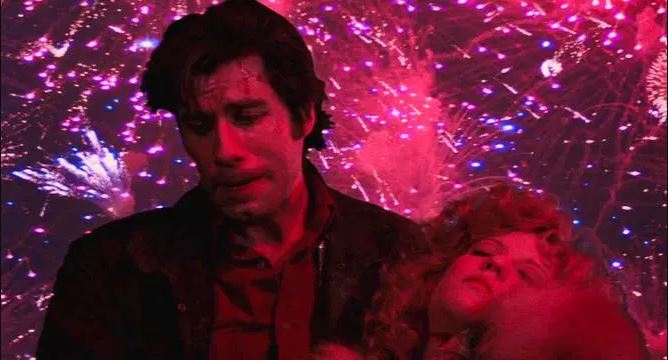
I’d Love To Turn You On At The Movies #232 - Blow Out (1981, dir. Brian De Palma)


Back in 1981, director Brian De Palma followed up his hit thriller Dressed To Kill with something darker and grimmer, gave John Travolta his best on screen role ever (that's right, ever), took a none-too-unbelievable look at American politics, and created his finest film. That film is 1981’s Blow Out, and despite critical acclaim at the time of its release, it was a box office failure, probably in large part due to the film’s bleak outlook - and probably also, as Nancy Allen suggests in the bonus materials contained in the Criterion release of the film, that an intellectual, personal, and political work was released and expected to compete in summer blockbuster season, rather than in the fall, when “critics’ films” tend to come out. But time has been kind to the film, and it's shown itself to be among the smartest and best-made of the run of 1970s political thrillers. It might help that it actually came after the end of the 70s, with Watergate and its aftermath in the rear-view mirror, rather than being released in the thick of it when everything was still unfolding; the kind of behind-the-scenes machinations that power Blow Out no longer seemed like far-fetched paranoia.
The film starts out as a cheesy horror flick, quickly revealed to be a screening of Co-Ed Frenzy, a low-budget slasher film-within-the-film for which cop-turned-soundman Jack Terry (John Travolta) needs to record new sound effects (and which provides a running joke that turns gut-wrenching in the film’s final moments). Out at night recording, he hears (and records) a blow out and sees a car careen off a bridge and plunge underwater. Diving in to save the woman inside, Sally (Nancy Allen), he becomes embroiled in a plot to derail the upcoming presidential election, but due to the constant movement of the shadowy antagonist Burke (John Lithgow) he finds it difficult to convince others that a conspiracy may be afoot.
The film is De Palma's finest - the place where his thematic ideas about voyeurism and watching (and here, listening) and systemic violence perpetrated against women mesh with his virtuoso filmmaking in a dazzling array of traveling Steadicam work, split screen, slo-mo, 360 degree pans, and other effects that all heighten and work in service of the story being told, rather than merely drawing attention to themselves. And beyond his famous camerawork, the sound design of the film is marvelous - as befits a movie about a soundman - with the visuals we see and the sounds that accompany them often providing an ironic complement or counterpoint. Even in the seemingly innocuous opening credits sequence where Jack is cataloging his stock effects - gunshots, glass breaking, a body falling to the ground, and so forth - these are played over a split screen montage of a TV broadcast of an event for a presidential hopeful whose car is, unbeknownst to him, about to end up at the bottom of a river, and the entire sequence conveys a lot more than the names of the crew. And later in the film, the disparity between TV news reportage and events we've seen firsthand always provides a chuckle.
And as fine as Travolta is in the film, he's matched scene for scene by Nancy Allen, who as Sally attempts to control her own destiny only to be swept away by forces beyond her control, and those of Travolta’s attempts to protect her. And it would be a disservice to not tip the hat to De Palma regular John Lithgow, whose chameleon-like bow as the villainous Burke keeps the film's seemingly implausible menace feeling very real indeed, or to another De Palma fave Dennis Franz, perfectly sleazy as photographer Manny Karp.
If the film were merely a clever thriller, it would be enough to recommend it, but it's more than that, refracting recent political history - Watergate and Chappaquiddick particularly - through De Palma's ideas to arrive at a fully integrated - dare I say it? - work of art. The film looks at sordid post-Watergate closed-door dealings, with the subsequent mistrust of government coloring the cynical proceedings in a film that endlessly looks outward to the modern political landscape and reflects it darkly back on itself. One wonders what sort of grim thriller could be made out of the raw material of today’s political events.
- Patrick Brown

Monday, October 14, 2019

I'd Love to Turn You On #242 - The Cure - Disintegration (1989)

            You’ve almost certainly heard of the Cure. And you’ve almost certainly heard at least one song off their 1989 album Disintegration. It’s hardly obscure; after all, we’re talking about the album that brought us “Lovesong.” But there’s nothing quite like listening to the whole thing all the way through for the first time. It’s brooding. It’s melancholy. It’s like watching a thunderstorm happen in reverse. This album is quintessential for the Cure; it combines the darker, moodier feeling of early albums like Faith and Pornography with the accessibility of albums like Kiss Me, Kiss Me, Kiss Me. There’s a reason this album is a classic, which still earns acclaim thirty years after its release. If you’re gonna get into the Cure, this is the album to start with.
            Disintegration was written at a rather turbulent time for the Cure. During its production, the band’s keyboardist and one of its founding members, Lol Tolhurst, left the band and was replaced by touring keyboardist Roger O’Donnell. Robert Smith, the band’s frontman, was suffering from depression and turned to psychedelic drugs to cope. His introspection about turning 30, and about the legacy of the band, also influenced the album; they’d begun writing poppy tunes to avoid being pigeonholed as simply a Goth band, but Smith now wanted to get back to their roots. This resulted in an album which kept some pop elements, but returned to a darker sound.
            To start with, there’s the opening track, “Plainsong.” It starts out quiet, with gently ringing bells, and then explodes rather suddenly into an atmospheric, warm, shimmery intro that hits like the first burst of sunlight through the clouds at the end of a storm. Then comes the guitar, dripping with melody. By the time the vocals hit, you’re fully immersed. Their echoes complement the atmosphere of the song perfectly, and Smith’s voice blends in, rather than being sung over the rest of it.
            After “Plainsong” is “Pictures of You.” Like much of the album, the keys, the shimmers, and guitar sounds from “Plainsong” carry over to this track, but Smith’s vocals take on more of a leading role. Then comes “Closedown,” which continues the feeling, but brings in more of Simon Gallup’s bass and Boris Williams’ drums. By this point you can tell the album has been building up to something, but you’re not sure what.
            And then there’s “Lovesong.” It’s an achingly sweet declaration of love, written as a wedding present to Smith’s wife (and high school sweetheart), Mary Poole. With its heart-melting lyrics and yearning melody, it’s easy to see why this song is so well-loved by fans and casual listeners alike. I can’t hear it without wanting to sing along; it’s beautiful. It starts out softer and subtler than previous tracks on the album, with a catchy bass line and quiet keys. Then come the vocals and the iconic guitar and keyboard riffs, adding a new energy to the album and giving it new depth. This song is where Disintegration goes from good to great.
            "Lovesong" is followed up by “Last Dance,” a heart-shattering track that brings back the shimmery atmosphere from earlier in the album, but makes it colder and sadder. The tender nostalgia in the lyrics is matched by Simon Gallup’s melodic bass and the reverb-heavy guitar that seems to drift down like snow over the listener. There’s a subtle desperation conveyed that sticks with you long after the song ends.
            And then there’s “Lullaby,” easily one of the top three tracks on Disintegration. It’s a bit of a departure from the earlier sound of the album, but it’s a perfect fit. The frantic, paranoid vocals are whispered rather than sung, fitting perfectly with the eerie lyrics, which describe being eaten by a spider man in a nightmare. It’s isolation, it’s terror, it’s helplessness, and it’s so strangely pretty you can’t help but listen again.
            Next comes “Fascination Street.” The reverb-laden guitars are back, echoing in a kind of organized chaos over the bass that draws you in. It’s a while before the vocals come in, which gives the listener a chance to get used to the building tension. But when the vocals hit, the tension only continues to build, which keeps the listener engaged and yearning for more.
This leads into the angst-ridden “Prayers for Rain,” a dark, gloomy track, with bleak imagery in its lyrics and simple but captivating guitar. Of all the tracks on Disintegration, this one is the closest to the deliciously nihilistic, desolate sound on earlier albums like Pornography. It’s one of my favorite tracks on the album. The way it takes the warm elements of earlier tracks on the album and darkens them keeps me coming back to this track over and over again.
“The Same Deep Water As You” starts out with the sound of thunder and rain, which sets the pleasant but melancholy tone for the whole song. It’s not as dark as “Prayers for Rain.” Instead it’s a warm and mellow type of yearning, in striking opposition to the next song on the album, “Disintegration,” like the calm before a storm. It has a way of washing over the listener, bringing back the shimmering atmosphere that characterizes so much of this masterpiece of an album.
The title track, “Disintegration,” is much more fast-paced. It has a frantic, desperate feel to it, which persists until the last chord. It’s about selfishness, deception, and endings, and you can’t help being pulled into the narrative by Robert Smith’s deeply emotional vocals. The album has felt like it was building up to something, and with this track, it finally comes to a head.
After this is “Homesick,” for which Lol Tulhurst provided the basis before he left the band. It’s full of dramatic, aching sadness. Like most of the Cure’s work, it’s melody-driven. Disintegration feels like a breakup album, and this feels like the aftermath to the ending “Disintegration” represents.
Finally, the album ends with “Untitled.” It has a happier, warmer tone, in contrast to “Disintegration” and “Homesick.” This provides some closure, and ensures the listener doesn’t leave feeling too broken down. It’s still sad, but it’s less intense, and the lyrics echo back to the perception of unreality expressed in “Pictures of You.”
The Cure were one of the biggest bands of their era, transcending genre and crafting a legacy that will endure for generations. Disintegration is an album that captures all their best elements, and it’s the album that changed me from a casual listener to a fan. It’s melancholy and it can be dark, but it’s intensely beautiful. Is there really any better album for when you’re feeling down?
- Madden Ott

Monday, August 5, 2019

I'd Love to Turn You On #237 - R.E.M. - Reckoning (1984)


Very few bands have been as persistent and present in my life as R.E.M. have been. Just as my mother smothered me with “Love Me Do” in the car on the way back from my first ski lessons, we would come home to find my dad grilling steaks as Lifes Rich Pageant blared from the Luxman. In my youth, the esoteric cover art and political overtness of albums like Document and Green always felt way over my head, like I wasn’t supposed to know about or listen to it – but it was the 90’s and, thanks to “Losing My Religion,” they were inescapable. The group’s cultish second album, 1984’s Reckoning, was the first album of theirs I bought for myself, and it kick-started my own Rapid-Eyed love affair. Written and recorded immediately after the release of their classic debut, Murmur, the record bears moments of a young band fully actualizing their democratic and unified vision.
The band’s signature urgency is immediately evident as drummer Bill Berry hits rapid fire on his snare to usher in the album’s haunting opener, “Harborcoat.” Like many of the best early R.E.M. songs, “Harborcoat” has an anthemic energy, yet it remains abstract and surreal – almost pagan-like in its search for musical divinity and as primitive as the watercolor snake that adorns the album’s sleeve. As with many of the record’s upbeat numbers, Berry’s agile drumming, the fierce jangle of guitarist Peter Buck, and the angular pulsing of bassist Mike Mills drive and decorate the track. As an opaque and sepia-toned portrait of the horrors of war (and loosely based on The Diary Of Anne Frank), the song serves as an entry point into the beautiful brain and inimitable voice of singer Michael Stipe (with a full head of curly hair, no less!)
While some of his performances retain the same mumbling mysteriousness as Murmur, Stipe has clearly begun to write and sing more directly on Reckoning. This can be noted through the album’s reoccurring themes of deep loss, the Deep South, and water; qualities which are prominent on the record’s first single, “So. Central Rain (I’m Sorry),” an autobiographical story where “these rivers of suggestion” force Stipe to end his triad with an otherwise heterosexual couple. He also tackles bereavement on the slow and stunningly sad “Camera,” which takes place at the funeral of another girlfriend who died in a car accident. On the fast and fierce “Pretty Persuasion,” Stipe seems to comment vaguely on capitalism in the verse before uttering one of his most visceral and suggestive choruses: “He’s got a pretty persuasion/She’s got a pretty persuasion/God damn, pure confusion.
Sonically, Reckoning has a more organic quality compared to its predecessor, yet it also contains some tactful and subtle experimentation. At the suggestion of producers Mitch Easter and Don Dixon, much of the album was recorded binaurally in order to faithfully capture the band’s live sound, allowing each band member to be heard clearly in an accurate stereo image. The brash drone of harmonica in the interlude of “Harborcoat” is the perfect counterpoint to Buck’s brisk guitar arpeggios. “Letter Never Sent” is perhaps the most danceable track on the album, as Berry’s four-on-the-floor drumming accents Stipe’s mumblings of catacombs and homesickness. Most interestingly, on the gorgeous “Time After Time (Annelise),” the band dips its feet into sixties-esque raga-rock and utilizes congas and bongos to give the song an exotic and earthy feel. The Americana-tinged “(Don’t Go Back To) Rockville,” written by Mike Mills as a plea to his girlfriend not to leave town, is one of the most straightforward entries in the band’s early catalog, with a playfulness that is accented by the southern twang in Stipe’s singing and Buck’s serendipitous piano. 
Serving as a key entry point into early alternative music, as opposed to the sleek sounds of new wave or the bubblegum excess of Madonna, Reckoning captures a band that had no idea what they were getting themselves into – no idea that they would eventually sign the largest record contract in history. It’s simply the sound of four college kids from Athens: three who were just as enamored with Wire’s arty post-punk as they were with the classic chime of the Byrds’ Rickenbackers - plus a uniquely enigmatic singer, equal parts Jack Kerouac and Patti Smith, who wrote cryptically of history, heartbreak, sexuality, enlightenment, and death. It’s a trailblazing sound that’s had a distinct influence, inspiring everyone from Kurt Cobain to Thom Yorke to Bradford Cox to create arresting guitar music that was muscular and robust, yet seeped in critical thought and emotional depth.
        Ethan Griggs

Monday, February 18, 2019

I'd Love to Turn You On #225 - James Blood Ulmer - Free Lancing


           James “Blood” Ulmer is a guitarist filed in our jazz section, but don’t hold that against him. One quick listen to the distortion-laden soloing in “Night Lover” starting right around 3:25 and running into the tumult he’s creating just under a minute later tells you he’s as beholden to electric blues and rock guitar as to the clean, single-note picked lines that the phrase “jazz guitar” usually calls to mind. Or you could start at the very beginning (a very good place to start) with the lead cut “Timeless” and in less than a minute you’ll know that though Blood Ulmer may know and respect Wes, Django, and Grant, he’s got no use for their gentility and clean tones. Hendrix and Delta Blues are his sonic touchstones and the loose-knit harmonic freedom of his former bandleader Ornette Coleman his conceptual one, and his career - a varied mix that lands him in our jazz section because of the Ornette connection but could just as easily find him solidly placed in the blues section - is a remarkable one that continues unabated to this day.
            Free Lancing is his third released album, and one that found him signed to Columbia Records, who worked with him for three (very good) albums before cutting him loose, when the mid-1980s ushered in a different kind of jazz than Ulmer was making. Which is what, exactly? I often see this called "free funk" or "jazz-rock" or something hyphenated that suggests that its mixture of jazz, funk, R&B, blues, and rock is as hard for folks to put a finger on and define as Ulmer's polyglot guitar playing itself.
After growing up in South Carolina, Ulmer bounced around a bit before finding his way to New York City in 1971. There he played with several notable ensembles before connecting with Ornette Coleman, who Ulmer credits with helping him define the direction of his music. His debut album Tales of Captain Black (which features Ornette) set the template for his earlier recordings - catchy themes and knotty soloing, a dash of sonic chaos, mostly quick tempos - though it occupies a decidedly jazzier realm than this one. The follow-up, Are You Glad to Be in America?, with its pointedly race-conscious title track, folded more blues and R&B into the mix, though the horn section of David Murray, Olu Dara, and Oliver Lake simultaneously touched on jazz and soul, with solos and charts that hit different styles as needed. These (and his playing on Arthur Blythe's superb album Lenox Avenue Breakdown and its follow-up) brought him to the attention of Columbia Records, where he took advantage of their excellent recording facilities to make his best-sounding and most rocking record yet.
            The album kicks off with "Timeless" featuring its basic trio: Amin Ali on electric bass and G. Calvin Weston on drums, providing the galloping rhythm with Ulmer’s sharp, inquisitive soloing leading the charge, then running non-stop throughout. Sometimes his playing is delivered in a fast run of notes, or a short cutting burst that stops on a dime; sometimes he's floating more serenely over the rhythm before taking an abrupt turn back into the maelstrom. And sometimes the whole group becomes untethered, relishing in noise for its own sake before snapping back into the gallop on command. But then the sound and fury of the lead cut changes abruptly into the funky soul of "Pleasure Control" where Ulmer's vocals get as raw as his guitar sometimes, though they're not as omnipresent as his constant guitar. This track sounds like an errant outtake from some funk group’s recording sessions where they revved up the tempos, let the guitar cut loose, and brought in the female backing singers (and second guitarist Ronnie Drayton, who's along on all three vocal tracks) just for fun before getting back to the business of making slow burns. But it sounds great. And it's followed by the aforementioned "Night Lover," another burning trio instrumental that even finds a snatch of melody from Ulmer’s “Tales of Captain Black” sneaking into his soloing. We get another vocal funk cut in "Where Did All the Girls Come From," which sports the mellowest rhythm yet, then the original side-ender of "High Time" which pulls the horn section from the previous album for a funky instrumental track.
            The second half progresses similarly - trio plus horns on the fast funky opener "Hijack," another vocal cut in "Stand Up To Yourself," and the mellowest cut the basic trio put on the album, "Happy Time," which ends the record on a fade that insinuates they could keep on going all night if you asked them. But in between those, there are a couple more standouts of note. On the record's title track, Ulmer cuts loose with the wildest guitar playing of the record, in what sounds like slide work (but I don't think it is). And "Rush Hour," another funky, horn-accented track with a quick, staccato rhythm features an uncredited harmonica player and saxophonist David Murray taking a burning solo - or perhaps duet is more appropriate, seeing as he's entangled throughout his solo with Ulmer blurring the line between comping support and soloing on his own, a trick straight out of Ornette’s book.
            Hopefully this isn't your first encounter with Ulmer. And if it is, hopefully it's not your last. Throughout the 1980s, Ulmer continued to pump out great albums - Free Lancing is only the tip of the iceberg. Find the never-on-a-domestic CD Black Rock if you can (keep an eye on the used vinyl bins!), or the superb guitar/drums/violin trio Odyssey, which finds Ulmer exploring a country-ish vibe for much of the album. Or pretty much anything by his more exploratory jazz-centered groups Music Revelation Ensemble or Phalanx. Or one of his more straight-up blues albums, particularly those produced by Vernon Reid (and especially Memphis Blood: The Sun Sessions or No Escape from the Blues: The Electric Lady Sessions). Or maybe his most recent album Baby Talk, a live collaboration with European free jazz trio The Thing. Are you getting the idea that you more or less can't step wrong with Ulmer? Then my review did what it's supposed to. The catalog keeps appearing and disappearing from being in print, so take advantage of this one while it's still around, and then start exploring.
-         Patrick Brown

Thursday, November 15, 2018

I'd Love to Turn You On #218 - Mötley Crüe - Motley Crue (Elektra, 1994)


I grew up in the 1980s, the decade of excess, and many of my tastes (from music and films to food and clothing) were shaped during that decade. It’s no surprise then that, given its ubiquity on radio and MTV, that I developed a serious love for heavy metal and hard rock. I not only decided that I wanted to play music like this, I also wanted to live the hard-partying lifestyle that my musical heroes lived. That’s neither here nor there. And while many people grow out of the music they loved as a kid, “hair metal,” for lack of a better term, has never stopped meaning a lot to me. And no artist exemplified the hedonism of the ‘80s better than my favorite band at the time, Mötley Crüe.
Cut to the 1990s: a decidedly tough time for many formerly successful metal and hard rock bands. While some completely faded away, others tried rather misguidedly (looking at you, Metallica) to glom onto the rising trend of “grunge” and “alternative” music. Still others, like Winger and Cinderella, put out some of the best, most focused records of their career in the ‘90s and they sadly went almost completely unnoticed. The Crüe fell into this latter category with the release of their self-titled album in 1994. But first, a bit of history.
In 1991, The Crüe released their first official career retrospective, Decade of Decadence ’81-’91 and with it, three new songs. Of those three songs, the first single was called “Primal Scream” and it was possibly the heaviest and best written song they’d ever recorded up to that point. It was a good time to be a Crüe fan and, naturally, I was excited to see if they would continue in this direction for the next proper album. The band enlisted engineer Bob Rock, who had worked with The Crüe on the hugely successful 1989 album Dr. Feelgood and set to work on its follow up. During these sessions, the band had a rather public falling-out with frontman Vince Neil which resulted in his being fired from the band. Or he quit. Neither camp can exactly remember this rather large detail correctly - and who really gives a shit now? But this left the Crüe in the rather unenviable position of replacing the widely adored voice and face of the band for the past 12 years.
Enter John Corabi, vocalist for the fellow L.A. band The Scream, of whom bassist and chief Crüe songwriter Nikki Sixx was a huge fan. Corabi brought a fresh new element to the band with his gravelly, Rod Stewart-esque voice and his rhythm guitar capabilities. This was in stark contrast to Vince Neil’s high-pitched whine and limited musical ability. Lead guitarist Mick Mars said at the time that he appreciated being able to work with a second guitarist for a change as it allowed him more room to experiment with his riffs and solos rather than “having to focus on just keeping the rhythm.” Corabi also was a competent lyricist, bringing a few of his own songs to the sessions with lyrics tackling much darker and more thoughtful topics than those to which Sixx was accustomed. “Droppin’ Like Flies,” for example, deals with environmental issues of the day and “Uncle Jack” is a scathing track about Corabi’s own uncle, a convicted child molester. The material was such a drastic departure that they even dropped the trademark umlauts from their name for the first and last time ever.
Sonically, Motley Crue (or MC94 as some fans call it) is even bigger and grittier than Metallica’s “Black Album,” making it a career defining moment for Bob Rock as well. Tommy Lee’s drumming on this album is better and heavier than it’s ever been, with pummeling beats and interesting, complicated fills, particularly on the album’s lead single “Hooligan’s Holiday.” The album still boasts the rock swagger that the Crüe are known for, like in the glam rocker “Poison Apples,” but for the most part it’s almost completely unrecognizable as a Crüe product. Songs like “Smoke the Sky” or “Hammered” would be at home on a Bay Area thrash or speed metal album, and Mars ventures into Jimmy Page territory with his lead riff on the killer “Welcome to the Numb,” my personal favorite track on the album.
           The album sold about as well as could be expected. Fans and critics alike were not ready to embrace such a drastic change from the band’s sound and, in particular, Corabi himself. That goes for myself too, by the way. I had nothing against Corabi personally. I even owned the Scream album. But I was very pro-Vince at the time and refused to buy MC94 for the longest time (even though I did secretly think “Hooligan’s Holiday” was a killer song when I first saw the video on MTV). Although the record did make it to number seven on the Billboard charts, the sales rapidly declined to the point that the ensuing world tour had to be re-booked from large arena venues to small clubs and theaters. Eventually, the tour was cancelled altogether. A far cry from the band’s ‘80s heyday.
J. Eagle - a 9-year old Crue fan
            Ultimately, MC94 is the only album that the band would make with John Corabi, as he was fired shortly after its release to allow Vince Neil to return to the fold. On the one hand, as a fan of the band’s classic material, this made me happy. On the other hand, the eventual “reunion album” that they put out in 1997, Generation Swine, is without a doubt the biggest piece of shit they’ve ever released, so it was a bittersweet reunion to say the least. In retrospect, I wish I would have given the album more of a chance but now I’m taking this opportunity to turn others onto this incredibly underappreciated gem.

                                                                              -         Jonathan Eagle

Monday, May 5, 2014

I'd Love to Turn You On #105 - Prince – Around the World in a Day

The massive success of Purple Rain made Prince a superstar.  He was in as rare an air as there is, with only Michael Jackson on the same plane commercially and no one in his class creatively.  Yet Prince was a restless musical genius, bursting with new ideas he just had to get out.  He was not about to coast on the success of Purple Rain, releasing single after single to keep the hit machine rolling.  A new album was about to be unleashed on the public while Purple Rain was still topping the charts.  However, this new album was to be a completely different animal.  Many artists have attempted to follow a smash commercial hit with something more experimental and challenging but no one who ever done it was as big as Prince was in 1985 and no album was as different from its predecessor as Around the World in a Day.

The album isn't talked about much these days, but at the time the public's appetite for new Prince music was such that even this left field excursion would get several tracks played on the radio and sell a whole bunch too.   The press dubbed it Prince's psychedelic album and compared it to Sgt. Pepper.  It certainly does have plenty of psych flourishes and Prince was almost certainly aware of the Paisley Underground scene going on in Los Angeles (more on that later).  But what the album shares most with the Beatles' classic is the attempt to sneak underground and experimental elements into the pop mainstream.  The mass public of the sixties was ready to accept the Beatles' experiments because they loved the Beatles.  They felt the same way about Prince in the eighties and while Around the World in a Day hasn't become a lasting classic like Sgt.
Pepper, the mere fact that it was successful and kept Prince in the spotlight is testament to Prince's talent, charisma, and popularity.

The album kicks off with the title song and immediately challenges its pop audience with eastern textures and percussion.  Slightly more familiar ground comes with the infectious melody of "Paisley Park."  Here, Prince taps into the mid-60s pop-psych vibe that L.A.’s Paisley Underground bands like The Three O'Clock and The Dream Syndicate were also hitting.  The song is important enough that he named his studio and record label after it.  Another psych-pop masterpiece is "Raspberry Beret," the album's biggest hit, with a trippy video to go with it.  It's also the most joyous song on an album that can get a little dark at times.  "Tambourine" ends side one with a bit of stone cold funk, a reminder that gettin' the dance floor movin' is still a top priority.  Side two (yes I'm still thinking in vinyl terms, though the CD is what we're selling here) opens with a blistering critique of "America," a particularly bold statement right in the middle of the Reagan 80s.  No less relevant, yet cloaked in another infectious melody, is "Pop Life," a critical look at modern stardom and the state of the world.  If any tune on the album deserves to be considered an all-time Prince classic, this is it.

Around the World in a Day stands as his greatest creative achievement.  At the height of his success he followed his muse and we all reaped the rewards.
For the last two songs, Prince turns to his two favorite subjects, God and sex.  While these twin obsessions are often painted as a contradiction, Prince knows full well that religious devotion always contains a strong sensual element and erotic revelry often becomes quite spiritual.  "The Ladder" has a strong gospel vibe with a spoken parable even, yet it builds to a fervent climax just as strong as any bedroom jam.  "Temptation" is the album's epic closing track and starts off with pulsing funk jam and the erotic lyrics Prince has always been known for.  Then, a little over the halfway point, the bottom drops out.  We've suddenly entered a morality play where Prince struggles with his urges and desires in the face of a judgmental higher power.  A brave and challenging album ends with its bravest moment yet.  Prince would continue to challenge the public's notion of pop, soul, rock and funk throughout his career, but
            - Adam Reshotko