Showing posts with label Frank Zappa. Show all posts

Tuesday, June 30, 2020

Zappa


Iconoclast, auteur, philosopher, social commentator, genius. My relationship with Frank Zappa began, like it did for many, in 1969 with the release of Hot Rats. The cover of that landmark LP so captures the late 60’s mindset: beautiful, a little scary and just plain weird. Musically, it was a heady thrill ride of heavy guitar, big ideas and jazzy chops. It seemed miles ahead of most stuff on the radio. 1971’s Fillmore East-June 1971 was my next stop. Juvenile, hilarious, rude-it defined underground to me. It was the musical equivalent of an R. Crumb comic book. In ’73 and ’74 Zappa struck gold with Overnight Sensation and Apostrophe, which were loaded with FM hits that, again perfectly captured the gestalt of the era. You can see, at the time I was sort of drawn to those Zappa albums that rose to the commercial surface and actually got radio play. I was also lucky enough to see him in concert several times and was both blown away and mystified by these dense, instrument heavy bands slogging through labyrinthine compositions at breakneck speed.  Later, I started to recognize the artistic diamond mine that the Frank Zappa catalog was. It has been one of my greatest pleasures over the last 20 years to try to wrap my arms fully around the depth and breadth of this incredible artist’s output.

C.U. Events Center 1981
I have found every period of Zappa’s output to reward repeated listening. Few artists had as grand a vision that they held on to for an entire career and actualized to the level of Frank Zappa did. He had fearless determination in the face of stupid and corrupt labels, a largely indifferent public, money woes and a never-ending stream of amazing, but undependable musicians. The sheer number of world-class players who passed through his various bands is staggering. The best of the best appeared on his records and on stage. As for Zappa himself, his energy as a composer, arranger, performer, producer and promoter of his own (and others’) output is almost hard to believe. It seems, from his pre-teen years onward, Zappa never took a break - not until his untimely death from prostate cancer in 1993.
I enjoy it all, but the first 10 years (66-76) of his career represent the apex of his artistic growth. He did not stop innovating for a second in that period. The span of musical ideas from Freak Out (1966) to Grand Wazoo (1972) to Roxy And Elsewhere (1974) is hard to take in. From psychedelic parody, to orchestral rock ensembles to a science fiction soul review, Zappa seemed to be the master of all he surveyed. Starting with 1976’s Zoot Allures something seemed to change with Zappa. His musical ideas remain lofty, but his lyrical thrust took on a slightly darker tone. Always prone to social criticism, his observations accurately reflect the spirit of the post-Watergate, coke-fueled disco era. It ain’t pretty! But then, sometime in the mid-80’s when I had my first record store, I got a bootleg copy of Zappa’s unreleased masterpiece from the 70’s Lather which was a sprawling, confounding, multi-genre box set. I was completely inextricably driven to dive back in to the Zappa universe. 
Toward the end of his life, he shifted his focus back to the strictly musical with releases like Yellow Shark and Jazz From Hell. Since his death, his widow Gail and now his son Ahmet have taken his legacy into the future by releasing as many albums of his music as he did in his own lifetime. It has been a thrilling ride studying Frank Zappa’s life work. The dense, percussion-heavy, guitar lead ensemble sounds of his compositions are immediately recognizable and never fail to thrill me and bring a smile to my face. - Paul Epstein


Monday, July 11, 2016

I'd Love to Turn You On #158 - Frank Zappa - Lumpy Gravy


Prepare yourself for one of the most complicated and interesting stories in the history of modern popular music. In 1967 an executive from Capitol Records, impressed with The Mothers Of Invention’s first two albums, approached head Mother Frank Zappa about writing and conducting a piece of classical music for Capitol Records. The thinking was, if Zappa just conducted but didn’t play on the album he would not be in violation of his existing recording contract with MGM Records. This was extremely optimistic thinking on their part and presaged a professional life marked by almost constant lawsuits for Zappa. But I get ahead of myself. Back in 1967, Zappa took the challenge and wrote a complicated, dense, brilliant, highly listenable piece of modern classical music. He entered Capitol’s studios with a group of over 30 of the finest jazz, classical and session musicians in Los Angeles (dubbed “Abnuceals Emuukha Electric Symphony Orchestra and Chorus”) and in short order recorded and edited the music down to about 23 minutes of masterpiece. It is arguably the greatest piece ever realized by Zappa. It has so many signature Zappa moments - wild leaps of time ala John Cage, matterhorns of percussion inspired by his hero Edgard Varese, jazzy interludes, soundtrack music for films never made - all edited together by Zappa with his patented disregard for standard measures of song. It simply flows from idea to idea, yet it all feels wonderfully a part of some cosmic whole. Capitol released it as a promotional 4-track tape to reviewers and industry insiders and were, of course, immediately slapped with a cease and desist order from MGM Records. (Now you want to talk about a REAL collectible - something the top Zappa collectors in the world drool over -that original 4-track tape is RARE! Hardly any of them exist and it is next to impossible to find.) So, to avoid a protracted lawsuit, Zappa takes the tapes of his masterwork and begins to reassemble them into a new and different work. He edits in some surf music, sound effects and the results of an experiment he conducted whereby various friends (including Eric Clapton and Tim Buckley) stuck their heads inside a piano and spoke closely enough to the strings that they vibrated in a strange and sympathetic way. Different parts of these weird, echo-y recordings would appear on Zappa records until the end of his life, but this is their first and most effective use. The new, re-edited version is released to the world in 1968 as Lumpy Gravy, while the original classical piece becomes the subject of rumor and desire.

Throughout the years, I have found Lumpy Gravy to be the most interesting and confounding of all Zappa releases. Re-edited, his original work is wildly audacious. He changed it from a classical piece with avant-garde leanings to an avant-garde suite that nods to classical. It is no less great. Lumpy Gravy stands alongside the most ambitious albums produced in the 1960’s in any genre. As it was released in 1968, it makes perfect sense in the arc of Zappa’s career; it is a completely weird exercise in musique concrète, but with a hip edge brought by the spoken word parts, which link the album clearly to the first Mothers Of Invention releases. In a strange way, the legal restraint of the original classical piece may have saved Zappa’s career (such as it was). If that primal composition had been given wide release, it might have been too confusing for the record buying public and in some way changed the course Zappa took moving forward. He was forced to recast the music in a more Mothers-friendly fashion, and thus, though the album is still incredibly weird, it fits in with other releases of the day.

Why have I expended so much ink discussing a project you can’t hear? Well, thanks to the Zappa family archives you can hear it now. With the release of Lumpy Money we can now hear that original piece, alongside hours of other Lumpy Gravy and We’re Only In It For The Money related materials from the sessions. In addition to that groundbreaking original classical piece, there are hard to find mixes of both albums, interviews, live cuts, extra session work - it is literally a treasure trove of prime-era Zappa goods. I believe this release is the most essential purchase in the entire Zappa catalog (now numbering 103 official releases). It shows Zappa as a completely self-possessed artist at only 26. He had vaulting ambition and, unbelievably, the talent and drive to see his vision come to reality (twice in this case). If however, this seems like too much to digest at once, I suggest just picking up Lumpy Gravy. It has much of what makes Frank Zappa great in the rock and roll universe, but it also shows very clearly why he simultaneously ruled other universes at the same time. He was, quite simply a one-of-a-kind musical genius with no peer, and Lumpy Gravy is ample proof.

-         Paul Epstein

Monday, July 30, 2012

I'd Love to Turn You On #62 - Frank Zappa - Chunga's Revenge


The catalog of Frank Zappa is vast and often difficult to navigate.  There's a tremendous amount of brilliance but also some flat out crap.  The majority of the catalog is getting re-released starting with 12 titles covering the earliest, and many would say best, period of Zappa's career.  Much has been written about all-time classics like Freak Out!, We're Only In It For the Money, and Hot Rats, so I'd like to talk about a personal favorite that doesn't usually get a lot of attention, 1970's Chunga's Revenge.  This is an album that, among other things, introduced the world to Flo and Eddie.  Of course, many were already familiar with Howard Kaylan and Mark Volman through their work with The Turtles.  But the former pop stars were looking to move on to other realms and approached Zappa himself about working together.  The timing was right as Zappa had recently broken up the original Mothers of Invention and was in the process of forming a new group.  Kaylan and Volman were soon re-christened as The Phlorecent Leach (later shortened to Flo) and Eddie.  Their superb harmony vocals turned out to be a perfect fit for the always doo-wop obsessed Zappa.  The rest of the new band included jazz keyboard player George Duke, who would be an important part of Zappa's bands throughout the 70s, and big time rock drummer Aynsley Dunbar.  This diverse combo produced appropriately diverse music that happened to come together for a great album.
You can pretty much break down the ten tacks on Chunga's Revenge into five vocals and five instrumentals.  Flo and Eddie show off their peerless vocals in a variety of ways.  First off, they provide soulful counterpoint to Zappa's growly lead vocals on the bluesy "Road Ladies."  They give a pop edge to the proto-metallic stomp of "Tell Me You Love Me."  Album closer "Sharleena" is a gorgeous soul/doo-wop number that shows a sensitive side rarely seen in Zappa's works.  This became a frequent staple of live shows throughout the years and there are many great versions available but none that can match Flo and Eddie's vocal work.  The remaining vocal tracks showcase the humor and satire that have always been present in Zappa's works and would become a major feature of the Flo and Eddie era. "Would You Go All the Way" lampoons small town jingoism (with George Duke providing a patriotic trombone line) while "Rudy Wants To Buy Yez a Drink" takes on sleazy music biz types.  The humor would eventually dissolve into juvenile smuttiness that would come to dominate albums like Fillmore East, June, 1971 and other live recordings from the era, but here they keep things relatively restrained and the songs are great to begin with.
The instrumental tracks are even more diverse.  Opener "Transylvania Boogie" and the title track are raw slices of guitar rock with Zappa ripping some pretty impressive solos.  The short jazz-styled composition "Twenty Small Cigars" is reminiscent of Hot Rats tracks like "Little Umbrellas" and "It Must Be a Camel." "The Clap" is a minute and a half of innovative percussion.  Zappa started out as a drummer and has always come up with challenging works for his talented percussionists to play.  The longest track on the album is "The Nancy and Mary Music," nearly ten minutes of live improvisation that goes to a number of different places and even includes some wild scat vocals from Duke.
Perhaps the most impressive thing about Chunga's Revenge is how all these different elements come together into a whole.  The album has a great flow to it.  It's a bit of a transitional album but the fact that it stands so well on its own is a testament to the overflowing creativity that Zappa was exhibiting at the time.  It's always been a favorite of mine and could well be a fine introduction if you've never listened to any Zappa before.  Just one question that's always been on my mind about that iconic photo on the cover; is he screaming or yawning?
- Adam Reshotko

Friday, March 5, 2010

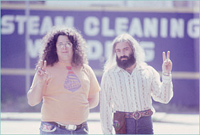
Check this picture out.

Dave Alvin, formerly of the Blasters posted this on his facebook page. It just kills me. Here you have one of the great American roots bands, The Blasters, as young men, running in to one of the great eccentric legends of modern music on the streets of Southern California. I love that Zappa is carrying some high-end shopping bags and looks every bit the sophisticated Cary Grant to The Blasters dead-end kids. I love both these artists, but with completely different sides of my brain. The Blasters represent the last gasp of American Rock and Roll that had some genuine connection to the grimy black and white streets of the mid-20th century. They were kids out of Downey, California who idolized the past generations of blues, country and r&b singers and forged their own version of real Americana. The band’s authentic arrangements were bookended by brothers Phil and Dave Alvin, who like all great brother acts could barely stand the sight of each other. Older brother Phil was a charismatic frontman gifted with one of the great rock voices. Dave is a lightning guitar ace who is capable of writing the great American short-story in 2 minutes 30. His songs like “American Music,” “One Red Rose,” “Fools Paradise” or “Just Another Sunday” are just perfect little rock gems - as good as anything that came out in the 70’s or 80’s. 
Zappa on the other hand, is a figure of such towering achievement, and so unlike any other popular artist that it is hard to talk about him in the context of rock and roll. He is an artist completely of his time, but detached from the constraints of popular fashion to such a degree that he was always leading his own parade. He was fearless in the face of style, political correctness and his fans expectations. This would lead one to believe that he was a real condescending jerk. Interestingly, almost every musician who dealt with him, on album or socially, has said quite the opposite. He had the reputation of being a generous and friendly person who did not feel he was above his peers in any way. He was friendly with many bands, and showed a keen understanding of all types of music. Dave Alvin remembers him as being friendly, and the picture shows him as a sweet, middle-aged eccentric - just the way you’d hope to remember him. I have nothing remarkable to say about this picture - just that it is two of my favorite musicians that have nothing to do with each other, together and looking, well - like humans.

Wanna check em out? Unfortunately some of the Blasters best stuff is out of print - but their first, primal recordings (American Music) are still available and very worth getting. Zappa is like exploring the universe. Where to start? How about a very obvious and a very un-obvious place? His early album Hot Rats remains one of the most musically satisfying rock albums ever. The fact that it was made in 1969 and still sounds futuristic still speaks volumes. Speaking of volumes of futuristic music, give Boulez Conducts Zappa a try if you want to hear Zappa’s music in a completely different context (classical), but still hear all the trademark wit and compositional abilities. No matter what he tackled, Frank Zappa accomplished it with a completely original, musical take that was uniquely his own.
Paul Epstein