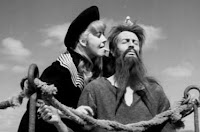
 Luis Buñuel’s relationship with his home country
of Spain was a complicated one – it informed his work and was the root of his
uniquely skewed outlook on the world, but he spent most of his life out of the
country and made only three films there during his career. Born in the mountain
town of Calanda in 1900, he moved with his family to the rural region of Aragon
and its capital city Zaragoza when he was young. Attending college in Madrid,
he became close friends with Salvador Dalí and Federico García Lorca, moving to
France after graduation and joining the Surrealist group with Dalí, ultimately
creating one of his most famous works with him, the short film Un Chien
Andalou. He made another film (the scandalous L’Age d’Or) with Dalí before their friendship dissolved, then
returned to Spain during the turbulent years leading up to the Spanish Civil
War. Back in Spain, Buñuel made another short film, Las Hurdes, a semi-documentary about a poverty-stricken mountainous
region of Spain near the Portuguese border. The film provoked an uproar with
Spanish officials for its brutal depiction of extreme poverty and was banned in
Spain from 1933 to 1936, and then again by Francisco Franco’s regime when he
came to power after the Civil War. Buñuel left the country when Civil War broke
out, departing for the U.S. and then Mexico, where he settled for the rest of
his life.
Luis Buñuel’s relationship with his home country
of Spain was a complicated one – it informed his work and was the root of his
uniquely skewed outlook on the world, but he spent most of his life out of the
country and made only three films there during his career. Born in the mountain
town of Calanda in 1900, he moved with his family to the rural region of Aragon
and its capital city Zaragoza when he was young. Attending college in Madrid,
he became close friends with Salvador Dalí and Federico García Lorca, moving to
France after graduation and joining the Surrealist group with Dalí, ultimately
creating one of his most famous works with him, the short film Un Chien
Andalou. He made another film (the scandalous L’Age d’Or) with Dalí before their friendship dissolved, then
returned to Spain during the turbulent years leading up to the Spanish Civil
War. Back in Spain, Buñuel made another short film, Las Hurdes, a semi-documentary about a poverty-stricken mountainous
region of Spain near the Portuguese border. The film provoked an uproar with
Spanish officials for its brutal depiction of extreme poverty and was banned in
Spain from 1933 to 1936, and then again by Francisco Franco’s regime when he
came to power after the Civil War. Buñuel left the country when Civil War broke
out, departing for the U.S. and then Mexico, where he settled for the rest of
his life. After
re-establishing himself as a filmmaker of note in Mexico, Buñuel was invited by
Spain to make a film funded by the government, presumably looking to call
Spain’s filmmaking son back to his homeland. But the film he made, Viridiana (based on a novel by the
author Benito Pérez Galdós), contained scenes considered blasphemous and
subversive – despite the script being approved by censors. Franco attempted to
have the film destroyed and recalled from its entry at the Cannes film
festival, but Buñuel had already left the country with his film. It was
immediately banned in Spain, but won the Palme d’Or at Cannes and pushed Buñuel
to the upper ranks of international directors, allowing him to make some of his
seminal works throughout the 60s.
After
re-establishing himself as a filmmaker of note in Mexico, Buñuel was invited by
Spain to make a film funded by the government, presumably looking to call
Spain’s filmmaking son back to his homeland. But the film he made, Viridiana (based on a novel by the
author Benito Pérez Galdós), contained scenes considered blasphemous and
subversive – despite the script being approved by censors. Franco attempted to
have the film destroyed and recalled from its entry at the Cannes film
festival, but Buñuel had already left the country with his film. It was
immediately banned in Spain, but won the Palme d’Or at Cannes and pushed Buñuel
to the upper ranks of international directors, allowing him to make some of his
seminal works throughout the 60s. With these two films
created in Spain behind him, it was with some trepidation that the Spanish
government again allowed Buñuel to make a third film, Tristana. Could another film made with Franco still in power, be
trusted in the hands of Buñuel, the man who said of his surrealist days “Scandal
was a potent agent of revelation, capable of exposing such social crimes as the
exploitation of one man by another, colonialist imperialism, religious tyranny
- in sum, all the secret and odious underpinnings of a system that had to be
destroyed.”? Apparently so!
With these two films
created in Spain behind him, it was with some trepidation that the Spanish
government again allowed Buñuel to make a third film, Tristana. Could another film made with Franco still in power, be
trusted in the hands of Buñuel, the man who said of his surrealist days “Scandal
was a potent agent of revelation, capable of exposing such social crimes as the
exploitation of one man by another, colonialist imperialism, religious tyranny
- in sum, all the secret and odious underpinnings of a system that had to be
destroyed.”? Apparently so! Tristana, unlike Buñuel’s previous Spanish films, did not provoke outrage
or scandal and was not banned in Spain (or elsewhere, to my knowledge) – but it
could have been. Buñuel turned again to a Galdós novel as source material and
found a work that’s very similar in tone to Viridiana
– a young woman is taken in by an older gentleman after her parents’ passing
and he takes more than a paternal interest in her. The gentleman, Don Lope, is
again played by Fernando Rey (in his second of four collaborations with Buñuel),
and the young woman Tristana is played by Catherine Deneuve, who Buñuel had
worked with to great effect in Belle de
Jour. Their relationship in the film is complex and always shifting –
Tristana starts the film naïve and meek, a religious woman still mourning the
loss of her family, while Don Lope is an atheistic, anti-capitalistic, mostly
leftist gentleman who nevertheless retains some archaic notions of honor (very
similar to Buñuel himself, in fact). Though Tristana is repulsed by his
advances she still remains under his care and as the film continues she begins
to assert her independence and a shift begins. Tristana slowly adopts the
hardened exterior of her guardian while his strong postures fade away and he
becomes the helpless ward. Ironically, it’s Don Lope’s regular talk of the
assertion of freedom and individual will that powers Tristana’s bids for
autonomy that leave him an emotional wreck.
Tristana, unlike Buñuel’s previous Spanish films, did not provoke outrage
or scandal and was not banned in Spain (or elsewhere, to my knowledge) – but it
could have been. Buñuel turned again to a Galdós novel as source material and
found a work that’s very similar in tone to Viridiana
– a young woman is taken in by an older gentleman after her parents’ passing
and he takes more than a paternal interest in her. The gentleman, Don Lope, is
again played by Fernando Rey (in his second of four collaborations with Buñuel),
and the young woman Tristana is played by Catherine Deneuve, who Buñuel had
worked with to great effect in Belle de
Jour. Their relationship in the film is complex and always shifting –
Tristana starts the film naïve and meek, a religious woman still mourning the
loss of her family, while Don Lope is an atheistic, anti-capitalistic, mostly
leftist gentleman who nevertheless retains some archaic notions of honor (very
similar to Buñuel himself, in fact). Though Tristana is repulsed by his
advances she still remains under his care and as the film continues she begins
to assert her independence and a shift begins. Tristana slowly adopts the
hardened exterior of her guardian while his strong postures fade away and he
becomes the helpless ward. Ironically, it’s Don Lope’s regular talk of the
assertion of freedom and individual will that powers Tristana’s bids for
autonomy that leave him an emotional wreck.
 In Buñuel’s universe,
boundaries placed on desire are always under attack, and Tristana’s undermining of family values and portrait of marriage as
a corrupt institution should, in theory, have been upsetting to Spanish
censors. But for some reason, perhaps because rising stars Catherine Deneuve
and Franco Nero were cast to help the film toward international success and
nobody involved on the Spanish side of the production wanted to seem to be as
out of touch as Don Lope, the film passed without friction. It’s as mysterious,
challenging, sardonic, and strangely beautiful as any film in Buñuel’s catalog.
In Buñuel’s universe,
boundaries placed on desire are always under attack, and Tristana’s undermining of family values and portrait of marriage as
a corrupt institution should, in theory, have been upsetting to Spanish
censors. But for some reason, perhaps because rising stars Catherine Deneuve
and Franco Nero were cast to help the film toward international success and
nobody involved on the Spanish side of the production wanted to seem to be as
out of touch as Don Lope, the film passed without friction. It’s as mysterious,
challenging, sardonic, and strangely beautiful as any film in Buñuel’s catalog.
-
Patrick Brown