Tuesday, March 26, 2013

I'd Love to Turn You On #78 - Freddie Hubbard – Red Clay


To be honest, I’m not a huge fan of Freddie Hubbard. He’s a remarkable player and a brilliant technician, but I have found his records to be a little lacking somehow. But since he played on seminal recordings by a couple of my all-time faves in the jazz world – Ornette Coleman’s Free Jazz and John Coltrane’s Ascension – I persevered with him. Didn’t help his case with me that he dismissed these albums I love as chaotic free-for-alls rather than the remarkable statements they were and are. But all it took was a listen to this album, recorded in January 1970, to turn me around on the man – or at least on this record.
First off, he’s surrounded by a great band and that helps things considerably. With two of Miles Davis’ 1960’s sidemen, Herbie Hancock (on electric piano and organ) and Ron Carter (on bass), backing him Hubbard’s music is sure to groove in the fashion of such then-contemporary late 60’s Miles albums as Miles in the Sky and Filles de Kilimanjaro, all lengthy workouts that take their time to develop, sometimes playing it laid back and cool, and other times erupting with the fire Hubbard commands so readily. Nice too that drummer Lenny White, another Davis alum fresh off the previous summer’s sessions for the not-yet released Bitches Brew album, knows his way around the kinds of contemporary rhythms that Hubbard was seeking here. And also quite nice that Hubbard has tapped the chameleonic tenor sax player Joe Henderson as his front line partner, given that Henderson could fit into any surroundings from straight ahead swing to some pretty “out” jazz.
But it’s all grounded by Hubbard himself, who has found a framework for his spectacular playing and also written a batch of tunes that showcase him and his band to their best. The first half is very much in the mode of the times, ushering in the 1970’s with the title cut’s relaxed grooving and “Delphia,” a waltz-time ballad that develops into something more mid-tempo. In both of these cuts, it’s odd how Herbie Hancock’s keyboards quietly comp their way into the forefront of the sound, even while the trumpet and saxophone takes flights of fancy over the top of the rhythms. The second half is something more akin to the hard bop that Hubbard is most associated with. “Suite Sioux” is a fast burner, with tangly solos from both Hubbard and the consummate sideman Henderson over the lightning rhythms, while “The Intrepid Fox” uses tricky changes to close out the regular album. Closing out this CD though are a pair of bonus cuts – a fine alternate take of the title cut and a take on John Lennon’s “Cold Turkey” that starts out as raw and off-puttingly harrowing as the original, but settles into a groove more in the style of the rest of the record.
I’ll admit it – Hubbard rubbed me the wrong way at first and I still cringe at his comments about great records he participated in that he failed to see the worth of, but if I had gone in blind on the evidence of this record, it never would’ve taken me as long to learn what his strengths are.
- Patrick Brown

Friday, March 22, 2013

I'd Love to Make You Laugh #2 - Tim Northern - Second CD


Welcome readers to the second installment in the I'd Love To Make You Laugh portion of Spork where I will be reviewing the latest and greatest in the stand-up comedy world. This time I will be reviewing National club comedian Tim Northern's second CD, Second CD.

Mr. Northern is a veteran in the college and comedy club scene nationally as well as a finalist on CBS's Star Search. He can be heard here locally on Denver's own Comedy 103.1, where he has not only been highlighted as a performer but as host as well.

Word play! That is the best way for me to describe Tim Northern's laid-back yet cerebral approach to stand-up comedy. Ben Stein has been quoted as saying, "I love the fact that he assumes his audience has a brain." Mr. Northern himself has stated, "That's what I'm striving for. I provide two-thirds of the joke, and you provide the other third. It's like 'do-it-yourself comedy." This sort of delivery is brave as it relies on a crowd that is open to and ready to do some thinking.

The first thing I must point out about Tim Northern's Second CD is the track listing. Do not pay attention to it as an indicator of things to come as they are a joke in themselves and not reflective of the material. Tim starts this set by giving the crowd a personal standing ovation for being out on a Sunday night. He then begins to spin his magic at word play by indicating to the crowd that he has just learned to read and while finding it frustrating, ultimately jokes: "reading is cool man."

Things really get going with Tim's now famous take on Dr. Seuss's Green Eggs and Ham and his musings on his newly found reading skills. Observations on his midget brother the professional Foosball player, rat poison intolerance, his deep love of pancakes and going on the "patch" keep the listener’s mind working in tune with the audience.

Not only does Tim excel at word play but his impressions of Richard Pryor, Samuel L. Jackson, Dyslexic Italians and others are truly a fresh take on the "impression" genre. Tim's love life, issues with the Internet and working in the community are next up as his famous "Tits for Tats for Tots" campaign is born.

Bits such as Dyslexic Bob, getting healthy in the non-smoky mountains with bi-polar bears, doing a show at the zoo and a Dead Poet's Society Basketball game help round out a truly thought provoking 16 track CD. As a bonus let the last track run and hear some hilarious out takes with Tim Northern and son!

Recorded in front of an all-ages crowd in Louisville, Kentucky by Joe "Dookie" Dutkiewicz and edited by Ross Duncliffe. Tim Northern's Second CD is a must own for fans of clean cerebral comedy with great word play. Available NOW in comedy section at Twist & Shout!

            - Jeff Albright

I'd Love to Turn You On At the Movies #61 - Scarface (1932, dir. Howard Hawks)


There once was a gangster film about an ambitious crime lord and his ruthless and violent rise to power trafficking in illegal substances. He was played with consummate skill by a chameleonic actor of the first rank, who many claimed exaggerated the character’s non-American accent to the point of parody. The film was exceedingly violent, simultaneously drawing the ire of censorship boards and thrilling audiences seeking an exciting glimpse into the network of the criminal underworld. That film is Scarface. But I’m not talking about the one with Al Pacino, I’m talking about the 1932 one with Paul Muni from which director Brian DePalma and screenwriter Oliver Stone took big chunks in their 1983 homage to director Howard Hawks and screenwriter Ben Hecht’s groundbreaking film based loosely on the life of Al Capone (here named Tony Carmonte). And where DePalma’s film goes gleefully over the top in tandem with its lead character, Hawks’ film is more restrained, more tightly controlled, and probably more thrilling in the long run – but no less violent in intent.
            Producer Howard Hughes, who had previously bankrolled the drama Hell’s Angels, featuring the most spectacular plane stunts ever put on film to that date (or perhaps ever), wanted to comment on what he felt was a scourge undermining the country during Prohibition – organized crime – and decided to make the most realistic and upsetting portrait of it ever put on film, pushing the violence of great earlier crime films like Little Caesar, The Public Enemy, and Underworld to the limit. And push it he did. Along with director Howard Hawks, they fashioned a crime epic that in no way undercut the viciousness, the brutality of the crime world of the day, even though their alleged glamorizing of the criminal lifestyle tied them up in battles with censors that delayed the release of the film for nearly a year. With Hawks’ fast, mobile camera crafting a lithe and exciting film, it’s hard not to get swept up in the rush of the rise of Tony Carmonte, though it’s hard to see how the censors could find anything likeable or relatable about his sociopathic violence or his inevitable fall that would be perceived as glamorous. In response to the censors, Hawks and Hughes fashioned a scene in which concerned citizens get to vent to police and government officials their frustration with the mob violence on the streets (including a representative Italian immigrant decrying how these gangsters are giving his people a bad name) and it’s the film’s only bum note, a moralizing aside that only interrupts the flow of an otherwise terrific film.
            Paul Muni as Carmonte is remarkable, playing him in the early scenes as uneducated but not dumb, with an arrogant insouciance that comes from his unshakeable belief that he’s going straight to the top. And he’s right, of course. And in the grand Hawks tradition, there’s a brilliant ensemble cast at work around him: Osgood Perkins (Anthony Perkins’ father) as mob leader Johnny Lovo, Carmonte’s boss; Karen Morley as gangster’s moll Poppy, moving to whoever has the power and money to keep her in style; Ann Dvorak as Tony’s sister Cesca, playing her as flirty but experienced teenager with whom Tony is creepily obsessed; and Boris Karloff as North Side rival boss Gaffney. Hawks’ taut direction (plus the hand of Hughes wanting to push the film further) is also at play in the action scenes, with an terrific nighttime high-speed car chase later in the film that finds Tony shooting it out with some would-be assassins only one of many such scenes. And he’s also got his hand in one of the film’s signatures – a visual “X” motif marking any impending scene of violence, as when a scene recreating the St. Valentine’s Day Massacre moves from seven X’s in the rafters down to a wall showing the shadows of the Massacre taking place. The film moves breathlessly through Carmonte’s rise and fall, and Muni treads a perfect line of nailing this anti-hero whose life is fascinating and repellent in equal measure. It’s a trick that DePalma, Pacino, and Stone would recreate with success in 1983, pushing the envelope for the time of what could be put on screen, but it was done first, and equally well if not better, way back in 1932.
            - Patrick Brown

Friday, March 15, 2013

Fables of the Reconstruction: Herbcraft & MV+EE

Herbcraft has come a long way in the two years since their first album, Herbcraft Discovers the Bitter Water of Agartha. That one was a gem of the DIY psychedelic scene, a terrific concept – a portrait of an imaginary long-lost concept album from 1973. Matt LaJoie, the man behind Herbcraft, recorded it in his bedroom in Portland, Maine, over the course of a snowy weekend. It was one of those great ideas that catches your attention and is executed well enough to hold it through both sides. It’s a little thin and wobbly, sure, but that’s part of its charm. But now, with Herbcraft’s third LP release, The Astral Body Electric, LaJoie is playing with a full band, and the sound is nicely muscled and steady. It’s a major advance down the path to psychedelic godliness. The most dramatic improvement comes with the addition of drums, which were the most conspicuous missing element from the first two records. There’s also some flute and organ mixed in to give it a 60s-Renaissance-Star Trek sort of feel here and there, and LaJoie’s voice is fuller, more confident. Together these new dimensions make this album feel less like a third album and more like a stunning debut. But it’s still Herbcraft. If you liked space-jet-around-the-roomiverse guitar sound of Ashram to the Stars you should be happy here because this record’s full of weird noises. And if you like the plodding-spiritual-pilgrim plot of Agartha, you’ll be happy, too. The Astral Body Electric has that same Third-World-in-outer-space sound. It pulses with a vaguely Middle-Eastern rhythm that would’ve worked well as the soundtrack for just about any scene in The Last Temptation of Christ, and these beats pull the record together like a loop of thread. The structure’s not constricting - quite the opposite - it allows Herbcraft to roam further than they ever have.
            The other thing about The Astral Body Electric is that it was mastered by Matt Valentine of MV+EE, and this factors hugely into its quantum-leap-ness. Valentine uses a technique called Spectrasound. It makes the music sound like it’s coming from all corners of the room. For instance, if you’ve listened to MV+EE’s 2012 release Space Homestead on a good system, you probably noticed that there’s this part where it sounds like someone’s knocking on the walls, outside, across from where your speakers are. That’s Spectrasound. It finds spaces beyond the reaches of the balance knob and fills them with sound. At one point while listening to the new Herbcraft album I got up to see if the washing machine was going berserk way off in the laundry room, but it was just something I was hearing in the music and the Spectrasound. I have no idea how Spectrasound works. I’ve emailed Valentine and asked him. I told him about the wall knocking. All he said was, “it's in the walls alright, heh heh...crackin' me up.” And on the internet the only explanation I could find was this: “MV’s production technique places tones dancing all around the stereo sound field.” Whatever it is, it’s psych-O-delic. Especially on MV+EE’s newest, Fuzzweed. It’s like being in the wormhole Jodi Foster went through at the end of Contact, except it’s low-gravity and slower than the speed of light, and it’ll only get you as far as the sofa and the fridge and back, 40 minutes, round-trip. It’s all good, but side two is the masterpiece: a 20-minute three-parter that starts off as a ghostly folk tune and then just goes off, everywhere, into spiral galaxies ruled by Iron Man and inner spaces made of slide-guitar plumes, and so on, and so forth. I’ve tried to describe it at another site and failed. The best I can do here is to say that if you’ve listened to the last track on Space Homestead, “Porchlight>Leaves,” and dug it, you’ll dig this. That track, the trippiest highlight of that record, is but a road report from the journey to this freaktastic Spectrasymphony.

Monday, March 11, 2013

I'd Love to Turn You On #77 - War - The World Is A Ghetto


About 6 and half minutes into the 13-minute, instrumental, cinematic epic “City, Country, City” the listener can’t help but be carried away to a place of all-enveloping grooviness. No matter when you were born, it is immediately “back in the day” and it is summer and everything is cool. War has that effect on a lot of people, and their finest album The World Is A Ghetto is the quickest passport I can think of to that wonderful land of used to be. Considering that The World Is A Ghetto was the best selling album of 1973 according to Billboard, War has been relegated to a historical handful of hip bands that fit into a skin-tight bag of soul/rock that has been, if not forgotten, at least given short shrift by the historical/journalistic arbiters of history. War, like Sly and The Family Stone or Parliament/Funkadelic, sat as comfortably in the record collections of the 1970’s next to The Beatles or Joni Mitchell or The Allman Brothers as they did rubbing shoulders with Miles Davis, Stevie Wonder and James Brown. In other words, War had that rare and uncanny ability to cross the lines of race, class and culture. I don’t mean like in that publicly acceptable Michael Jackson, mass appeal way, I mean that on a Friday night in the mid-70’s no matter what part of town you were from, War was likely to make an appearance on the turntable at some point. Additionally, War became a particular favorite of the Latin culture. At a time when few Latin stars crossed paths with the charts, War spoke directly to that experience, offering up such La Raza classics as “The Cisco Kid,” which opens The World Is A Ghetto, and “Low Rider” a few years later.
Musically, The World Is A Ghetto ticks all the boxes of a conscious, stoner soul classic. Everyone in the band shares in the percussion and vocal duties, which ensures that this band has rhythm and harmony down. In fact, one of the distinctive features of War was that they had a uniquely communal identity (fortunate because they changed personnel over the years) that allowed them to forge a recognizable sound, but not be tied to the relative skills of any one front man. If there was a visual front man it was the only white guy in the group, harmonica player Lee Oskar. With his huge afro, gunslinger’s belt of harmonicas and perpetual motion in time to the music he was great to watch as the band chugged out their sophisticated blend of rock, jazz and soul. The songs are layered with fat bass lines, heavy organ, beds of congas, bongos, timbales, wah-wah guitars and Oskar’s harmonica lines weaving on top of it all with sax player Charlie Miller’s jazzy explorations. This is truly an “all the way through” album. There isn’t a weak cut. From the classic funk riff of “The Cisco Kid” to the ultimate down-tempo stoned contemplation “Four Cornered Room,” to the epic 10 minute title cut, to the album-closing upbeat jam “Beetles In The Bog,” each song is a template for what a band can accomplish with some great songs, some seasoned players and time enough to jam in the studio. You remember; the good old days.
            - Paul Epstein

Monday, March 4, 2013

I'd Love to Turn You On At the Movies #60 - Flirting With Disaster (1996, dir. David O. Russell)


Before all the hubbub surrounding his latest Oscar-nominated release in theatres, The Silver Linings Playbook, director David O. Russell has built a career coming from hearty film stock with a slant towards the risk-taking side of being born from independent film. Despite the high caliber releases of such films as Three Kings (which paired him with George Clooney and Mark Wahlberg), The Fighter (Wahlberg again along with Christian Bale) Russell has always circumvented the typical rules of making a Hollywood picture and been one of the few lucky filmmakers (like Soderbergh alongside him) with a Sundance Film Festival teething ring to cut his own swath in mainstream cinema.
But of his earliest films, which includes the hilarious and shocking mother/son incest romp Spanking The Monkey, it is perhaps his second feature, Flirting With Disaster, that packs the most punch as a film merely for the fact that it is one of the greatest filmed comedies of the independent film movement (and probably the best comedy ever released by the Weinstein lorded Miramax films).
In the film we meet Mel and Nancy Coplin (played by a winning Ben Stiller and Patricia Arquette) a young couple with a newborn son that Mel, trying to subvert an identity crisis due to being adopted and having no connection to his roots, refuses to name until he can find his birth parents and find some clarity. Enter Tina Kalb (an always appreciated Tea Leoni) who comes on from the adoption agency as his caseworker (and part-time psychology student) who suggests she join the Coplins in a road trip to meet his birth parents. This plan not only unsettles Nancy, who notices an obvious connection with the pair, but Mel’s adopted parents as well (an amazing Mary Tyler Moore and George Segal) who feel slighted by Mel’s quest and can’t understand how they raised such an ungrateful child. Despite everyone’s pleading Mel & co. set off looking for the Schlichting clan that, due to Tina’s own newbiness, is not as easy as expected. Along the way an old flame of Nancy’s pops up, now a gay cop and seeking to adopt a child with his cop/partner (both played by the great Josh Brolin and Richard Jenkins), which irks Mel beyond words. When everything comes to a boil the time comes to meet the Schlichtings and let’s just say that the true best of this great film is saved for last.
For only being his second feature film Russell pulls some masterful moves with Flirting With Disaster. He hands his shining and hilarious writing to a game cast (there literally isn’t one bad apple in the whole bunch) and builds a house of cards that, the bigger and taller it gets, we can’t wait to watch collapse and fall apart.
After Flirting Russell took a semi-serious turn in his Three Kings but returned to broad comedy with the delicious and perplexing I Heart Huckabees that will remind you of Flirting’s bananas nature and comic genius even more. If there is one thing to find sentimental in Flirting it is simply that we seem to be long past a time when even a risk-taker like Miramax would produce a film as nuanced and honest as this one. The Silver Linings Playbook is great but continues to note a seriousness that often takes away from its fun, but Flirting has nothing to prove except that it exists to make you laugh and remember that a quality comedy isn’t that easy to come by anymore.

Keith Garcia
Programming Manager
Denver Film Society

Tuesday, February 26, 2013

I'd Love to Turn You On #76 - Bob Dylan - Oh Mercy


1989.  A year a lot of people were waiting for, waiting for the 80s to end.  Yes, there were some good times in that decade, but many of us who lived through it couldn't wait for it to be over, envisioning a much more radical 1990s and the count up to a millennium that would either bring the end of the world or a new era of growth and change.  For me, 1989 was also the year I graduated high school.  I was more than ready to throw off the bonds of conformity and complacency and move on to life's next chapter.  High school had more than a few good times of its own and I had my own personal coping devices to get me through.  A major one, probably the biggest, was the music of Bob Dylan.  I got into Dylan just as high school was starting.  There weren't too many other Dylan fans at my school and when we found each other it was like exchanging a secret handshake.  Of course, why would 80s high schoolers care about Dylan in the first place?  He was a relic from a previous era who wasn't making much relevant music at the time.  The Dylan albums I obsessed over were some 20 years old, primarily Bringing It All Back Home and Highway 61 Revisited.  Like most artists of his time, Dylan spent most of the 80s making slick, over-produced albums of sub-par material.  And as the contemporary bands I listened to, like The Replacements and Husker Du, were primarily ignored by the public at large, it seemed like I was living in an era where rock and roll was dead or dying.  We needed to desperately slam the door on the 80s and try again in the 90s.  Lo and behold, Bob Dylan played a major part in slamming that door shut.  He released an album called Oh Mercy.
Now Dylan's previous 80s albums weren't all terrible.  1983's Infidels is pretty good and there are some gems to be found digging through Down in the Groove.  What he really needed were sympathetic collaborators to help get him out of his rut.  Bono from U2 suggested he hook up with producer Daniel Lanois.  Dylan wisely took this advice and headed down to New Orleans to meet up with Lanois and a group of local musicians.  It didn't hurt that he brought with him his best batch of songs since the mid-70s.  The album opens with the fiery thrust of "Political World."  This angry, impassioned number flew in the face of the entire previous decade.  Everything is not alright, the captain is asleep at the switch, and the ship is going down.  The bluesy "Everything Is Broken" echoes this message.  But all is not doom and gloom.  The hopeful and uplifting "Ring Them Bells" follows.  It has a spiritual feel to it and is much more effective than the dogmatic Christian records he released in the late 70s and early 80s.  It's been covered many times and old flame Joan Baez even used it as the title song for her 1995 album.
Another oft-covered song is the far more darker "The Man in the Long Black Coat."  Corruption and temptation are given the form of a demonic creature who nonetheless converts all he encounters into following his wicked ways.  But is it this mysterious stranger who is at fault, or those all too eager to follow?   Perhaps the album's most haunting track is "Most of the Time."  Dylan has been an expert at crafting infectious songs out of sexual politics since his classic mid-60s recordings.  Here he confronts the lies we tell ourselves when a relationship goes sour and the longing that never seems to go away.  It stands as one of the all time great Dylan songs of loss and regret.  Self-doubt seems to dominate the rest of the album from the sparse "What Good Am I?" to the quietly funky "What Was It You Wanted?"  The album closes with the poignant "Shooting Star" which assesses Dylan's perception of his own place in the world as a legend who may or may not have anything left to offer the world.
As it turns out, Dylan still had a lot to offer and still does to this day.  His comeback wasn't firmly cemented with Oh Mercy as his next few releases were another mixed bag.  But he reteamed with Lanois again in 1997 for Time Out of Mind, which may actually be an even better album, and hasn't looked back since.  He has been as relevant to modern times as he was in his 60s heyday.  High school kids even listen to him.  And they have the advantage of having current Dylan music to call their own, in addition to all the great material from the past 50 years.  There were several other cultural touchstones that came along in 1989 to help usher the decade out the door.  Neil Young had his own comeback album Freedom.  Faith No More and Nine Inch Nails released albums that would soon break through into the mainstream, heralding the alternative rock explosion of the early 90s.  Yes, real rock & roll was back in vogue.  No, the 90s weren't perfect and had plenty of problems of their own.  But for me, I was in college, had a group of friends I could really relate to (and are still friends to this day), and didn't get weird looks when I told people what music I listened to.  And that included saying that my all-time favorite artist is Bob Dylan.
            - Adam Reshotko

Monday, February 18, 2013

I'd Love to Turn You On At the Movies #59 -‘Round Midnight (1986, dir. Bertrand Tavernier)


I have always maintained that there are very few movies about music that actually get it right. For a variety of reasons, Hollywood needs to dumb down the artistic and human aspects of musicians the same way it does with cops, cowboys and young lovers. It all just comes across as phony. ‘Round Midnight on the other hand takes a far more prosaic, realistic and human turn, presenting the story of a jazz musician who is three-dimensional, fraught with weakness and utterly believable. In one of the greatest casting coups in film history, director Bertrand Tavernier cast real-life jazz giant Dexter Gordon as the pro/ant-agonist of his melancholy character study that perfectly captures the grey-hued realities of an artistic life reaching its natural denouement.
Dexter Gordon’s character, Dale Turner, is a composite of Bud Powell, Lester Young and Gordon himself. The movie takes place in 1959 Paris, the same year that Bud Powell and Lester Young lived and played there and when Gordon himself performed a famous session with Powell, observing first hand the decline of a once great player. This very intermingling of fact, fiction and insight is ultimately what makes ‘Round Midnight so successful. Dale Turner is living and playing in Paris to small, adoring audiences, but his life is a shambles: he is a hopeless alcoholic, he suffers from crippling depression, he is broke and alone in the world and as he proclaims “I’m tired of everything but the music.” This is much the same state both Young and Powell found themselves in during this time period. Bud Powell met and befriended a Frenchman named Francis Paudras who became his caretaker and savior in many ways. It is in this historical detail that the movie finds its central theme. The relationship that Dale Turner and Francis develop; slowly, carefully, poignantly growing from hero worship to co-dependence, to nurturance is drawn with such aching realism that it almost transcends the movie’s many other virtues. Francis saves Turner’s life, returns some sense of pride to the wounded warrior and in exchange Turner opens his heart and mind to Francis and his young daughter as they struggle to become some kind of fractured family unit. The stability of family and a temporary respite from drink allow Turner to play with renewed vitality, and it is in the music that ‘Round Midnight finds its other pillar of greatness. With a who’s who of 60’s and 70’s jazz greats led by music director Herbie Hancock, Freddie Hubbard, Ron Carter, Billy Higgins, John McLaughlin, and many other top-notch players give the movie absolute musical veracity. The band plays tight, perfect arrangements as Dexter carefully lays out his patented solos with unimaginable tone and restraint. The director gives the music enough time to seep into the fabric of the movie. It isn’t a movie with a soundtrack, it is a movie where the music is one of the stars.
As Turner comes back to life, he is inexorably drawn back to America. Francis takes him to New York City where temptation, corruption and more sadness await. They part, Francis returning to Paris to fix his own life and relationships, Dale Turner to sadly go down in flames much as Lester Young and Bud Powell did. The sad arc of the action never feels clichéd because it is all based on true life stories.
The real miracle of ‘Round Midnight is Dexter Gordon’s enchanting, heartbreaking, almost mystical performance as Dale Turner. He fills every frame with honesty and pathos that could only be born of hard experience. He doesn’t play it for cheap sentiment either; we see him as an incorrigible alcoholic, an uninvolved parent, and a drifter without home. But, at the same time we are shown a man of rare artistic temperament, deeply sensitive to his own muse and living for one thing; he states near the end of the movie, “I’m dying of everything…except music,” and it is clear that what he really means is he is living only for music.
Compared to other movies about legendary musicians, ‘Round Midnight succeeds as a complex, nuanced exploration of the artistic impulse and its double-edged sword: talent. Instead of wallowing in heroic cliché or romantic bullshit it attempts to look gritty reality square in the eye. ‘Round Midnight strikes true as an exploration of music, musicians and those who circle their orbit. It is an unforgettable look at a unique time and place in the history of jazz.
            - Paul Epstein

Friday, February 15, 2013

Tuesday, February 12, 2013

I'd Love to Turn You On #75 - Beastie Boys - Hello Nasty


            When Hello Nasty was released in 1999, I think it was the victim of heightened expectations. Most fans liked it OK, but adjudged it a major letdown after Check Your Head and Ill Communication. For me, it’s better than either of its immediate predecessors and time has shown that it pointed the direction the group would end up heading for the rest of their career. And more than that – where Check Your Head, to the delight of many fans, found the band putting their dusty old instruments back in their hands to jam with the inspired amateurism that’s the hallmark of punk rock, it also set them on the wrong-headed idea that they could do no wrong as that rambling album became noted as a landmark and a new direction. And it was a new direction, I suppose, but it just wasn’t as good as what’s they’d done before. Ill Communication was a refinement of the ideas there and in some ways a move to break away from Check Your Head, but it wasn’t until they enlisted turntablist DJ Mixmaster Mike and settled on a decidedly retro/electro sound for Hello Nasty that the group righted the drift of the last couple albums and put them back on par with the denser, subtler work they essayed with Paul’s Boutique.
            For a little enlightenment about the record, I would direct you past the songs that I hope you already understand and enjoy - "Intergalactic" (and its great video) and "Body Movin'" and "Three MC's and One DJ" - to two other, subtler tracks that absolutely kill - "Flowin' Prose" and the Lee 'Scratch' Perry feature "Dr. Lee, PhD" where the great dub artist fits right in the varied, catchy picture (and also, probably joking, calls them the Beastly Boys). Subtle is the key word for this album. Beyond “Intergalactic” (which marks the last time the Boys were in the Billboard top 30), this album doesn’t jump out at you with a “Fight For Your Right to Party,” a “Sabotage,” a “Hey Ladies.” It marks their move to a more mature sound and style, even while keeping a youthful freshness to the proceedings. “Flowin’ Prose” does just what the title promises while “Dr. Lee, PhD” jokes back and forth with Perry as peers, not students. Well, maybe T.A.’s in the Doctor’s master class, but still, it’s not a one-sided collaboration by any means. Maybe these two don't prove anything. Maybe the album's too long (though I can't find a cut I would want nixed). Maybe people just still wanted that stand up bass sound they had when they played at being a "live" band. Maybe I don't know what people want. But I do know one thing for sure - this album works for me from beginning to end. Throw it on, let the prose flows go, and you’re sure to get the spirit. And unlike both Check Your Head and Ill Communication before it, it doesn’t tail off at the end.
- Patrick Brown

Friday, February 8, 2013

I'd Love to Turn You On At the Movies #58 - Dillinger (1973, dir. John Milius)


I was working on a short movie when I was in film school and I needed the sound of gun shot, so I went to Video Station and rented Dillinger, the 70s version, directed by John Milius. I chose it because I remembered watching it in high school and being astounded by the endless shootout scenes. They were riotous cacophonies of nonstop gunfire – pistols, shotguns, machine guns. So understand that first: this is a violent film. In addition to being shot, people get beat up and run over by cars. But it’s a rather beautiful film, too, with carefully composed and atmospheric shots showing the Midwest as it might have looked in the Great Depression. And between the outbursts of riotous violence, there are scenes of almost hypnotic quiet and artful pacing. The influence of the great Italian cinema of the 60s, most notably Antonioni and Bertolucci, seems clear here, and Milius is in this 1973 movie no doubt trying to keep pace with the young American auteurs of the “New Hollywood” – Terrence Malick, Arthur Penn, John Schlesinger. And Francis Ford Coppola, with whom Milius would later collaborate on Apocalypse Now. I caught it on a late show when my parents were out of town and I had the whole house to myself, and I was absolutely mesmerized by it, which, considering that I had a powerful stereo and a dozen or so other cable channels vying for my attention says a lot, I think, about its aesthetic appeal.
Still, I can’t overstress that this is a violent and macho film that’s not even remotely politically correct – the women characters are beaten often and hard, and their only reaction, other than tears, is a sort of resigned gratitude, and in one scene the movie’s lone black character gets angry but is offered chicken and he calms down right away. Despite his work on Apocalypse Now, which would seem to suggest an artistic bent, Milius’s career milieu has stayed more or less in the realm of adventure, violence and manliness, and Dillinger fits right in. Dillinger, played brilliantly Warren Oates, is an anti-hero whose lack of classic handsomeness is compensated for with undiluted confidence and unlawful bravery. All his life he wanted to not only be a bank robber but to be the best one America had ever seen – a legend. He’s pursued by Melvin Pervis, the original FBI “G-Man,” played by Ben Johnson (whose performance calls to mind Hank Hill of King of the Hill, only a lot meaner). His sole aim is to shoot Dillinger himself in vengeance for the death of a friend and colleague in the legendary Kansas City Massacre, and to smoke a cigar over his dying body. Yet this is Milius’s big attempt at art cinema, and beyond the plot and the Hollywood shoot-em-up conventions there’s a kind of cinematic music going on in the images and editing and the texture and mood of the scenes. Though not consistently gorgeous throughout, the way other great films of the time were (Godfather, Godfather II, Badlands), it has moments, many of them, as well as some terrific montages of black-and-whites of those very hard times.
Also, like almost all movies from bygone days about bygone days, the film offers an interesting perspective on the changing times. Watching it recently, I couldn’t help but think about the current debate on gun laws, in no small part because of the many references in the film to the NRA – the New Deal one, the National Recovery Administration. It was the very real gun battles that this film is was based on that that lead to our country’s earliest gun control measures, the ban on machine guns from the general public. As I watched I wondered if the stories in this film are what today’s NRA have in mind they talk about the Second Amendment as a safeguard against a tyranny, if this is the kind of the world they want us to go back to (remember that it was a long succession of Republicans in the White House who lead us to the Great Depression). Maybe the violence between the feds and the freedom-loving bad guys that makes this film so exciting and loud, maybe that’s the kind of America Wayne LaPierre wants us to live in again.
- Joe Miller

Friday, February 1, 2013

I'd Love to Turn You On #74 - Stereolab - Emperor Tomato Ketchup


Stereolab is the band that defines the seemingly contradictory concept of retro-futurism.  Odd elements of the past collide with visions of the future with the dream of creating a better present.  Bob Moog guides the music, Karl Marx inspires the lyrics.  Krautrock meets sunshine pop as lyrics switch from English to French, though the dreamy vocals make it easy to forget any content behind the loveliness.  Stereolab had been doing their thing since the dawn of the 90s but it all came together with 1996's Emperor Tomato Ketchup.  Led by the musical and romantic partnership of Tim Gane and Laetitia Sadier, the band's lineup and sound was constantly expanding throughout the decade.  The guitar-based sound of their earliest recordings was now enhanced by vintage synths, vibes, percussion, strings and other odds and ends, all combined with catchy melodies and the incomparable vocals of Sadier and the late, great Mary Hansen.
The album kicks off with "Metronomic Underground" and there couldn't be a more appropriate way to start.  A simple, funky drumbeat backed by primitive electronic noises is soon joined by an infectious bassline.  More and more instruments join in as well as looping vocals as the jam grows for nearly eight minutes.  This is followed by the string-enhanced pop of "Cybele's Reverie," still one of the band's most popular songs.  Throughout the album, the band manages to move in different directions while maintaining a distinct sound of their own.  The sunshine pop of "Spark Plug" gives way to the motorik beat of "OLV 26."  "The Noise of Carpet" is a guitar-based rocker that was released as a single in the U.S.  It didn't burn up the charts here as it's not exactly the grunge-alternative sound that dominated radio at the time.  But looking back, it fits right in with the direction bands like Radiohead were heading.  The back half of the album is loaded with gems too, like the organ driven "Motoroller Scalatron" and the haunting closer "Anonymous Collective."
Stereolab continued to grow and evolve.  Albums such as Dots and Loops and Sound-Dust are also excellent.  Unfortunately, the group was dealt a serious blow when Mary Hansen was killed in a bicycle accident in 2002.  They continued to make good music but a key spark was definitely missing.  The band is now on an indefinite hiatus but has left a huge catalog of great music waiting to be discovered.  Emperor Tomato Ketchup is the best place to start, then move both forwards and backwards in time, as such non-linear movement is what Stereolab is all about.
            - Adam Reshotko

Friday, January 25, 2013

Fables of the Reconstruction: Low-Hanging Fruit, Pt. 3

More cheap thrills from the used vinyl bins…

Jesse Colin Young – Together
This is a no-frills early-70s downhome hippy-rock record that goes just right with a beer at the end of a hard day, or a bong hit at the start of an easy one. The opener is “Good Times,” a sweet reminiscence of the summers of love in San Fran, and the remaining ten songs range from blues to boogie-woogie to country to folk, a near-even mix of covers and originals, all tied together with Young’s smooth, mellow-my-mind voice. Seriously, his singing is right up there with the very best, whether it’s a tender love song, like the title track, or the relentlessly happy “Lovely Day,” or “Peace Song,” which is every bit as idealistic and hopeful and love-inspiring as “Get Together” was. I got this record for $2.99 at Twist and Shout and it plays with hardly a crackle. I listen to it often.

Emerson Lake and Palmer – Tarkus
Side one is a rock symphony called this:
Tarkus- Eruption
- Stones of Years
- Iconoclast
- Manticore
- Battlefield
- Aquatarkus
And, as the name suggests, it’s 20 minutes of prog awesomeness. Hard to describe without making weird noises with a high-pitched voice and a spastic tongue. Drum solos, bass solos, keyboard solos, all soloing at full speed at the same time, in perfect sync, and a climactic, soaring guitar solo near the end. Honestly, I’m kind of hinky on ELP because they were such good musicians and, judging from the film footage I’ve seen of them in concert, they were insufferably arrogant about it. And on some of their records they sound a little too safe for me. But not this one. It’s exactly the kind of balls-out pretentiousness I want when I reach for prog.

Tom Tom Club – Close to the Bone
Unexpectedly trippy. Like Remain in Light trippy, but happy, and way more danceable. There are lots of beats that weave in and out and bounce all across the stereo, super synthed-up with echoes and cosmic curviness. No kidding, these dance tracks are as atmospheric and complex as the Talking Heads at their early-80s best. This record stands as a solid companion to Speaking in Tongues, released the same year. I don’t remember this band being so good. When I was in my teens and always hunting for freaky shit, I thought Tom Tom Club was just better than average synth-dance-pop, and that wasn’t really my thing. But if I’d only known just how far out this record gets in a tight universe of butt-bumping boogie, I would’ve jumped in and boogied too, maybe even gotten laid. (“He’s the man with the four-way hips!”) This record isn’t better than average. It’s where this kind of music went when it died. 

Monday, January 21, 2013

Fables of the Reconstruction: Low-Hanging Fruit Pt. 2

When I got back into collecting vinyl, my first impulse was to buy back all the stuff I owned before I went digital. The classics. But once I’d collected most of those, I wanted more, more, more. I’m not rich, so this means buying cheap – stuff that’s in abundance in the used bins and in relatively low demand. (And some of which is not even available on CD.) I call this bounty low-hanging fruit. Last week I shared a few of my recent favorite finds. Here are some more:

Nilsson – Pussy Cats
If you believe the documentary Who Is Harry Nilsson?, the late great singer/songwriter peaked with Nilsson Schmilsson and then binged his way through a bunch of mediocre-to-bad albums to oblivion. His tenth album, Pussycats, is singled out as a particularly low moment: party buddy John Lennon pushed him past the edge and blew out his beautiful voice. Which is true, except it leaves out the fact that it’s flat-out gorgeous. I mean, come on. This is rock and roll. Destruction is an essential part of the aesthetic. And what else would you expect from Lennon (the man who took acid everyday for like a year or something as part of a conscious quest to destroy his ego, and who, by his own admission, succeeded) directing Nilsson (the man who’d ask friends out for a drink and they’d come home three days later without a clue of where they’d been or what they’d done). It’s a spectacular mess of an album, and so weird. Yes, his voice cracks. There’s only about three seconds of his unworldly high-pitched smoothness. And at times he actually sounds like Lennon on parts of Imagine and Plastic Ono Band. But he’s raw in the best rock and roll way – like Sam Cooke at the Harlem Club or Joe Strummer or Bruce or any other gravel throat who’s ever ripped the guts right out of your solar plexus. And he’s surrounded with Lennon’s fuzzed-out trippy pop arrangements. Mine cost twelve bucks, which is a little high for a low-fruit designation, but I’d have paid three more for it, even without the double gatefold full of mid-session snapshots of Nilsson and Lennon and everyone else who joined the party.

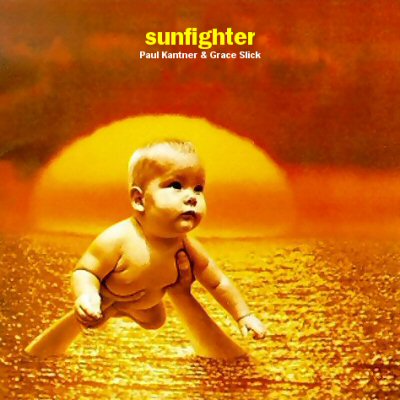
Grace Slick and Paul Kantner – Sunfighter
When I look at the cover of this album, I wonder what it was like being the daughter of a couple as freaky as Kantner and Slick. Baby China appears on the cover naked and chubby, held up toward the sun on the hands of her mom and dad, which are rising out of the sea. The gatefold opens to a photo collage of cosmic explosions, and the inner sleeve has a picture of Kantner and Slick side by side, both of them young kids -- him standing erect in his military uniform, her at a piano, sitting as straight as an Aryan, in her officer coat and tails. On the other side is a dystopian poem called “Pets.” It’s a very odd artifact in celebration of a newborn child, and it’s made stranger still by the fact that it was mass-produced and sold around the world. I had a huge crush on China when I was in high school and she was an MTV VJ, and now, 41 years later, I own a copy of her baby album that I got for $2.99 from Twist and Shout. It has heavy ring wear and the initials “JB” in the upper left hand corner. As for the music, it’s all eminently listenable, if not consistently memorable: solid, somewhat hard-driving, early 70s rock, with some acoustic strands woven in here and there, and lots of Kantner fantasy/sci-fi lyrics about wizards and lizards and the like. But the album has stellar high points. Side one breaks down halfway through into a wonderful wash of outer space freakiness. And side two features “China,” Slick’s ode to her daughter, which begins, “She’ll suck on anything you give her.” It’s just piano and swells of strings toward the end, and Slick’s voice is magnificent as she sings of her child and the world: “It all comes in, so fast, it all comes in.” Surely China has a fondness for that one.

Steve Hackett – Voyage of the Acolyte and Please Don’t Touch!
Records by ex-Genesis ax man Hackett abound in the used vinyl racks, and they really put the old “don’t judge a book by its cover” credo to the test, because almost all of them have hideously cheesy artwork. But some are full of great music, and are worth much more than their miniscule asking price. Odds are you can get a bunch for less than $20. Voyage of the Acolyte is generally agreed to be his best, and it’s certainly the most psychedelic. One good friend described it to me as “blobular.” Hackett’s main gift, other than his stratospheric guitar playing, is his ability to craft complex and epic arrangements, and Voyage takes your ears around the world forward and backward through time. So does his second solo effort, Please Don’t Touch!, the first to feature his mastery of a Roland GR-500 Guitar Synthesizer. The sounds shift from stuff that would be perfect for a sci-fi movie soundtrack, full of amplified drama and tension and weird sounds, to lovely strains of classical-inspired acoustic guitar, to late-70s guitar-god pop. The vocal tracks, few and far between, are a bit unexpected. They feature guest singers Richie Havens, Steve Walsh of Kansas and R&B siren Randy Crawford, a trio whose voices are so distinct that they would give the record a various-artists feel, were it not for the connective thread of Hackett’s considerable composition talents.

I'd Love to Turn You On At the Movies #57 - Julia (2008, dir Erick Zonca)


Julia is a movie about an alcoholic (and pretty much everyone around her) making a lot of bad decisions and then the fallout of those decisions leading to worse consequences. It’s something like a thriller, because it keeps a high level of tension throughout the film as it moves into a seedy criminal underworld, but it’s also a drama about this sad messed-up woman. And yet, in spite of its seriousness and intensity there are some darkly comic moments, usually delivered because you can see Julia’s alcoholic brain thinking hard, trying to find the quickest way out of a situation and usually deciding on a course of action that you already know is going to solve an immediate problem and yet create another, which of course she can never see. In Mexico, where about half the film takes place, it was known as Crimen Repentino, which translates as “Sudden Crime” and this may very well convey better a sense of what the film’s like, moving quickly from one bad situation to another, and then when we think there’s a respite, we’re quickly back in the thick of it based on yet more bad decisions Julia’s made: the way she flirts almost automatically when she senses it might give her some advantage, the way she lies compulsively to avoid taking the blame for any of her actions.
Then again, maybe the English title conveys the idea of the film best, because it is definitively centered on the tour de force performance by Tilda Swinton as Julia. She manages to draw you into Julia’s world, creating a thoroughly unlikable woman who you still manage to have sympathy for – a tricky act to pull. But that’s probably got something to do with the kid, too, but more about that in a second. The start of the chain of events of the film, which I can only tell a little bit of so as not to give anything key away, is that Julia has lost another job because of her drinking. Her friend, trying to help her get her life together, tells her that the only way she’ll get continued help from him is to attend AA meetings which she’s got no patience for. But knowing a good thing when she sees it and not wanting to cut off his support, she goes. There she meets a woman who we immediately sense is a little odd – and so does Julia – who asks Julia for help. You see, she’s Julia’s neighbor and has seen her before. She’s got a son named Tom whose evil grandfather, she explains, won’t let her see him. It would be simple, she explains to an eye-rolling, agitated and bored Julia, to simply kidnap Tom when he’s out on a picnic and zip off to her family home in Mexico where there’s tons of money and a perfect life just waiting for her – and for Julia too if she’s willing to help out. At first Julia says the same thing we do – “Are you nuts?” – but then she starts to see that maybe it could work, she could help out for a little bit and get a huge payoff for merely driving a car. And that’s as much as you can know before watching it because part of the major interest of the film is watching how Julia’s terrible judgment – but also her quick-witted thinking – keeps things moving.
 And once things start to roll, there’s no stopping it. Julia moves from one situation to the next, behaving badly and foolishly in a way that’s sometimes uncomfortable to watch, sometimes perversely funny as when she slurs to the kid she’s trying to kidnap “I can see you’re mad at me.” The movie could easily have been a generic road-movie comedy with an edge – there are a lot of films with a grouchy adult paired with an annoying kid where we come to like both of them by the end – but this is not that movie. It pulls inspiration from John Cassavetes’ 1980 film Gloria, where Gena Rowlands is a gangster’s former flame who ends up protecting a kid when the mob wipes out his family but misses him. For me, this film is even better than its inspiration, and that’s largely due to Swinton’s amazing performance which, again, puts you in a position of sympathy with a woman you probably shouldn’t be sympathizing with. She simply nails the mind and mannerisms of an alcoholic, constantly assessing the way to use her assets to turn any situation to her best immediate advantage, which proves to be what keeps her alive and moving in the film as things go from bad to worse.
- Patrick Brown

Tuesday, January 15, 2013

I'd Love to Turn You On #73 - Lou Reed – The Blue Mask


This is where Mr. Heroin grows up. There had been increasingly overt hints that he might go this way on his previous three albums, but here he’s fully engaged with opening up his adult side rather than merely flirting with the idea. Which is not to say that he’s given up the extremes of his youth. Or rather, he may have given them up – when the album was recorded he was clean and sober, had married and settled into a home in New Jersey – but he hadn’t forgotten those extremes. Maybe he wasn’t the reporter filling us in on the seedy underbelly of New York nightlife anymore, but his writing stemmed from that base even if he wasn’t sending his reports from the gutter. Predictably, fans of his early sex/drugs/rock & roll phase have had strong reactions against the album, connecting only with the music at its most brutal as in the harrowing title cut’s examination of a masochist that makes “Venus in Furs” seem like a naïvely decadent tale and in the illumination of a paranoid drug addict’s mindset in “Waves of Fear,” featuring a brilliantly splintery and abstract solo from co-guitarist Robert Quine. Some may also connect with the straightforward examination of the alcoholic of “Underneath the Bottle” or the disturbingly deadpan delivery of “The Gun,” recalling his unjudgmental tales of squalor from the early Velvet Underground days.
But the claque of fans expecting him to live out their sordid fantasies for the rest his career don’t get Lou. And since the record’s release in 1982 they’ve had a hard time understanding the simple beauty and delicacy of songs like “My House,” celebrating his friend and mentor Delmore Schwartz, or "Women," in which he extols Bach, poetry and wine with his sex, and "Heavenly Arms," in which he extols the virtues of then-wife Sylvia. And there’s no parallel in his catalog for the direct, adult rumination of something like “The Day John Kennedy Died,” featuring Doane Perry’s light touch on the drums and Fernando Saunders’ evocative fretless bass work, both of which help define the sound of this album. Of course Perry and Saunders can also rise to the occasion to meet the muscular drive of “The Blue Mask” or “Waves of Fear” on command but it’s the way the band interacts across the board in all modes here that defines the way Lou’s career would move from this album forward. It’s not that he’d never married delicacy and noise, he did that from the very first Velvets album, but he’d never written things in such a direct and straightforwardly adult manner before. He’d also never delivered a vocal performance like this, putting aside the “flat bark” and sneer Lester Bangs identified in his 1970’s albums in favor of a vocal with real strength and reach, especially on the two powerhouse cuts, and made all the more affecting because of the simple beauty and understatement of his love songs.
Sure, there’s some rough stuff here, but it’s something Lou is decidedly positing as part of his past, and it’s that dichotomy between the rockers and the ballads that more than ever in his career throws people for a loop. From here, he’d continue to mine this vein of material for several more albums, most notably this one’s terrific follow-up, the (presently) import only Legendary Hearts, culminating in his most likeable album, New York. But The Blue Mask is where he first drew together the threads of his 70’s and with a new, great group in tow knotted them into one of his best ever albums that would point a new way forward for his career. -Patrick

Thursday, January 10, 2013

Fables of the Reconstruction: Low-Hanging Fruit, Pt. 1

For the past couple of months I’ve been feeding on low-hanging fruit -- stuff that’s plentiful in the used vinyl bins, and cheap. I like to go to the record store with a hundred bucks or so and come home with more records than I can hold in my arms. The trick is to like music that other people have liked enough to buy but not enough to keep. Lots of other people. Big-label stuff from the halcyon days of the record business, the 70s and 80s. Records that sold by the thousands and hundreds of thousands but never became universally accepted as must-haves. There are a lot of wonderful things to be found within these broad parameters. Here are a few of my recent favorites.

Gentle Giant – Free Hand and Interview
These records came out near the end of the band’s life, when they were at the peak of their creativity and skill, and they’re unlike any records made by any artists before or after. They weren’t the big breakout hits the band hoped they’d be, but they sold better than anything else they’d done, though they’re less sought after today than their earlier records. They’re less like collections of rock tunes than compositions of abstract aural patterns. Which is not to say they’re muddy mélanges of free-form psychedelia and noise; weird as the arrangements are, they’re always accessible and often infectious. The same can be said of Gentle Giant’s earlier records, with their mix of hard-rock edginess and the complexities of classical music, but what makes these stand out in my collection (besides their cheap price) is how far they lean forward, especially Interview, which weaves strands of as-yet undefined new wave into the pastiche, particularly on track two, “Give It Back,” with its odd electrified and heavily layered polyrhythmic reggae vibe. I’ve listened to this record many times and every time it surprises me. It’s just some of the most unusual and unusually well done music in my collection.

Kinks – Soap Opera and Schoolboys in Disgrace
If you put any stock in the ratings on AllMusic, you’re bound to think the Kinks hit a low in the mid-1970s, at the tail end of their run of concept records. Don’t believe them. Reading the reviews for Soap Opera and its immediate predecessor Schoolboys in Disgrace (which earned one and two stars respectively) I expected a couple of pretentious, sprawling, incoherent, prog-rock wannabe pieces of crap. Nothing could be further from the truth. They’re both tight collections jam-packed with high-quality, hard-rocking pop songs – relentlessly fun, catchy and danceable. And funny. Especially Soap Opera, a tale of a rock star who changes places with an everyday bloke and gets trapped in his boring, miserable life. The poor chap has to drink to get some relief from the relentless monotony of it all and, in one of the funniest rock songs of all time, “Ducks on the Wall,” he falls into sexual frustration because of his new wife’s turn-off taste in interior design (“I love you baby, but I just can’t ball with those ducks on the wall!”). Great stuff to crank when you’re cleaning the house or drunk.

Fleetwood Mac – Tusk
With the possible exception of Son of Schmilsson, this is the weirdest high-budget, major-studio, top-40 album of all time. It came on the heels of the band’s biggest success, Rumours, and it was said to have cost a million dollars to produce. For most of the record it sounds like they spent that much: flawless late-70s pop, densely layered with lovely sounds from all kinds of different instruments, and dreamy harmony vocals, every note tucked into one another so perfectly that it’s endlessly airy and light. But some of the songs are strangely lo-fi, with fuzzed-out bass lines and guitar solos and spastic beats that sound like they were made with electrified rubber and a bunch of shiny new metal trash cans. And the title track is perhaps the strangest song ever to hit the Billboard top ten, with its marching band core shrouded in echoing crowd sounds and overlays of jungle sounds (“ooga agga ooga”). Back and forth this album goes from the lovely lovelorn dream pop of Christine McVie to the Wiccan crystal melodies of Stevie Nicks to the frantic break-all-the-rules genius of Lindsey Buckingham. Two LPs packed in double inner sleeves made from thick, shiny paper, covered with elaborate and dreamy art inspired by coke, Colombian weed and Cutty Sark. It’s a peerless artifact of a gloriously decadent time. It’s been reissued on heavy audiophile vinyl, but if you’re lucky, like I was, you might just find a pristine copy for six bucks – or less.