Tuesday, May 28, 2013

I'd Love to Turn You On At the Movies #66 - Fitzcarraldo (1982, dir. Werner Herzog)

Lawyer: “May I ask you a personal question? Do you really know what you’re doing?”
Fitzcarraldo: “We’re gonna do what nobody’s ever done.”

Like a lot of films I love, the bizarre and obsessive lead character of this film reflects the bizarre and obsessive director who brought his vision to the screen. And like the character Fitzcarraldo (portrayed with wide-eyed manic intensity by director Werner Herzog’s “best fiend” Klaus Kinski), Herzog had his sights set on doing with this film what nobody’s ever done, something that he decided – rightly, I’d say – was unique enough to call himself "Conquistador of the Useless" (later the name of a book of his production notes from the making of this film).
A bit of back story first: in the late 19th century, Carlos Fitzcarrald, an Irish-American-Peruvian made a fortune selling rubber he claimed in a remote part of the Amazon jungle, inaccessible by rapids in both directions on the nearest river. He managed to access the river by crossing a narrow isthmus where the turbulent river is separated from a second river by only a short mountain. Fitzcarrald sailed upriver, dissembled his ship, reassembled it on the other side and voila! he had access to the rubber tree forest in which he made his fortune.
But Herzog decided it wouldn’t be interesting enough to take apart a 32-ton steamer and have it rebuilt. Why stick to reality when you can have cinema? Instead he floated a 300+ ton steamer up river, cut a path across the mountain and built a winch and pulley system with the help of hundreds of native Peruvians and dragged the steamship over the mountain, without the use of any special effects. The effect of the actual steamship being propelled up the mountainside is remarkable. You can’t believe your eyes but there’s the evidence right there in front of you. It's truly insane. And beautiful. And it's wild optimism of a kind almost never seen in this world to make such a thing into reality. And it’s justifiably legendary, so I hope I didn’t need a spoiler alert there.
Back to the film: Herzog, after several setbacks, drafted Kinski to portray Brian Sweeney Fitzgerald (pronounced “Fitzcarraldo,” we’re told, because the locals couldn’t say “Fitzgerald”) and I can’t imagine that he could possibly have made a better choice, with Kinski’s wild face and intense stare conveying without a single sound out of his mouth the desire his character has to make his fortune. But he has no real desire to get rich – his dream is to bring the opera to the town of Iquitos where he lives and have the finest opera house in the jungle, a place so grand that he can have Caruso open it and have his pet pig sit in his own box and a red velvet chair. He’s tried two other moneymaking enterprises before to make his dream come true – the Trans-Andean railway (“but the project fell through”) and now an ice factory (“What good is ice here? To cool the rubber?”) and has now settled on becoming the latest rubber baron by crossing the mountain with his steamship.
The film itself follows his mad dream through – he surrounds himself with like minded eccentrics, from his girlfriend Molly, a madam in a local brothel who can help pull the purse strings of some potential investors, to his drunken cook Huerequeque, who helps him communicate with the natives, to the baron Don Aquilino who loves gambling enough to fund Fitzcarraldo’s dream for his own amusement and also take bets on the side as to whether he’ll be killed by hostile natives or go broke first. Herzog slowly puts pieces into place as Fitzcarraldo hatches his idea, puts it into action, assembles his crew, and then, almost an hour into the film, begins his journey upstream. Some people call the film ‘slow’ as a result of this type of pacing, especially when coupled with its many lengthy shots of the boat drifting around bends in the river while records of Caruso blare from the ship’s deck. I wouldn’t have it any other way because the payoff of Fitzcarraldo’s mad journey is that much sweeter. I also find the stunning photography in the jungle hypnotic in the extreme – cinematographer Thomas Mauch had worked with Herzog before several times, including his other Amazonian epic, 1972’s Aguirre: The Wrath of God, in which Kinski played a mad European conquerer seeking a fortune in gold in the Amazonian jungle. Familiar? Maybe a bit, but the tone of the two films couldn’t be more different. Where Aguirre finds the greedy expedition falling apart in infighting, sickness, and madness, Fitzcarraldo is about a man winning out against all odds, beating the naysayers and making even the most farfetched dreams come true. When the shot arrives of the steamship on mountain while Caruso plays it’s an indelible moment of cinema. It’s inspiring, each and every time out. After a point in the film when his idea seems achievable, everyone – viewer included – is simply swept up in his dream.
            For more about the film, I’d also direct you to the superb documentary Burden of Dreams, in which filmmaker Les Blank recounts the troubled production of the film that dragged on over four years – a story nearly as legendary as the film that actually made it to screen. Sick actors, injured crew, months of footage that needed to be scrapped, on-set fights with cast and crew – everything is detailed in Blank’s film that acts as a companion piece to Fitzcarraldo itself and shows Herzog to be as much a mad dreamer as the character he put on screen. If they’re not the same person at heart, they’re certainly two sides of the same coin.

- Patrick Brown


Monday, May 13, 2013

I'd Love to Turn You On At the Movies #65 - Wild River (1960, dir. Elia Kazan)


Elia Kazan is one of those filmmakers that makes it damn near impossible to pick a favorite film because of such a vast number of inarguable masterpieces to choose from. I’ve had many an argument over whether A Streetcar Named Desire is superior to East of Eden, or why On The Waterfront will always best Gentlemen’s Agreement. But, at the end of the day, when looking back at such an intimidating filmography, I have to side with Kazan himself and crown Wild River as his best picture. Or, if not best, at least the most fascinating.
            Wild River tells the tale of Chuck Glover (played incredibly by Montgomery Clift, expertly delivering a performance that falls somewhere between the classical acting of old, and the wave of method acting that Kazan loved so dearly), a US. Marshall working for TVA (Tennessee Valley Authority), with the ultimate goal of excising a stubborn old woman named Ella from her farm on an island. TVA is attempting this because the Tennessee River (as we learn in a poignant opening newsreel footage scene of a father recounting his battle with the river as it swept away his three children) has claimed countless lives and flooded the area for years. Their goal is to dam up the river and control its flow, thus bringing electricity and safety to the area.
            The aforementioned stubborn old lady is brought to life by Jo Van Fleet (Cool Hand Luke, The Tenant and Kazan’s own East of Eden), who is 45, portraying an 80 year old. Ella is a proud woman who aggressively guards the farm that has been in her family for decades. Of course (we are in Hollywood) she has a widowed granddaughter that will serve as a perfect catalyst and love interest for Chuck. Chuck inevitably begins to fall in love with Carol (an entrancing Lee Remick with the most piercing blue eyes since Rosemary Clooney in White Christmas), and the two of them begin the battle of trying to create the best possible situation for Ella, whilst navigating the waters of falling in love.
            Now, why should you care about this film more than any other Kazan film? Very simply, Kazan is playing by the same rules he built a career on, but has added a layer of subtlety that muddies the waters. Those familiar with him will no doubt expect some sort a tortured, tumultuous relationship at the core of the film. That expectation will certainly be met, but the romance here feels so earnest and organic that it becomes the centerpiece for the characters and the audience to latch onto as the film descends into darkness. Kazan couldn’t resist a passionate, animalistic love story and Wild River offers quite a different angle to approach what could have been a typical love affair. Rather than retreading old territory with in-your-face lovers and their quarrels, like A Streetcar Named Desire, Kazan is this time placing love right beneath the thin, near-exploding surface. The entire film bubbles with sexual tension and the anticipatory tingle of promised violence. Contrary to assertions at the times of its release, Wild River is anything but a slow film. Rather than allowing what is surely one of Kazan’s most melodramatic stories to reach eye-rolling levels of convenience and contrivance, he allows the story to unfold meticulously and purposefully.
             Kazan’s films were often concerned with touchy social issues of their time. Wild River wasn’t the first time Kazan tackled inequalities for African Americans (that would be Pinky), but the Depression-era setting certainly highlights the lunacy of continuing prejudice in America. Kazan holds no punches and indicts Southern culture (including the police force), the idea of progress for the sake of progress, the American dream, and the archaic ideas of segregation and inequality. Ella Garth runs a large farm predominantly with the help of African American farm hands that she pays, provides shelter for, and becomes a sort of mother to. Chuck decides that that is simply not enough. He endeavors to pay the African American men $5 a day. It’s no mistake that the rate happens to be the same that the white men in town receive. This causes a hullabaloo which results in a stand off that is most certainly a precursor to Sam Peckinpah’s nightmarish hell in Straw Dogs.
            Kazan is far too complicated as a filmmaker to set up what seems to be inevitable; the progressive new comer in town proves that his new ideas and technologies are the obvious way to advance society and the locals enact violence to hold onto their way of life tooth and nail. The film certainly seems as if that is the direction we are headed, but Kazan gives both Chuck and Ella a fair shake at presenting their side. In Kazan’s world, they are both right. The film makes no attempts at an easy out. We are not given a comfortable conclusion that awards the characters (and audience) for wading through this complicated world of grey. Instead, the film attempts to best represent the way the world actually works. A resolution must be met, but it most certainly won’t be the one that everyone hoped for.
            Wild River was also the last film on which Montgomery Clift seemed to maintain a certain level of self-control. He was on his way down battling an addiction to pills and alcohol. This addiction following a brutal car crash, resulting in an intensive rebuild of the actor’s face. His next endeavor was John Huston’s The Misfits with Clark Gable and Marilyn Monroe. Monroe (battling many addictions of her own) notoriously mentioned on set that Clift was the only person in worse shape than her. Perhaps this explains some of the undeniable desperation we get in Clift’s eyes and body language. If you ask this reviewer, he never turned in a bad performance (especially excelling in Hitchcock’s I Confess), but Wild River remains his most fascinating and quite possibly best. Clift’s famous method acting never seemed so raw and exposed as in Wild River. Considering Clift only lasted six years after Wild River was made, I think it is safe to consider this performance as a straw headed for the camel’s back: a story so firmly rooted in the grey area; a story that begins with a man so certain of what he believes and fights for, but ultimately ending in confusion, frustration and bitter acceptance. You can find all of these complications increasingly present in Clift’s eyes throughout the film.
             At its core, Wild River remains a fierce deconstruction of the American dream - the fierce individualism versus the “progress” of the future. Is it all for the greater good or is the future simply an unstoppable train? Kazan and his incredible team wrestle with these ideals with a melancholic urgency that pulls the viewer in and forces us to think. Wild River places a messy portrait of America right in our laps and refuses to be ignored. But, as with most Kazan films, it’s a quiet desperation cursed with the knowledge of the past and the dread of the future. Kazan hopes with all of his heart that things will change, but remains skeptical until proven otherwise.

If Wild River is a clear-eyed examination of the difficulty in balancing the greater good with individual rights, it's also a swan song to a disappearing way of life.” - Casey Broadwater

- Will Morris, House Manager, Sie Film Center

Monday, May 6, 2013

I'd Love to Turn You On #81 - Mazzy Star - So Tonight That I Might See


There is a famous quote attributed to Brian Eno that goes something like: “Only 100 people bought the first Velvet Underground record, but they all started bands.” This quote makes reference to the hypnotic qualities of that wonderful album, but doesn’t go into the people who bought it. Mazzy Star mastermind David Roback must have been one of them, because he takes many of The Velvet Underground’s greatest accomplishments and gives them a spit-shine for the MTV generaton. Mazzy Star’s basic features were Roback’s sumptuous, spacious arrangements produced with all the echo and fuzzed out guitars you could possibly want, however all of it was to frame the 9th wonder of the world: singer Hope Sandoval’s make-you-weak-in-the-knees voice.

“So Tonight That I Might See” is Mazzy Star’s second album and contains their only accidental hit “Fade Into You” which caught on and the video got quite a bit of play. That does not alter the fact that Mazzy Star were strictly an underground band making fairly non-commercial psychedelic music in an age that encouraged hair metal and synth pop. It was from that environment that Mazzy Star came forth with songs sculpted from fed- back guitars, ominous organ undertones and Sandoval’s controlled and beautiful voice. Except for one cover (Love’s contemplative “Five String Serenade”) all the songs are original compositions showing off the natural synergy Roback achieved by letting the vocal remain the star at the very center of every song. When given a natural talent this profound, the test of the band- leader and producer is largely to get out of the way and create backgrounds that are sympathetic to her gift. Which isn’t to say that Mazzy Star is in anyway minimalist, because they created some of the richest psych beds for Sandoval’s voice to lay on since The Doors stepped aside for Jim Morrison’s equally scene-stealing voice.

Roback came about his sensibilities as part of L.A.’s “Paisley Underground” movement of the early 80’s. He was a founding member of Rain Parade, Rainy Day and Opal before discovering Hope Sandoval (a Rain Parade fan) and offering to produce her. What followed was a classic rock and roll Pygmalion story with the two players weaving in and out of each other’s lives seemingly forever. In 2011 and 20112 Mazzy Star released a single and played a handful of gigs, raising hope that they would finish their long-promised fourth album and resume touring for the faithful. Like all periods of their career it has come in fits and starts with no resolution on the horizon. In the meantime we have their first three albums to content us, “So Tonight That I Might See” being the most immediately rewarding with Sandoval’s vocal powers reaching new heights on masterpieces like the tough-edged “Wasted” the icy “Mary Of Silence” and what could be her finest performance on record, the slow, darkly haunting “Into Dust.” Roback delicately picks acoustic guitar with a subtle string arrangement behind him, and Hope Sandoval gives one of the most hauntingly controlled vocal performances I’ve ever heard. It is as powerful as it is delicate.

The title track ends the album in what can only be called a tribute to The Velvet Underground with a droning guitar and a marching beat under Sandoval hypnotically intoning lyrics as if in a trance. The song concludes 7 minutes later in a hail of squealing guitar notes. The album strikes a perfect balance between familiar sounds and some misty new land, finding a place that is nostalgic yet totally fresh. If we are lucky, Sandoval and Roback will find their way to this place again and continue their journey, if not they have left some fantastic evidence that they existed.
-Paul Epstein

Wednesday, May 1, 2013

Chris Haney and Barry Fey - Strange Bedfellows Department


 At first I thought I had nothing to say about either of these deaths, and I certainly didn’t see any valid connection between the two people, but as my feelings have sorted out a little I am starting to see some weird connection-at least in my life.

I was, like a lot of people, devastated by the news that Chris Haney had been killed in a tragic and seemingly pointless shooting at the Denny’s on Alameda and I-25. I have been touched and a little surprised at how many people knew and loved this gentle man. I am surprised because I was ignorant of the man he had become. Because in my heart Chris will always be the little boy I knew; the kid who grew up a block from the house Jill and I and our kids lived in for over 30 years. He and our son Ben became close friends in 7th grade when they were both going to Merrill Middle School. Along with Caleb Braaten (who now owns the ultra-hip Sacred Bones record label in NYC) they were the Three Amigos. My nickname for him was Hanaroonie. For a short time our telephone message at home was Ben and Chris playing guitars and singing a Suicidal Tendencies song. For a few years there they were inseparable, discovering baseball cards, then music, then mild delinquency, then shaky adulthood together. To me, they were just kids. I remember about six months after I started Twist and Shout, a young customer from South High came in and informed me that his friend Chris Haney was going around telling everyone at school that he and Ben and Caleb were going to be taking over and they’d be running the store because I would have to be retiring soon (I think I was 30 at the time). It totally cracked me up then and makes me smile still. It is also emblematic of the person Chris became. I have no doubt that Chris said it with complete conviction and the best of intentions. He had a wide-eyed infectious optimism and internal sweetness that made me always want to root for him. He didn’t change much over the years in my eyes-he got taller and taller and taller, balder and balder (hmmm I’m beginning to see why I relate to him so well), but when I would run into him at Gothic shows or at Twist or just out he seemed like that same goofy, nice kid. He loved music, and he stayed true to his roots and upbringing. He went to the clubs and he worked at the clubs. He was a fixture at the Gothic and seemed to such a natural part of the local scene-the good part of the music biz.

To me, Barry Fey represented the other side of the music business. And by that I don’t necessarily mean the “bad” side, but rather the “adult” side. As a part of the music business myself I have come to understand that in many ways the biz side is bigger than the music side. Barry Fey was that. He wasn’t about the music really, he was about the business getting done and getting done right. He did it too. When I moved to Denver in 1968 it still called itself a cowtown. Barry Fey was one of the major reasons that changed. With the music came relevance to the counterculture, which in many ways has turned into mainstream greatness as a city, which Denver most certainly has. Obviously Fey did not do this himself. He was an awfully big part of it though. Decades of incredible shows at Red Rocks, arenas, theatres, stadia and clubs left an amazing legacy. For me, he was an abstract figure for years, this big guy onstage at countless shows making announcements. Tales of his terrifying temper were famous. When I got into the music business in the 80’s he was sort of on his way out as a promoter, but that was when I started crossing paths with Barry. He would come into the store and talk to me, or I would make him a mix tape for some bus tour he was doing, or he would fish around to see what his memorabilia was worth. I would see him walking in the park occasionally, or eating in a restaurant. One time we went to a party at his house, but for the most part he was still a pretty distant guy. In the last year he did a book signing at the store and he was really trying to be nice. He seemed frail. Then The Colorado Music Hall Of Fame (on whose board I serve) inducted him at a ceremony in Boulder. He seemed even more frail and walked past me like we had never met. All this might lead you to believe I didn’t mourn Fey, but as news of his death (apparently suicide) has sunk in I have felt a diffuse sense of loss. Live music made me who I am in many ways, and Barry Fey made live music happen in Denver for my most important concert going years. Whatever failings and weaknesses he had as a human being don’t really matter because he made a huge difference in all our lives who lived through his era.

So Barry was the adult, and Chris was the kid, and somewhere in between these two very different poles lies me and Twist and Shout and The Gothic and The High Dive and all the weird corners of Denver and You and your friends and family. Hold them tight.

-Paul Epstein


Thursday, April 25, 2013

I'd Love to Turn You On #80 - Sonic Youth - A Thousand Leaves

It's sad but true.  After 30 years, Sonic Youth appears to be done, Thurston Moore & Kim Gordon's domestic split having doomed the band as well.  If this is indeed the end, they have left behind one of the most remarkable and consistently excellent catalogs in rock music.  Has anyone else been so good for so long?  Of course, this is not the rock that blasts from radios and fills stadiums.  It's experimental, often noisy, occasionally spacey, yet mostly rocks the way the best rock does.  The albums Sister and Daydream Nation are acknowledged classics while Goo and Dirty were semi-popular in the alterna-grunge explosion of the early 90s.  But as the decade wore on and trends faded, Sonic Youth continued to explore, taking their music further out and expanding their sound.  1998's A Thousand Leaves is full of long songs and moody moments as the band stretches out and explores.

Long songs are nothing new for Sonic Youth.  A decade before, they made Daydream Nation a double LP in order to hold several songs that stretched to 7 or 8 minutes.  On A Thousand Leaves, they use the CD format to expand even further.  The album starts off with perhaps its most experimental track, "Contre le Sexisme," which finds Kim Gordon doing what appears to be stream-of-conscious spoken word over moody atmospherics.  This is followed by its most straight-forward rocker, the catchy "Sunday."  Things really start to grow with the epic "Wild Flower Soul."  Starting with a blast of noise, the song then retreats back to quieter yet catchy verses that slowly build to a dramatic climax.  This is big, epic rock as filtered through SY's unique sensibility.

The album's other long songs go in different directions as well.  "Hits of Sunshine" is dedicated to the then-recently departed Allen Ginsberg and is appropriately rambling, jammy and poetic, the perfect tribute to the poet who bridged the gap between the beats, hippies and punks.  Lee Ranaldo's "Karen Koltrane" is another long rambler, but with the atmospheric noise that has often characterized Ranaldo's contributions to the band.  The album concludes with a pair of quiet yet catchy numbers.  Moore's "Snare, Girl" has a light, bouncy feel.  Gordon closes things out with the soaring "Heather Angel."  A Thousand Leaves may not have the reputation of Sonic Youth's better known works, but it is every bit as good and a reminder of just how amazing this band could be.  Though they may be done, Ranaldo's recent solo album and Moore's Chelsea Light Moving project prove the members are still making engaging, challenging music.  And their catalog is full of excellent albums to explore and experience.

- Adam Reshotko

Monday, April 22, 2013

I'd Love to Turn You On At the Movies #64 - Glengarry Glen Ross (1992, dir. James Foley)


When I moved to Denver in 1968 and was enrolled in Denver Public Schools a weird thing happened one day when our class was interrupted and a tall man with oily black hair, large pores and a strong southern accent came into our classroom and gave us a pitch about selling his line of plastic combs to our families and neighbors. He told us we could win prizes and that the experience would build character. I might be wrong, but I don’t think it was ever made clear to us kids what the ostensible school-related or charitable reason was that this frightening scumbag was allowed into our school day. We were pretty much forced to participate and I remember not doing that well and my Dad being pissed that he had to buy these crappy red combs. That experience stuck with me for the rest of my life. I have met many salesmen over the years and some have been very nice people, but that “type,” that brand of peculiarly American snake-oil salesman remains a reality in modern life and is still to be regularly encountered. No movie has ever quite gotten this phenomenon as perfectly as Glengarry Glen Ross. Combining the greatest ensemble cast since Twelve Angry Men with David Mamet’s precise, biting, insightful and torturous dialogue and director James Foley’s claustrophobic filming, Glengarry Glen Ross is a modern masterpiece of existential angst.
Are you familiar with Gil Gunderson, the character on The Simpsons who is perpetually at the end of line at another dead end job? Gil is a caricature of Jack Lemmon’s character in Glengarry. Lemmon is Shelly “The Machine” Levine the most pitiful, washed-up, sad excuse for a salesman since Willy Loman in Death Of A Salesman, whose plight, along with three other losers (Alan Arkin, Ed Harris and Al Pacino) are trying to complete high pressure sales of bad real-estate developments to confused old people and cold call victims. They exist in a high-pressure office environment run by a lizard of a man brilliantly played by Kevin Spacey, where they are subjected to threats, abuse and a competitive system that threatens their job at all times. The movie begins with one of the greatest scenes ever as Alec Baldwin comes to the office to give a “motivational” speech. He lays out the incentive package thusly; “first prize is a Cadillac, second prize is a set of steak knives, third prize is you’re fired.” It is with this pressure that we crawl under a rock with these men and see how bad a job can be. Pacino is riveting as the egotistical Rickie Roma, a man with the ability to figure out people’s particular weaknesses and then exploit that information to sell them something they don’t want. He’s despicable but it is impossible to take your eyes off him. It is one of his great performances on screen. In fact, each actor offers a once-in-a-lifetime performance. The movie lives with the men as they inhabit this office, trying to arrange what they call “sits” where they actually get with their prospective client and wear them down until they sign a contract to buy one of their housing developments which carry names like Glengarry Estates. The outside world is treated like just another nasty character, bringing either pouring rain or blinding light. Their life is a pitiful string of lies, exaggerations and affronts on the bottom of the investment chain.
To give away the specifics of the plot would spoil the film as it unwinds into a bleak void of bad intentions and even worse results. It is a cautionary tale about how greed and the drive to gain money can put people on a slippery slope to reprehensible behavior. There are no good guys and everyone involved gets covered in monkey stink by the end. Glengarry Glen Ross achieves greatness through the pressure cooker environment it creates as these sad men try to claw their way to the top of a very small hill. David Mamet is perhaps the greatest practitioner of biting, tough language filled with soliloquy, which gets straight to the underbelly of the American dream. I find watching this movie to be a devastating experience. I can only take it about once a decade, but I find it must be seen repeatedly. Whenever I question my career decisions or the path my life has taken, Glengarry Glen Ross becomes a useful point of reference.

- Paul Epstein

Tuesday, April 16, 2013

Fables of the Reconstruction: Low-Hanging Fruit Pt. 4 - Gatefolds


If you really want to get into the spirit of Record Store Day, squeeze through the used aisles and pick up a few gatefolds. These oversized works of mass-produced art are the quintessential vinyl experience. They say you can’t roll a joint on a digital download. But you can eat an entire midnight munchies meal off of an open gatefold. And many of them are cheap cheap cheap. Some of my favorites were a mere $2.99. Like the three Carole King albums I own, Tapestry, Music, and Rhymes & Reasons. All together they cost me less than the price of a good sandwich, and they’re classic specimens, especially the latter two: great big pictures of Carole at a grand piano with her husky at her side and sunlight warming through the window; soft close-ups of her smiling and lost in thought. They’ve got a matte finish with a linen texture that feels nice on your fingers. It’s intimate, like you’re in Carole’s house and sipping tea as she sings to you. And I’m not ashamed to say I love Carole King, gatefold or no. I was a little kid when her music was everywhere and it couldn’t help but shape my mind and soul. “So Far Away” gets me every time, even when Johnny Rivers sings it, which he does quite well on Home Grown, his best, in my opinion. Here the guy who sang “Secret Agent Man” goes on a jag through sunny early 70s commune-esque spirituality. This record also comes in a gatefold. Another matte finish, faux linen, but with lots of pictures of Johnny with a bushy beard, smiling, in meadows full of tall grass and flowers. He sings the hell out of some of the best songs of that era – “Our Lady of the Well,” “Rock Me On the Water,” “Fire and Rain.” Just a gorgeous record.
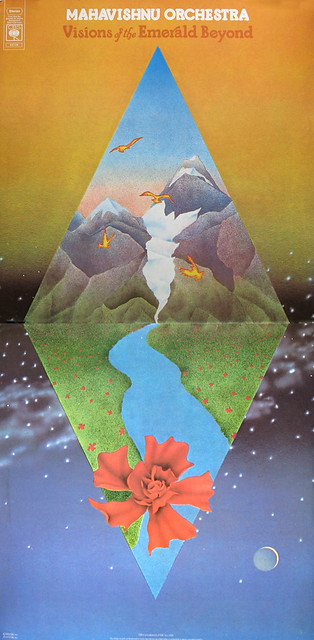
            Some classic gatefolds don’t qualify as low-hanging fruit because they’re expensive, such as the Rolling Stones Their Satanic Majesties Request, arguably the greatest album cover of all time, at least for people who have taken a lot of acid. A 3D photo of the band in wizard costumes is not easily topped. Inside is a maze and a crazy collage. I got my copy for 70 bucks in Atlanta – the exact same pressing of the one I got for Christmas my junior year in high school, brand new in the shrink-wrap. Probably cost $10 back then. No, what we’re interested in here is art for the poor man: Santana’s Caravanserai – big orange sun over a dark blue sky and desert and camels, inside a gloriously blurry sunset over the ocean; Allman Brothers Eat A Peach – peaches and melons the size of truck beds on the front and back, opens to a vast panorama of Magic Mushroom Land; Mahavishnu Orchestra’s Visions of the Emerald Beyond – mirrored pyramids that rise lengthwise, up and down, one to sunrise, the other to night; Gentle Giant’s Acquiring the Taste looks like a tongue licking an ass until you open and see it’s just a delicious peach; and all those Yes covers by Roger Dean, especially Close To the Edge, which is their best musically, too (even if you hate Yes you should own a Yes/Roger Dean gatefold, it’s an obligation of the hobby). There are so many.


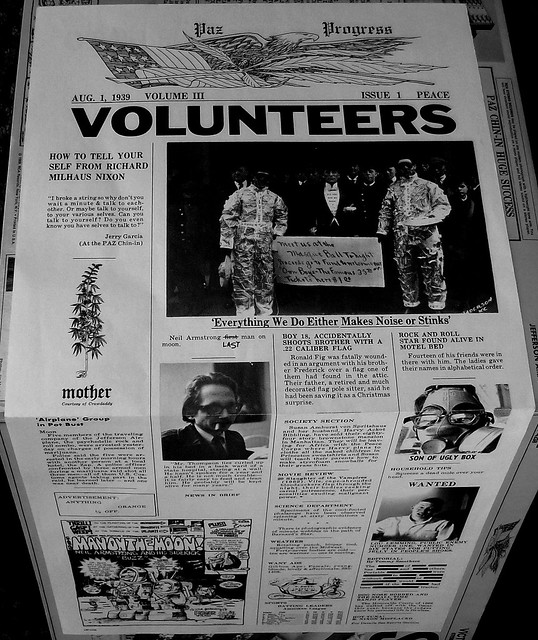
            And if a gatefold isn’t enough, there are double gatefolds, too, and gatefolds with inserts, booklets, and records that aren’t even gatefolds, they just have odd shapes, like The Low Spark of High Heeled Boys and Shoot Out at the Fantasy Factory by Traffic, which have two corners cut out and the art is an optical illusion of a 3D box that looks very real if you stare at it long enough. This kind of super packaging is generally the domain of superstars like Elton John, Jefferson Airplane, Harry Nilsson, Joni Mitchell, artists with big budgets and a fondness for excess. After Nilsson Schmilsson, Nilsson was all gatefold for the rest of the 70s. Pussy Cats and Duit On Mon Dei are both triple folds with lyrics on one spread and on the other, collages of snapshots taken during the making of the album, both of which appear to have been outrageous parties. Mitchell uses the double gatefold for her underrated tour de force Mingus to give it more of an art book feel, with her paintings of Charles in fields of white with delicate lines of text here and there. But few can top Elton and the Airplane (and still qualify as low-hanging fruit). Their more elaborately packaged albums are like mixed-media happenings you can hold in your very hands. Elton’s albums have a Hollywood flair. Tumbleweed Connection comes with a twelve-page sepia-tone booklet full of 19th Century old West etchings - trains and riverboats and guns, shots of Elton and his band and lyricist brooding dramatically. Goodbye Yellow Brick Road folds out three ways like one of those reflective things people used to hold up across their chests to get a darker tan. All the lyrics are splayed across in all different colors and each one has its own little illustration, like those old time movie posters with drawings of the actors and the most dramatic scenes. And the whole concept of Don’t Shoot Me I’m Only the Piano Player is a night at the picture show. The cover shows a couple buying tickets at a theater with album’s title across the marquee. Inside, on the left panel, the song titles and album credits are laid out just like a movie poster, and on the right is a big picture of Elton holding his hand out like a stop sign. It’s all colorized and cool looking, and so are all the other photos in the booklet it opens up to. Page after page of groovy cool-colored pictures. It’s just a wonderful artifact. I think mine cost $4. And Jefferson Airplane. Volunteers and Bark: two of the best covers ever made, and both relatively inexpensive. Bark comes in a paper bag with JA printed on the front, just like the old A&P logo. Open it up and on the other side are freak-comic portraits of the band in thick-black ink. The bag is folded over a standard record cover with picture of a dead fish wrapped in paper and tied in string with a bow. And inside is a fold-open lyric sheet printed in red and black, and on the back is a list of things you can do with the bag. A long list and, as you might imagine, some of the suggestions are quite unusual. I love this record, even though it’s not the record I reach for when I want to really listen to the Jefferson Airplane (I play it when I want to hear early, very well done hard rock). When I want the Airplane in its fullest revolutionary glory, it’s gotta be Volunteers, a Woodstock-era masterpiece with the freakiest and coolest mega-gatefold of all times. It’s done up like a newspaper published in Mescaline Land, with phony stories and lots of pictures. It has so much going on, you can stare it for hours. And that’s really what the gatefold is all about – sitting and staring and listening, slowing down, paying attention, making an event out of a collection of music. And isn’t that precisely what we celebrate when we celebrate RSD?


Monday, April 15, 2013

I'd Love to Turn You On At the Movies #63 - Mommie Dearest (1981, dir. Frank Perry)


“Hysterical,” an adjective meaning both “prone to excessive or uncontrollable emotion” and “extremely funny,” is probably the best word that can describe the cult film Mommie Dearest, the dramatic interpretation of Christina Crawford’s 1978 tell-all autobiography about life with her glamorous movie star mother Joan Crawford, played by Faye Dunaway.
The story begins at an awkward point in Joan Crawford’s career when she was old enough to be widely respected as an actress, but too old to actually get any meaty roles. After some legal finessing, Crawford upped her publicity by adopting a baby girl she named Christina (AKA “Christina Darrrr-ling”). Christina was promised a perfect existence and grew up with all the things Joan never had, like pony-filled birthday parties, an Olympic sized swimming pool, designer clothing and a large, very clean Art Deco mansion. But growing up with a neurotic single mother who just happens to be a perfectionist Hollywood megastar with major OCD tendencies would take a toll on anybody, and Christina quickly and repeatedly learned that it was Mommie’s meticulously ideal way or the highway. (Here “highway” translates into “forced into a remote convent school for several years” and “nocturnal coat hanger beatings.”) But somehow through the bumps, bruises, and traumatizing night terrors, Christina attempted to accept Joan’s strange way of showing her motherly love -- until, of course, the not-so-shocking-but-still-pretty-shocking ending to the story that prompted the writing of Mommie Dearest, a book which remained on the New York Times Bestseller list for 42 weeks.
This particular DVD release, “The Hollywood Royalty” edition, is peppered with fantastic special features that will delight both the hardcore Mommie fans and uninitiated viewers. One of my most favorite people in the world, cult director John Waters, blesses us with a hilarious yet sympathetic commentary track to really highlight the film’s many strengths and point out where a few weaknesses might be hiding. (Spoiler alert: they’re mostly in the rose garden and the closet.) Three short documentaries take you on the set and behind the scenes, featuring interviews with producer/writer Frank Yablans as well as cast members like the wonderful Diana Scarwid, who talks candidly about her emotionally charged performance as adult Christina and the enduring legacy of the movie. Another welcome voice is Joan Crawford enthusiast and impersonator John Epperson, AKA Lypsinka, interviewed in the Joan Lives On feature along with additional comments from John Waters on the film’s cult following.
Although marginalized by audiences and thoroughly lambasted by critics upon its release, this lavish biopic remains one of the most memorable portraits of a movie actress ever seen depicted on screen. How much of it is factually accurate we’ll never know, but hey – it still makes for some fine watching if you take it all with a huge grain of salt. In addition to getting a helping hand from gay and drag queen audiences keeping it in the limelight, Mommie Dearest has withstood the test of time for some darn reason, and I’d like to think it’s because the film is actually good. I recall seeing Mommie Dearest on television for the first time and being absolutely amazed -- not because the censors let the film’s sole F-bomb slip by, but because the performances, sets, costumes and overall power of the whole production impressed me even as a nine-year-old. (Yes, nine. I was even inspired enough to play-act pretend Mommie Dearest scenes. Don’t ask.)

In the words of the great John Waters, Mommie Dearest is “not a movie that’s ‘so bad it’s good’… it’s a movie that’s ‘so good it’s perfect.’”

Fun Fact! Faye Dunaway was convinced during filming she would win an Oscar® nomination for her performance. Today she not only refuses to speak about this film in interviews, but also has an aversion to letting her suitcases touch hotel room floors.

--Shove M., used buyer and resident grab-bag decorator

Monday, April 8, 2013

I'd Love to Turn You On #79 - Boz Scaggs - Boz Scaggs


For what seemed like months in 1974, but was probably more like a couple of days, the first American Boz Scaggs album (originally released in 1969) never left my turntable. It was one of those albums that would just get flipped over and over, never reaching saturation point. The album, which was deleted for a number of years, was reissued by Atlantic in 1978 in an effort to cash in on Duane Allman’s ever growing reputation for history making guitar solos. The penultimate cut on the album, an incredible, churning, thirteen-minute guitar and horn driven blues called “Loan Me A Dime” was getting some FM radio play and it caught my ear and Boz Scaggs immediately came out of the stacks and became one of my favorite albums again. “Loan Me A Dime” is a bona-fide classic building in an inexorable journey to musical nirvana with the Muscle Shoals horns creating a pounding background for Duane Allman’s lead guitar to take center stage and drive the song in a completely heroic series of solos to one of the great, big finishes in rock history. “Loan Me A Dime” got me in the door, but I was soon smitten with the subtler joys of this wonderful album.

While “Loan Me A Dime” is a total winner that justifies the purchase of the album alone, over the years it has been the ballads and slower country numbers on the album that have really grown on me and made me go back over and over on those cloudy days that threaten emotional rain at every turn. Kicking off with the upbeat “I’m Easy” it is immediately obvious that this is no ordinary singer. Boz Scaggs has a completely unique voice; throaty, smooth and soulful, he is truly the American version of Van Morrison (in fact I sat next to him once at a Bay-area Morrison show and he was as much a fan as the rest of the audience). It is with the second cut on the album, the moody “I’ll Be Long Gone” that Scaggs really shows what he does best – wrap those velvet pipes around some melodious melancholia and deliver the way great singers throughout history have done. Scaggs has the enviable ability to actually convey emotion in his voice. It isn’t just the words he chooses, or the relative volume control he exercises, he actually makes the listener feel what he is feeling. One would think this is an obvious equation, but I am constantly alarmed to hear singers who might as well be singing words out of the phone book for all the emotional impact their performance imparts.  Followed up by another slow and sad number “Another Day (Another Letter)” one starts to become increasingly aware of the superb backing on every song. It is the cream of Muscle Shoals with Duane Allman leading the way on track after track, playing some of his most memorable and satisfying accompaniment. He plays signature leads on slide and dobro and offers some of his best work outside his own band. For instance, check out his moving accompaniment on “Finding Her.” He perfectly matches Scaggs’ own masterful vocal performance echoing the sentiments being voiced with a haunting slide punctuating each line. It might be Allman’s most delicate playing on record.

From the cover, picturing Scaggs looking like a sepia-toned cross between a hippie and a riverboat captain, there is a deep Americana in the marrow of this record. It stands with The Band’s self-titled album and Workingman’s Dead as a glimpse into a uniquely identifiable ironic patriotism that existed in the late 60’s. It was cool to embrace American tradition and history, while protesting current American policy. It was a way to claim the country as yours while remaining above the political fray. No track illustrates this better than Scaggs’ take on Jimmie Rodgers’ “Waiting For A Train” which features Allman on pitch-perfect dobro and Boz singing it like he’s recording inside a boxcar. It is another heart-warming and authentic performance on an album filled with them. Scaggs would go on to much greater success with later albums and really catch lightning in a bottle with his multi-platinum soul masterpiece Silk Degrees, but for my money, this album is his most significant contribution to the great American songbook.
            - Paul Epstein

Monday, April 1, 2013

I'd Love to Turn You On At the Movies #62 - High Plains Drifter (1973, dir. Clint Eastwood)


It’s hard to watch High Plains Drifter, and not think of Clint Eastwood, the film’s star and director, forty years later, speaking to an empty chair at the Republican National Convention. The movie is full of twisted American right-wing ideology that wasn’t apparent to me the first time I saw the film on the late, late show, when I was in high school. Back then I just thought it was a trip, full of spaghetti western spaciness: long, well composed shots of sweaty, road-worn men riding across the windswept desert, an eerie soundtrack a la Ennio Morricone, and the surreality of the low budget sound effects, the boots of the swaggering gunslingers scratching out a hypnotic rhythm across the dirt of Main Street, the ever howling wind. In the end Eastwood has a whole town painted red and writes hell across the welcome sign, which is one of the best plot twists in the history of the genre. It’s still all that when I watch it now, but it’s also a glimpse into the still-forming psyche of a GOP nut.
            The whole sociopolitical head-trip begins early in the film when Eastwood’s character, a nameless stranger and ostensibly the protagonist, rapes a woman in a horse stable. It’s clearly a rape. She’s screaming and slapping at him as he drags her through the dirt, throws her into a pile of hay, and mounts her, but after a while she seems to be enjoying it. Throughout the movie the woman reappears several times, and in each instance she’s enraged at having been raped, shouting and begging the townspeople to punish the man, but they shrug her off, say she wanted it, that she’s only mad because he didn’t come back and give it to her again. Of course all this brought to mind those two recent Republican Senate candidates who lost because they said a pregnancy caused by rape is god’s will, which isn’t exactly a Republican ideal, but still. No, the right-wing themes become more apparent in the way the townspeople react to him and how he reacts to them. Instead of throwing Eastwood in jail or driving him out of town, they enlist him as their protector against three violent bad guys who are about to get out of jail who will certainly come and destroy the town. At first, Eastwood turns them down, but they offer him anything and everything he wants, so he promptly promotes a midget to sheriff and mayor, and goes around redistributing all the wealth, making the bar owner provide free liquor to everyone, the cobbler give away free boots, and so on. In other words, he’s a Communist dictator, albeit an ironic one. In truth he’s a true American, a rugged individualist; he just steps into the role of a Lenin or a Stalin to teach them all a lesson, because in the end they’re just namby-pamby liberals, too weak and fearful and corrupt to take matters into their own hands. Communism-by-way-of-rapist-tyrant is what they deserve.
            The movie came out to strong reviews, and it maintains a high rating at Rotten Tomatoes, but not everyone is a fan, not even all those who lean to the right. Upon its release, John Wayne, an outspoken SoCal Reaganite, groused, “That isn't what the West was all about. That isn't the American people who settled this country.” And while the same could be said of every one of Wayne’s films, it’s beside the point: Westerns aren’t about the time of the Great West, they’re about the time in which they were made, and this came out in the summer of 1973, when the world was closing in on Nixon and his 18 minutes of missing tape. It’s a peculiar time for Hollywood. Anti-heroes and unhappy endings were very much in vogue, and while this reflects a very real feeling that American society was falling apart, it also shows a time when Americans’ distrust of government was nearing its peak. Eastwood stepped into this climate and delivered a tour de force of macho bleakness, which might well have been what he intended to recapture when he stepped out on the stage in Tampa and, after declaring himself a “conservative” and not a “left winger… left of Lenin,” says, to a chair, “We own this country. We -- we own it. It is not you owning it, and not politicians owning it. Politicians are employees of ours.”
            - Joe Miller


Tuesday, March 26, 2013

I'd Love to Turn You On #78 - Freddie Hubbard – Red Clay


To be honest, I’m not a huge fan of Freddie Hubbard. He’s a remarkable player and a brilliant technician, but I have found his records to be a little lacking somehow. But since he played on seminal recordings by a couple of my all-time faves in the jazz world – Ornette Coleman’s Free Jazz and John Coltrane’s Ascension – I persevered with him. Didn’t help his case with me that he dismissed these albums I love as chaotic free-for-alls rather than the remarkable statements they were and are. But all it took was a listen to this album, recorded in January 1970, to turn me around on the man – or at least on this record.
First off, he’s surrounded by a great band and that helps things considerably. With two of Miles Davis’ 1960’s sidemen, Herbie Hancock (on electric piano and organ) and Ron Carter (on bass), backing him Hubbard’s music is sure to groove in the fashion of such then-contemporary late 60’s Miles albums as Miles in the Sky and Filles de Kilimanjaro, all lengthy workouts that take their time to develop, sometimes playing it laid back and cool, and other times erupting with the fire Hubbard commands so readily. Nice too that drummer Lenny White, another Davis alum fresh off the previous summer’s sessions for the not-yet released Bitches Brew album, knows his way around the kinds of contemporary rhythms that Hubbard was seeking here. And also quite nice that Hubbard has tapped the chameleonic tenor sax player Joe Henderson as his front line partner, given that Henderson could fit into any surroundings from straight ahead swing to some pretty “out” jazz.
But it’s all grounded by Hubbard himself, who has found a framework for his spectacular playing and also written a batch of tunes that showcase him and his band to their best. The first half is very much in the mode of the times, ushering in the 1970’s with the title cut’s relaxed grooving and “Delphia,” a waltz-time ballad that develops into something more mid-tempo. In both of these cuts, it’s odd how Herbie Hancock’s keyboards quietly comp their way into the forefront of the sound, even while the trumpet and saxophone takes flights of fancy over the top of the rhythms. The second half is something more akin to the hard bop that Hubbard is most associated with. “Suite Sioux” is a fast burner, with tangly solos from both Hubbard and the consummate sideman Henderson over the lightning rhythms, while “The Intrepid Fox” uses tricky changes to close out the regular album. Closing out this CD though are a pair of bonus cuts – a fine alternate take of the title cut and a take on John Lennon’s “Cold Turkey” that starts out as raw and off-puttingly harrowing as the original, but settles into a groove more in the style of the rest of the record.
I’ll admit it – Hubbard rubbed me the wrong way at first and I still cringe at his comments about great records he participated in that he failed to see the worth of, but if I had gone in blind on the evidence of this record, it never would’ve taken me as long to learn what his strengths are.
- Patrick Brown

Friday, March 22, 2013

I'd Love to Make You Laugh #2 - Tim Northern - Second CD


Welcome readers to the second installment in the I'd Love To Make You Laugh portion of Spork where I will be reviewing the latest and greatest in the stand-up comedy world. This time I will be reviewing National club comedian Tim Northern's second CD, Second CD.

Mr. Northern is a veteran in the college and comedy club scene nationally as well as a finalist on CBS's Star Search. He can be heard here locally on Denver's own Comedy 103.1, where he has not only been highlighted as a performer but as host as well.

Word play! That is the best way for me to describe Tim Northern's laid-back yet cerebral approach to stand-up comedy. Ben Stein has been quoted as saying, "I love the fact that he assumes his audience has a brain." Mr. Northern himself has stated, "That's what I'm striving for. I provide two-thirds of the joke, and you provide the other third. It's like 'do-it-yourself comedy." This sort of delivery is brave as it relies on a crowd that is open to and ready to do some thinking.

The first thing I must point out about Tim Northern's Second CD is the track listing. Do not pay attention to it as an indicator of things to come as they are a joke in themselves and not reflective of the material. Tim starts this set by giving the crowd a personal standing ovation for being out on a Sunday night. He then begins to spin his magic at word play by indicating to the crowd that he has just learned to read and while finding it frustrating, ultimately jokes: "reading is cool man."

Things really get going with Tim's now famous take on Dr. Seuss's Green Eggs and Ham and his musings on his newly found reading skills. Observations on his midget brother the professional Foosball player, rat poison intolerance, his deep love of pancakes and going on the "patch" keep the listener’s mind working in tune with the audience.

Not only does Tim excel at word play but his impressions of Richard Pryor, Samuel L. Jackson, Dyslexic Italians and others are truly a fresh take on the "impression" genre. Tim's love life, issues with the Internet and working in the community are next up as his famous "Tits for Tats for Tots" campaign is born.

Bits such as Dyslexic Bob, getting healthy in the non-smoky mountains with bi-polar bears, doing a show at the zoo and a Dead Poet's Society Basketball game help round out a truly thought provoking 16 track CD. As a bonus let the last track run and hear some hilarious out takes with Tim Northern and son!

Recorded in front of an all-ages crowd in Louisville, Kentucky by Joe "Dookie" Dutkiewicz and edited by Ross Duncliffe. Tim Northern's Second CD is a must own for fans of clean cerebral comedy with great word play. Available NOW in comedy section at Twist & Shout!

            - Jeff Albright

I'd Love to Turn You On At the Movies #61 - Scarface (1932, dir. Howard Hawks)


There once was a gangster film about an ambitious crime lord and his ruthless and violent rise to power trafficking in illegal substances. He was played with consummate skill by a chameleonic actor of the first rank, who many claimed exaggerated the character’s non-American accent to the point of parody. The film was exceedingly violent, simultaneously drawing the ire of censorship boards and thrilling audiences seeking an exciting glimpse into the network of the criminal underworld. That film is Scarface. But I’m not talking about the one with Al Pacino, I’m talking about the 1932 one with Paul Muni from which director Brian DePalma and screenwriter Oliver Stone took big chunks in their 1983 homage to director Howard Hawks and screenwriter Ben Hecht’s groundbreaking film based loosely on the life of Al Capone (here named Tony Carmonte). And where DePalma’s film goes gleefully over the top in tandem with its lead character, Hawks’ film is more restrained, more tightly controlled, and probably more thrilling in the long run – but no less violent in intent.
            Producer Howard Hughes, who had previously bankrolled the drama Hell’s Angels, featuring the most spectacular plane stunts ever put on film to that date (or perhaps ever), wanted to comment on what he felt was a scourge undermining the country during Prohibition – organized crime – and decided to make the most realistic and upsetting portrait of it ever put on film, pushing the violence of great earlier crime films like Little Caesar, The Public Enemy, and Underworld to the limit. And push it he did. Along with director Howard Hawks, they fashioned a crime epic that in no way undercut the viciousness, the brutality of the crime world of the day, even though their alleged glamorizing of the criminal lifestyle tied them up in battles with censors that delayed the release of the film for nearly a year. With Hawks’ fast, mobile camera crafting a lithe and exciting film, it’s hard not to get swept up in the rush of the rise of Tony Carmonte, though it’s hard to see how the censors could find anything likeable or relatable about his sociopathic violence or his inevitable fall that would be perceived as glamorous. In response to the censors, Hawks and Hughes fashioned a scene in which concerned citizens get to vent to police and government officials their frustration with the mob violence on the streets (including a representative Italian immigrant decrying how these gangsters are giving his people a bad name) and it’s the film’s only bum note, a moralizing aside that only interrupts the flow of an otherwise terrific film.
            Paul Muni as Carmonte is remarkable, playing him in the early scenes as uneducated but not dumb, with an arrogant insouciance that comes from his unshakeable belief that he’s going straight to the top. And he’s right, of course. And in the grand Hawks tradition, there’s a brilliant ensemble cast at work around him: Osgood Perkins (Anthony Perkins’ father) as mob leader Johnny Lovo, Carmonte’s boss; Karen Morley as gangster’s moll Poppy, moving to whoever has the power and money to keep her in style; Ann Dvorak as Tony’s sister Cesca, playing her as flirty but experienced teenager with whom Tony is creepily obsessed; and Boris Karloff as North Side rival boss Gaffney. Hawks’ taut direction (plus the hand of Hughes wanting to push the film further) is also at play in the action scenes, with an terrific nighttime high-speed car chase later in the film that finds Tony shooting it out with some would-be assassins only one of many such scenes. And he’s also got his hand in one of the film’s signatures – a visual “X” motif marking any impending scene of violence, as when a scene recreating the St. Valentine’s Day Massacre moves from seven X’s in the rafters down to a wall showing the shadows of the Massacre taking place. The film moves breathlessly through Carmonte’s rise and fall, and Muni treads a perfect line of nailing this anti-hero whose life is fascinating and repellent in equal measure. It’s a trick that DePalma, Pacino, and Stone would recreate with success in 1983, pushing the envelope for the time of what could be put on screen, but it was done first, and equally well if not better, way back in 1932.
            - Patrick Brown

Friday, March 15, 2013

Fables of the Reconstruction: Herbcraft & MV+EE

Herbcraft has come a long way in the two years since their first album, Herbcraft Discovers the Bitter Water of Agartha. That one was a gem of the DIY psychedelic scene, a terrific concept – a portrait of an imaginary long-lost concept album from 1973. Matt LaJoie, the man behind Herbcraft, recorded it in his bedroom in Portland, Maine, over the course of a snowy weekend. It was one of those great ideas that catches your attention and is executed well enough to hold it through both sides. It’s a little thin and wobbly, sure, but that’s part of its charm. But now, with Herbcraft’s third LP release, The Astral Body Electric, LaJoie is playing with a full band, and the sound is nicely muscled and steady. It’s a major advance down the path to psychedelic godliness. The most dramatic improvement comes with the addition of drums, which were the most conspicuous missing element from the first two records. There’s also some flute and organ mixed in to give it a 60s-Renaissance-Star Trek sort of feel here and there, and LaJoie’s voice is fuller, more confident. Together these new dimensions make this album feel less like a third album and more like a stunning debut. But it’s still Herbcraft. If you liked space-jet-around-the-roomiverse guitar sound of Ashram to the Stars you should be happy here because this record’s full of weird noises. And if you like the plodding-spiritual-pilgrim plot of Agartha, you’ll be happy, too. The Astral Body Electric has that same Third-World-in-outer-space sound. It pulses with a vaguely Middle-Eastern rhythm that would’ve worked well as the soundtrack for just about any scene in The Last Temptation of Christ, and these beats pull the record together like a loop of thread. The structure’s not constricting - quite the opposite - it allows Herbcraft to roam further than they ever have.
            The other thing about The Astral Body Electric is that it was mastered by Matt Valentine of MV+EE, and this factors hugely into its quantum-leap-ness. Valentine uses a technique called Spectrasound. It makes the music sound like it’s coming from all corners of the room. For instance, if you’ve listened to MV+EE’s 2012 release Space Homestead on a good system, you probably noticed that there’s this part where it sounds like someone’s knocking on the walls, outside, across from where your speakers are. That’s Spectrasound. It finds spaces beyond the reaches of the balance knob and fills them with sound. At one point while listening to the new Herbcraft album I got up to see if the washing machine was going berserk way off in the laundry room, but it was just something I was hearing in the music and the Spectrasound. I have no idea how Spectrasound works. I’ve emailed Valentine and asked him. I told him about the wall knocking. All he said was, “it's in the walls alright, heh heh...crackin' me up.” And on the internet the only explanation I could find was this: “MV’s production technique places tones dancing all around the stereo sound field.” Whatever it is, it’s psych-O-delic. Especially on MV+EE’s newest, Fuzzweed. It’s like being in the wormhole Jodi Foster went through at the end of Contact, except it’s low-gravity and slower than the speed of light, and it’ll only get you as far as the sofa and the fridge and back, 40 minutes, round-trip. It’s all good, but side two is the masterpiece: a 20-minute three-parter that starts off as a ghostly folk tune and then just goes off, everywhere, into spiral galaxies ruled by Iron Man and inner spaces made of slide-guitar plumes, and so on, and so forth. I’ve tried to describe it at another site and failed. The best I can do here is to say that if you’ve listened to the last track on Space Homestead, “Porchlight>Leaves,” and dug it, you’ll dig this. That track, the trippiest highlight of that record, is but a road report from the journey to this freaktastic Spectrasymphony.