Monday, February 29, 2016

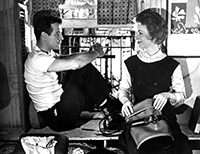
I'd Love to Turn You On At the Movies #135 - Sleeper (1973, dir. Woody Allen)

Back before Woody Allen got serious in the late 70s, he was an heir to the great slapstick film comedians. Roger Ebert drops Buster Keaton’s name in his review of this film while Allen himself says that he thought of it as a tribute to two of his favorite comedians, Groucho Marx and Bob Hope – and they’re both right. There are slapstick moments in Sleeper that are as funny as anything Keaton put on film and self-deprecating verbal wit on par with Groucho or Hope, all wrapped up in a goofy, freewheeling science fiction story that’s really just an excuse for Allen to riff on his favorite subjects – love, sex, and death – and take potshots at the some of the ridiculousness of the early 1970s.

Allen uses the standard sci-fi approach of a futuristic dystopia to tell the story of Miles Monroe, owner of a Greenwich Village health food store who goes in for a routine surgical procedure in 1973 and wakes up in 2173, unfrozen from his cryogenic sleep by a band of underground rebels who enlist him to help stop the oppressive Leader from enacting the sinister Aries Project. That’s about as much plot as is needed because the rest works itself out in ways you’ve seen before, though it’s Allen’s wit and goofy scenarios taking off from these commonplace plot elements that make this film something special. Some of them are time-bound – jokes about Nixon, Howard Cosell and United Federation of Teachers organizer Albert Shanker – and funnier to audiences of the time, but others – as when he’s forced to impersonate a robot servant, a convenience-oriented society that uses an “Orgasmatron” instead of sex, or when he drops lines like “My brain? That’s my second favorite organ” or “I was beaten up by Quakers” that don’t require any translation from 1973 to today. And some of the film’s moments are downright strange – as when he believes he’s being crowned Miss America or when he and Diane Keaton suddenly drop in a gender-swapped routine from Streetcar Named Desire – and funnier as a result. With training from his standup years in nightclubs, Allen is great with one-liners and I wouldn’t want to spoil any more of them, but this is the first of his films where he shows that he’s equally conversant in film – nodding to silent comedy of course (usually in dialogue-free scenes that feature him playing ragtime clarinet alongside the Preservation Hall Jazz Band or The New Orleans Funeral Ragtime Orchestra), and also to contemporary sci-fi (he enlists Douglas Rain, the voice of 2001’s HAL, to play a sinister computer here as well).

And as a special bonus for Coloradoans, much of the film was shot here in Colorado – within the first few minutes there’s a shot of our famous Botanic Gardens building, several scenes take place in and around The Sculptured House (the “mushroom house” off I-70 just west of the city, often now called “the Sleeper house” due to its inclusion in the film), the Church of the Risen Christ on South Monaco is turned into a McDonald’s, some of the outdoor shots were filmed at the Table Mesa Laboratory of the National Center for Atmospheric Research in Boulder, and so forth. Beyond the laughs of the film and the inevitable budding romance of Allen and Keaton’s characters, it’s fun for those of local privilege to location spot throughout the film. Sleeper stands as the finest film from a delightful era of Allen’s development, when slapstick and a ruthless desire to make people laugh was at the forefront of his mind. With the release of the classic Annie Hall in 1977, he started to take the relationships in his films far more seriously, and with 1978’s great Interiors he paid direct tribute to one of his cinematic heroes, Ingmar Bergman, rather than satirizing him as he’d done only a few years prior in Love and Death. I don’t value this period over his more mature works but there’s a verve here, a willingness to go to any lengths for a laugh that is missed in his later films, whatever other virtues they may have.

-          Patrick Brown

Monday, February 22, 2016

I'd Love to Turn You On #148 - Brian Eno/David Byrne – My Life in the Bush of Ghosts


After Talking Heads released their fourth album and masterpiece, Remain in Light, the band went on hiatus while its members explored side projects. Guitarist Jerry Harrison released The Red and the Black, an underrated solo album which built on his work with The Modern Lovers and Talking Heads. Rhythm section and married couple, Tina Weymouth and Chris Frantz, formed Tom Tom Club with Tina’s sisters and members of the Remain in Light touring band. Tom Tom Club’s debut functions like a release valve for the pressures building on Remain in Light and endures as a funky, energetic party album. Lead singer David Byrne and Brian Eno, producer of three Talking Heads albums, set off to create an album that draws upon similar archetypes as Remain in Light, but stands apart from anything these considerable talents have created before or since. My Life in the Bush of Ghosts sounds like Byrne and Eno discovered a way to tune into the radio signal of this entire planet and distill it into 40 minutes of genre-blurring, hypnotically engaging, and beautifully layered music.

Three and a half decades after its release, My Life in the Bush of Ghosts remains a ground-breaking and brilliant tangent from the minds of two of the most idiosyncratic and cerebral artists in popular music. Whereas Tom Tom Club seized upon the incredible pool of talent that had formed around Talking Heads and aimed it in a loose, upbeat, and fun-loving direction, Eno and Byrne set out on a concentrated, enigmatic, and exploratory mission into the unknown. My Life in the Bush of Ghosts contains some of the same DNA of poly-rhythms, experimentalism, and pastiche as Remain in Light, but this album grows into its environment without the frames and guidance of Byrne’s observational characters or recognizable song structures. Although both Eno and Byrne were known at this point for their skills and abilities as lead singers and songwriters, it may come as a surprise to some that this album features neither their voices nor their lyrics. The album’s liner notes credit both Brian Eno and David Byrne with, “guitars, basses, synthesizers, drums, percussions, found objects.” In place of Eno and Byrne’s vocals, nine of the eleven songs on the album contain elements cited in the liner notes as “voices” and include samples of radio hosts and callers, preachers, an exorcist, and singers from Egypt, coastal islands near the state of Georgia, and Lebanon. Among the eleven musicians who worked with Eno and Byrne on this album, eight are percussionists and three play bass. Eno and Byrne combine this robust rhythmic engine with the found, fragmented vocals to create a set of self-contained, evocative snapshots that, when regarded as a whole, reflect back to the listener like a mosaic formed from the pieces of a broken mirror.

Eno and Byrne reunited in 2008 for Everything That Happens Will Happen Today, an album that serves as a high point for both artists’ output in the last twenty years but bears no discernible connection to their first collaborative album. Everything That Happens Will Happen Today features some of Eno’s best recent production work as well as some of Byrne’s most natural vocals and most compelling lyrics since Talking Heads, but feels strangely orthodox and prosaic compared to the radical poetry contained within their first joint musical endeavor. My Life in the Bush of Ghosts merges elements of art rock, experimental music, funk, electronic music, African pop, folk music, field recordings, and minimalism into a highly influential sum, but few of its successors can compare with this fascinating musical exploration.    
John Parsell

Monday, February 15, 2016

I'd Love to Turn You On At the Movies #134 - The Five Obstructions (2003, dir. Jørgen Leth/Lars von Trier)


In this century, few directors have provoked, shocked, and captivated audiences like Lars von Trier. People who have watched Dancer in the Dark, Dogville, or Nymphomaniac: Vol. 1 & 2 are very unlikely to forget these films whether they loved or hated them. For a filmmaker who has specialized in crafting highly memorable and, in some cases, indelible on-screen moments, Lars von Trier himself can’t forget The Perfect Human, Jørgen Leth’s 1967 short film. The Five Obstructions, the documentary that tracks von Trier’s disciplined efforts to push Leth to re-examine and re-create The Perfect Human again and again with new limitations, serves as a revealing and intimate look at filmmaking, a portrait of an artist struggling against depression, and an unorthodox lesson in the redemptive power of a friend’s love.

The Five Obstructions opens with von Trier and Leth sitting down to watch The Perfect Human before they decide on restrictions for making a new version of the film. As they begin to debrief the film and create challenges for the next iteration, von Trier unleashes an almost wicked glee as he conjures up seemingly absurd rules for the new film. By the end of the brief meeting the two men agree that Leth’s next rendering of The Perfect Human must contain edits no longer than twelve frames, take place in Cuba (a country Leth had never visited before), answer the questions posed in the first version, and use no sets. Leth, who was in his mid-sixties during filming, staggers out of the initial meeting appearing stunned and befuddled at the amount of work ahead of him. Von Trier, who was in his mid-forties as this all transpired, counters Leth’s weary patience with a reassuringly firm confidence in the process of this project. Despite von Trier’s self-described “satanic” behavior in developing the successive courses of complications, the younger director consistently demonstrates affection and respect for the man he calls his “hero.” Upon returning from Cuba, Leth comes across as both rejuvenated and proud of his solutions to von Trier’s invented problems. Both men watch The Perfect Human: Cuba together and express how impressed they are with the result, but feelings of contentment pass quickly as von Trier begins the work of generating a new set of hurdles for Leth to clear for the next edition of The Perfect Human. Yes, this process occurs four more times and each time, von Trier’s motivation for engaging Leth in this endeavor becomes more apparent. The dynamic between von Trier and Leth pushes deeply into a special brand of pedantry. Once the pupil, von Trier reverses the student/teacher dynamic as he nudges, admonishes, and goads his mentor. As the film progresses, von Trier and Leth allow the audience sit in on a master class in which a former student challenges his teacher to unlearn the considerable skills he has gained over a lifetime in order to explore the still untapped potential within him.

A sense of love and a spirit of experiential learning flow through all stages of The Five Obstructions. I saw this film on the recommendation of a good friend who stated, “You should watch this. It reminds me of your relationship with your dad.” At first I was a little confused by the comparison, but it didn’t take long for me to see connections. My father was a teacher and I grew up with him telling me stories about an influential teacher from his youth. My father never forgot the time this teacher, Gladys Metcalf, explained to him, “You’re an ‘A’ student doing ‘B’ work and that’s why you’re making a ‘C’ in this class.” Society has developed many norms for guiding the young through their development, but there are few templates for mentoring our mentors. Lars von Trier reminds me of Gladys Metcalf in this film and reaffirms the value of asking more from people who we trust are able to accomplish more. The Five Obstructions rewards those who are familiar with von Trier’s feature films as well as those who know nothing of his work by sharing a compelling story about someone who won’t allow his friend and mentor to give up and fade away.

John Parsell

Monday, February 8, 2016

I'd Love to Turn You On #147 - Mary Lou Williams – Zoning


The average jazz listener is likely to come up short if asked to name the jazz pianist who began their musical career in the 1920s and, aside from a couple breaks, didn’t stop performing until their death in 1981; who started out playing stride piano and writing big band arrangements; who played a role in helping many of the bebop players solidify their concepts; who encouraged the gospel of jazz – often literally – in both Europe and the U.S.; and who continually refined their approach to the music, including ideas that would even encompass events as far out as performing a controversial 1977 two-piano concert alongside unrepentant avant-gardist Cecil Taylor. A good (though incorrect) guess would be Duke Ellington, who covers most of the time span in question, but the correct answer is the underappreciated jazz great Mary Lou Williams.

Williams began playing piano at age 6 and by the time she was 19 she was writing arrangements for Andy Kirk’s Clouds of Joy in Kansas City (and later New York), a gig she held until the early 40s when she began playing matron to the rising stars of bebop. From an interview for Melody Maker she noted "During this period Monk and the kids would come to my apartment every morning around four or pick me up at the Café after I'd finished my last show, and we'd play and swap ideas until noon or later." Anyone who refers to Thelonious Monk, Dizzy Gillespie and Bud Powell (to name only three of the musicians she coached and traded ideas with) “the kids” deserves a much greater status than Williams currently holds. But she didn’t just teach them, she took their ideas to heart and in her mid-40s work – notably 1945’s Zodiac Suite – you can hear bebop’s influence on her own playing.

In 1952, Williams began performing and living in Europe for two years, going on a hiatus from performing music upon her return to the States to focus on charity work within the Roman Catholic Church – specifically on helping addicted musicians kick drugs and return to performing. But by the late 50s, at the urging of two priests and Dizzy Gillespie, she returned to playing and before long was creating some of the most creative work of her career, blending her spiritual leanings with jazz, including two modernist masterworks: Mary Lou’s Mass and Black Christ of the Andes, both of which show an enormous grasp of different styles of music and a readiness to make her music challenging when she saw fit to do so.

After focusing mainly on live performances and working with children’s choirs throughout the rest of the 1960s the 70s found her recording in earnest, starting with the 1974 release, Zoning. It’s a great record, but that’s not all it is – like much of Williams’ latter-day work, this record encompasses a history of jazz that she was present for at every turn. Most of the record finds her working in one of two trios – a traditional piano-bass-drums group and contrasting with that a piano-bass-congas group – though on some cuts she plays solo, or in duo with one of the trio players. And on a couple cuts, she looks forward to her live date with Cecil Taylor by featuring a second pianist (Zita Carno) alongside her, creating some of the loosest, freest, and most abstract music on the record. It opens easy enough though, with the funky, driving bonus track “Syl-O-Gism” which was not on the original album. In listening, it’s difficult to imagine that anything but time constraints kept this off the record’s initial release. It’s followed immediately by Dizzy Gillespie’s lovely, reflective “Olinga,” featuring the same trio instrumentation, and that is in turn followed by “Medi II” which pushes the tempo back up to a rocketing speed. Williams’ interfacing with the bop crowd is readily evident in her playing here. The other bonus cut “Gloria” is the piano-bass-drums alternate version of the tune that occurs later in the disc and again – quality is not in question; it can only be the physical limitations of putting music on an LP that kept this slower version of the tune off the original release. Two dual-piano tracks follow: “Intermission” finds Williams and Carno working in unison before stretching out on this fragmentary and impressionistic tune, but the oddly-titled “Zoning Fungus” opens with a very loose and abstract pianos-only intro before the rhythm section drops in a tight groove for them to work against. The record is then given over to two piano/bass duos, with Mary Lou and Bob Cranshaw playing the lovely “Holy Ghost” and the bluesier and sometimes mildly dissonant “Medi I.” The bluesiness of “Medi I” gives way to the slow, funky, in the pocket groove of “Rosa Mae” which in turn leads to the impressionistic solo piano ballad “Ghost of Love.” The three tracks that close out the record all feature the piano-bass-congas trio, starting with the fastest number here: “Praise the Lord,” in which the rhythm section sets up a fast tempo then Williams drops into it and effortlessly finds her place. She’s not often given to showy runs in her solos, preferring instead to hitting the right note or phrase at exactly the right time – not unlike that “kid” Monk that she used to talk with. The originally released version of “Gloria” follows, faster than the earlier one on the album, and every bit as good and fun. The record closes with “Play It Momma,” a slow groover that is – as usual – funky and showcases Williams’ exquisite timing. A perfect ending to a great album.

Williams would make more records through the remainder of the 1970s (many of them worth seeking out), teach music at Duke University, perform at the White House, create the Mary Lou Williams Foundation to help the underprivileged and young find their way to jazz, and then pass away in 1981 of bladder cancer. In her biography Morning Glory: A Biography of Mary Lou Williams she would sum up her long and accomplished life with this simple statement that says it better than anything I could add: "I did it, didn't I? Through muck and mud."

-         Patrick Brown

Monday, February 1, 2016

I'd Love to Turn You On At the Movies #133 - The Hustler – (1961, dir. Robert Rossen)


Deep in the heart of every American male lies an aching question he must face throughout his life in moments of doubt and crises; “Am I A Loser?” I suspect women also face this feeling, but I don’t know for sure, and since The Hustler is an extremely male movie, and because our society has a different set of expectations and rules for men, we can run with that idea as a premise. There are few pastimes available in our society that are more inextricably linked to this question than gambling, or hustling. For the purposes of this particular movie, the hustle is pool, and the male is Paul Newman. In the history of anti-heroes, it’s hard to think of a more appealing loser than Newman’s character, Fast Eddie Felson. Made in 1961, The Hustler could be considered Newman’s breakout role. He speaks in his own voice, not affecting the southern, good-ol’-boy accent he used to such great effect early in his career, and he digs deep in exploring the motivations and weaknesses of his character, who is a pool hustler making his way across the country, haunting the seedy, grey temples of loss known as pool halls. Director Robert Rossen memorably shoots the entire movie on location in real pool halls, real bus stations and real dive bars, and the ambiance is palpable - the bottoms of your shoes might be sticky after this movie. Fast Eddie has a goal: he wants to play, and beat, the legendary pool hustler Minnesota Fats, played with Buddha-like calm by Jackie Gleason. He gets his chance early in the movie, starting strongly and beating Fats for the first 12 hours of a day-long pool marathon. Then, slowly his resolve starts to slip, just as Fats gets his second wind. Eddie slips into drunken sloppiness as the fat man turns the tables and takes Eddie for every penny he’s worth. He’s left broke and shaken and he embarks on his own personal trip to the bottom, so he can start to claw his way back to the top (bearing in mind “the top” in Eddie’s world is actually the lowest rung of society).

Eddie’s journey takes him into the arms of a drunken, artistic, sweet, but ultimately damaged woman named Sarah Packard (Piper Laurie), who tries to offer some meaning to Eddie’s life beside the endless spiral of drunken loss he finds in pool halls. He scrabbles his way along the bottom, having both his thumbs broken in a hustle gone bad and seeking solace in Laurie’s needy embrace. For a brief moment Eddie has a glimpse of what a “normal,” nice life might be like. As soon as the casts are off his hands however, he is back at the pool table, this time with the management and financial backing of a demonic gambler named Bert Gordon. Gordon is played by George C. Scott in his third-ever role, and the entirety of his weighty reputation as an actor could rest on this role of a lifetime. Gordon embodies everything that is venal and cruel in this world. When men look in the mirror, it is Bert Gordon who stares back and says “yes, you are a loser!” Gordon takes Fast Eddie and Sarah to Kentucky to play billiards with a rich dilettante after the Kentucky Derby, but instead Eddie again loses and, in a sad seduction, Scott uses both Eddie and Sarah’s weaknesses against them and causes Sarah to commit suicide in a sad and heartless scene. Eddie is further numbed as his life continues to follow a sad path to nowhere.

Eddie finally makes his way back to Minnesota Fats. He is in the same pitiful pool room, with the same group of wagering jackals (including Bert Gordon), but this time he has a sober intensity. He has reached the bottom. The face in the mirror has told him with no hesitation that he was indeed a loser. He’d lost everything: his pride, his money, his one shot at true love, what small reputation he once had - it’s all gone into the corner pocket. But here he is with one last chance to play Fats. The pool scenes in The Hustler are like the fight scenes in Raging Bull. In other words, they are beautiful, black and white works of art. Everything is shot in clear mid-screen shots, with the action on the table getting as much attention as the action on the character’s faces. And what action it is! Eddie plays the games of his life. He is playing for Sarah and to prove to Gordon and himself that he has value. Eddie wins, but it is a hollow victory. He has the respect of Minnesota Fats and the other losers in the pool room, but by turning on Bert Gordon he has sealed his fate and effectively ended his own career as a pool hustler. He leaves with his pride and some money, but we can’t be sure what the future holds for Eddie.

Ultimately the power of The Hustler lies in the post-noir seediness of the environment the director creates, and in the elemental brilliance of the four main performances. Rossen's depiction of the world is unrelentingly bleak and Newman, Scott, Gleason and Laurie all inhabit their characters in an uncanny way. Each one seems to embody an emotion - Newman’s pride, Gleason’s confidence, Laurie’s self-doubt and Scott’s ferocious desire, which, in the skillful hands of the director, give flesh to these emotions, and we can certainly see some part of ourselves in that flesh.

-         Paul Epstein

Monday, January 25, 2016

I'd Love to Turn You On #146 - Devo - Duty Now For the Future

You probably know something about the art project/guerrilla theater/rock band from Akron, OH known as Devo, The De-Evolutionary Band. After years of underground touring to go with handmade films and other forms of art-propaganda they finally released their debut album Q: Are We Not Men? A: We Are DEVO! in 1978. It was produced by Brian Eno (along with David Bowie an early supporter of the band) and is considered a post-punk classic. Two years later, their third album, Freedom of Choice, became a new wave smash, propelled by the hit single "Whip It." It is both perverse and inevitable that a band like Devo would score a big mainstream hit. Yet it also fits in with the band's philosophy and methodology, critiquing the excessive consumerism of modern Western society. Was this part of the plan all along? For Devo to first break through to the mainstream and then years later be considered yet another disposable one-hit wonder seems like it could have been the master plot of Devo masterminds Mark Mothersbaugh and Gerald Casale.

But we're not here to talk about all that today. For between the landmark debut and the massive breakthrough came the difficult second album, Duty Now For the Future. The twist, and there always is one with Devo, is that this often overlooked album is nearly as good as the first one, with lots of hidden gems and lost classics. Opening with the synthesized fanfare of the "Devo Corporate Anthem," the album picks up in earnest with the energetic "Clockout." This critique of corporate office work reminds us that the best part of the workday is often the end of it. Another short instrumental, "Timing X," displays the band's musical chops, particularly those of drummer Alan Myers. Devo's talent as musicians is rarely acknowledged, even by hardcore Devo-tees, yet they could always work their way around the tricky arrangements they created for themselves. "Wiggly World" is a great high energy rocker with some musical twists of its own. Lyrically, it provides advice for navigating a strange world where "It's never straight up and down." "Blockhead" is clearly a cousin of the first album's "Mongoloid" but is also a great song in its own right. After charging through at full speed for most of the album so far, Devo slows things down a bit for the moody and creepy "S.I.B. (Swelling Itching Brain)."

The inward turn continues with the start of the album's second half. "Triumph of the Will" uncomfortably combines fascist imagery with relationship trauma. Things pick up again with the cheery sounds of "The Day My Baby Gave Me a Surprize." "Pink Pussycat" is a nice bouncy pop tune which leaves the listener to wonder if Devo are indulging in cheap juvenile jokes or mocking them. Probably a little bit of both. Perhaps the album's best known song is "Secret Agent Man." This cover/parody of the hit 60s TV theme song had been in the band's repertoire since their earliest days. The additional lyrics play up the absurdity of undercover spy as pop culture hero. Even Devo know how to rock out and they do on the album highlight "Smart Patrol/Mr. DNA." The lyrics further deepen the band's philosophy and mythology that they had previously established on their debut album and underground films like The Truth About De-Evolution. Musically, the band charge through traditional rock song structure even including a couple instrumental breaks that show off the guitar work of Bob Mothersbaugh while Myers again brings strong drumming. The album concludes with the high energy synth-driven "Red Eye." The current CD edition includes a generous helping of bonus tracks. A pair of singles included here, "Soo Bawlz" and "Be Stiff," are just as good as anything on the album.

As the years roll on, Devo's achievements continue to gain recognition and their influence continues to grow. In the past year, right here in Denver, the Museum of Contemporary Art hosted an exhibition of Mark Mothersbaugh's visual works. He's also been one of the top film composers of the past few decades, particularly known for his work with Wes Anderson. The art and message of Devo have always taken on multiple formats. Yet their great run of studio albums has always been their core and the best way for newcomers to enter their wiggly world. When diving into this world, be sure not to overlook Duty Now For the Future.  It's one of the best.

-          Adam Reshotko

Monday, January 18, 2016

I'd Love to Turn You On At the Movies #132 - Monsoon Wedding (2001, dir. Mira Nair)

Simply put, Mira Nair's Monsoon Wedding is a romantic comedy of great substance! What on the outside would seem to be a straightforward story of an extended family and their friends preparing for the wedding of their daughter becomes something much more multifaceted and captivating. In the true fashion of a Shakespearian comedy the central storyline is complicated and littered with an array of side stories that vary from directly related to almost completely unrelated to the central story and therein lies the true charm of this film. Additionally what makes this film important is the way that Nair and writer Sabrina Dhawan have crafted a film that highlights and plays with the conventions and traditions of the Indian culture and its evolving place in the modern world.

At the heart of it, this is the story of an arranged marriage. But when you take a step back after the first few scenes it becomes obvious just how many different plotlines are working to tell this seemingly straightforward story. Of course there is the central love story of the arranged couple, Hemant Rai (Parvin Dabas) and Aditi Verma (Vasundhara Das ), and all of the complications therein, including (but certainly not limited to) Aditi's prior (and somewhat current...) love affair with the married talk-show host Vikram Mehta (Sameer Arya). While this is certainly an engaging story arc the most engaging stories are those that happen around this central tale. There is the stressful story of a father, Lalit Verma (Naseeruddin Shah), and mother, Pimmi Verma (Lillete Dubey), planning the wedding that relatives and friends from all around the world are flying in to attend; the humorous dealings of Lalit with the lovable fool of a wedding planner "P.K." Dubey (Vijay Raaz); P.K.'s own love story with the housekeeper Alice (Tillotama Shome); and a number of additional love stories sprinkled in for good measure and tumultuous issues bubbling just under the surface. While most of the stories described above are cheerful and exciting with a hint of drama, there is another brooding story of familial and monetary obligation and a family friend's abuse of power to exploit the daughters of his friend.

This is most definitely a film that focuses on the tensions involved in life, and by zeroing in on one very stressful and happy moment in the life of a family, Nair and Dhawan are able to portray not only the surface but the thoughts, emotions, secrets, joys, and sorrows that make us human. And the success of the film truly hinges of the way in which the story is told. The dialogue is succinct and subtle and the yet the way that the actors deliver the lines says way more about what is going on than the simple text would lead you to believe. In this film, as in life, it is all about subtext and reading between the lines. The way that the film was written and directed as well as the way that the actors portray their characters brings an undeniable, humanist element to every aspect of the narrative.

In addition to the complex and relatable Shakespearian story and amazing dialogue, two other things that make this film so special are the performances from all of the actors and the way that it was shot. Nair wanted to use several non-actors for the film as well as some seasoned and extremely talented Indian actors and actresses, which serves to amplify the human element of the film as many of the performances seem untouched by the craft of acting, lending a more "real" quality to some of the performances. Additionally, what really rounds out the humanity of this story is the fact that it was shot in around 40 days on handheld camera (with cinematography by Declan Quinn). While this technique isn't always effective, here, as in Thomas Vinterberg's The Celebration, it places the viewer squarely in the action and we feel as if we are a part of this family. We are there with them witnessing their triumphant celebrations as well as moments of defeat and desperation.

While this entry got quite wordy quickly, I assure you this is one of the most purely enjoyable, relatable, and engrossing films that I will have a chance to write about for this blog. Within the first half hour of the movie I can almost guarantee that you will absorbed in the plot and waiting with bated breath to see what happens next. So consider this your cordial invitation to Monsoon Wedding.


-         Edward Hill

Monday, January 11, 2016

I'd Love to Turn You On #145 - Harry Nilsson - The Point


Harry Nilsson's The Point, released as both an album and full-length animated T.V. special in 1971 succeeds on two different levels. It is another in a string of fantastic Nilsson records which were about to reach their apotheosis with 1972's Nilsson Schmilsson. Because of that album's overwhelming commercial and artistic success, The Point sometimes gets minimized. For me, being 12 years old upon its release, it was actually a far more impactful album at the time. As nearly as I can tell, Nilsson wrote the songs first, pitched the idea for an animated special to an ABC executive, got it green-lighted and the animation got made, then Nilsson himself kind of wrestled it into its final cinematic form. The original television broadcast in February of 1971 was a pretty big prime-time deal, which included Dustin Hoffman narrating the story - appropriate considering Hoffman’s tangential role in Nilsson’s career as the star of Midnight Cowboy, which included Nilsson’s version of the hit song “Everybody's Talkin'.” There are also scenes in The Point that feel oddly similar to Hoffman's breakout role in The Graduate. On the DVD version, the narration is supplied by Ringo Starr, also appropriate due to the ex-Beatle’s longtime friendship with Nilsson. The other voices include Mike Lookinland (Bobby Brady) and the great character actor Paul Frees, whose presence is almost miraculously recognizable and comforting from countless appearances in 1960's children's entertainment. All these points of cultural convergence lend an even greater emotional poignancy and historical weight to the film and album. It is inextricably linked to the decade it followed, and in a way, feels like one of the really clean, unsullied representations of the childlike sweetness of much of the 60’s experience.

The movie itself is an explosion of primary watercolor, with an animation style somewhere between Yellow Submarine and the cartoons found in The New Yorker. It is reminiscent of the best of the 1960's Saturday morning cartoons, but with the lysergic undercurrent of a Fillmore light show. It’s a simple tale of a boy named Oblio who is born different from everybody else in his world, because his head has no point. He has a round head, and everybody in the land of point must have a point. Sadly, Oblio and his faithful dog Arrow are banished to the pointless forest. Here they meet a variety of colorful characters who provide neat metaphors or solutions to the modern dilemmas of growing up and fitting in. During his experiences, we come to recognize Oblio as a classic alienated youth. He confronts and comes to grips with the generation gap, conformity, freedom, independence, identity and, when his parents knuckle under to society's expectations instead of supporting their son, the concept of “never trust anyone over 30,” before triumphantly returning home to show the rest of the world that under the shape of your head, we are all the same - an important lesson for all children (and adults). After more than 30 years of working in record stores, I have come to the conclusion that The Point was an elemental experience for many people who were lucky enough to experience it upon its initial airing. I've had so many conversations about it where people's eyes just glaze over with giddy nostalgia as they quietly breathe "Oh I just LOVED The Point when I first saw it." The film impacted many in a positive way. It was cool and it packed a strong moral wallop -perfect for the post-60's hangover.

Musically, this might be the easiest way “in” to Nilsson’s work. The songs are classic Nilsson - whimsicality with a heightened sense of innocence in consideration of his intended audience. As always his voice is a wonder - silky smooth and soaring. The album version breezes along much more quickly than the movie. Harry Nilsson himself provides an abbreviated, and thus somewhat more coherent narrative. He skips most of the dialogue, and just frames the plot succinctly, lending just the right amount of context to make this feel like a children's fable instead of another Harry Nilsson album. The songs themselves are some of his most touching and memorable. “Everything's Got 'Em,” “Me And My Arrow,” “Down To The Valley,” “Think About Your Troubles” and “Are You Sleeping?” are absolute classics of that most elusive of genres: kid appropriate rock which is as good as adult appropriate rock. The real treasure lies in two ballads: “Life Line” and the beautiful “Think About Your Troubles.”  Any Nilsson fan will love this record, and the record or the film can turn almost anyone into a Nilsson fan. As a separate entity the animated movie The Point is both a classic kid's film and full of psychedelic imagery, but the greatness of it all rests squarely on Harry Nilsson's wonderful songs.

-         Paul Epstein


Monday, January 4, 2016

I'd Love to Turn You On At the Movies #131 - Stop Making Sense (1984, dir. Jonathan Demme)

I assumed that anyone who had an interest would have seen this film by now, but I keep meeting people who haven’t seen it – fans of the Talking Heads even – so it felt necessary to write it up. If you’ve seen the film, you know about its irresistible energy, the joyous feel of the music (even when the band gets strange), the magnetic wonder of David Byrne’s performance. But maybe it’s been a while since you’ve seen it, or maybe you’ve never seen it. If so, this review is for you.

In late 1983, the Talking Heads were riding their most successful album to date – Speaking in Tongues – which charted higher than any of their previous albums and contained their first top ten hit with “Burning Down the House.” With these accomplishments under their collective belt they decided it was time to make a concert film to document the band in one of its most exciting incarnations. To take the directing reins they hired Jonathan Demme, who worked with Byrne and the group to design a film that, unlike most rock docs, almost never takes us out of the performance for interviews, audience shots, or extraneous images. They also spent a lot of the film’s budget (raised by the band) on recording the sound with then-new digital technology and the expenditure paid off handsomely – this hardly sounds live at all and it takes full advantage of the audio capabilities of both DVD and Blu-ray. The core of the group is of course the quartet – David Byrne, Tina Weymouth, Chris Frantz, and Jerry Harrison (in that order, as we shall see) – but here they’re augmented by extra percussion (courtesy of Steve Scales) extra guitar (Alex Weir sometimes chugging rhythm, sometimes playing the Adrian Belew role, sometimes shredding in his own style), extra keyboards (P-Funk’s synth wizard Bernie Worrell), and extra vocal support (Edna Holt and Lynn Mabry singing backing and harmony vocals). And Demme (along with cinematographer Jordan Cronenweth, famed for his work on Blade Runner) have a gift for staying out of the way of the band while still putting us right in their faces to capture the energy of the performances. Demme also made the wise decision in the editing process to favor long takes and hand held camera to keep you in the moment – against the grain of the current MTV era of rapid fire, quick cut video editing.

The film begins with a shot of the floor at the front of what we’ll soon find out is a barren stage. A pair of sneakers – belonging to David Byrne – walk into the frame. The camera follows then to a mic stand and a boombox is set down next to the mic. Byrne’s voice announces “I have something I want to play for you” and he presses play, starting a rhythm over which his voice and guitar start to play “Psycho Killer” as he sometimes stands at the mic, sometimes stumbles and dances goofily around the stage. When he’s done Tina Weymouth walks out on stage, bass in hand, and joins him for a duet on the great song “Heaven.” As the song nears its end, roadies roll out risers and a drum kit and then Chris Frantz comes out – in his blue polo shirt, the only one not dressed in the industrial, neutral colored outfits that the rest of the performers are – and bounds up behind his kit to fire up the early Heads song “Thank You For Sending Me An Angel” as the trio that the band originally was. After the group had worked a while as trio, Jerry Harrison joined to make them a quartet and to signify it he’s out on stage next on guitar to join them for “Found A Job.” After they finish most of the rest of the band comes out, the curtain drops, blocking the open background for the first time and they kick into “Slippery People” from the then-new Speaking in Tongues album. Meanwhile Byrne gets goofy, dancing with the other singers, and everyone on stage feels the rhythm. For “Burning Down the House,” the last of the performers hit the stage and the full band kicks into high gear, with Byrne even running laps around the risers for the next tune. Though Byrne’s twitchy energy is often the focus, Demme wisely cuts away to give everyone featured time onscreen because they’re all clearly having a blast and the energy from all quarters is infectious. At the midpoint, Byrne yells into the mic “Thank you! Does anybody have any questions?” and there’s a quick fade to black. The film fades back up on a series of visual projections and the show is now in a higher gear too – adding in an additional visual component to augment the music. It hits a high during “What A Day That Was” (from Byrne’s excellent 1981 solo album The Catherine Wheel) where the band is lit from below by strong lights that cast giant moving shadows behind them. The focus is on Bernie Worrell later as they roll into “Once In A Lifetime” but Byrne’s eccentric movements (partially recreated from the video) again pull the focus up to the front line. As the film rolls out to a close, the energy remains high, going through a Tom Tom Club solo spot, Byrne wearing (and then slowly discarding) the film’s famous “Big Suit” during “Girlfriend Is Better,” an extended workout on their version of Al Green’s “Take Me To the River” and the closer, “Crosseyed and Painless,” which ends things on an energetic high before fading back down to the sounds of the boombox beats from “Psycho Killer” as the credits roll.

Writing about it can’t possibly do it justice. It’s a viscerally exciting audio-visual experience from beginning to end and if you haven’t seen it you owe it to yourself to witness what film critic Leonard Maltin (in one of the few times I agree with him) called “one of the greatest rock movies ever made” and critic Pauline Kael called “close to perfection.” They’re right - I can’t think of a better concert film that exists, rock or otherwise.

-Patrick Brown

Wednesday, December 30, 2015

I'd Love to Turn You On #144 - Tom Lehrer – That Was The Year That Was


Superlatives like ‘genius’ are often thrown around as casually as a baseball in modern culture, but very few folks are deserving of such high praise. Tom Lehrer is one of those people actually deserving of that title and set the benchmark high for what a “Renaissance Man” looks like in contemporary times.

I’ve always said that for someone to appreciate and understand what it is that they’re listening to, well, they have to know what it is that they’re listening to. In this instance, one needs to understand who Tom Lehrer is to really appreciate this record. Lehrer was considered a child prodigy who entered into Harvard University at age 15 to study math and also began writing comedic songs to entertain his peers. Following the completion of his Master’s, Lehrer took time off of working on his doctoral degree to serve in the U.S. military as a researcher at the Los Alamos Scientific Laboratory with the National Security Agency.  During this time, as a means of circumventing liquor restrictions, Lehrer would smuggle alcohol by mixing it with Jell-O and consequently invented the Jell-O shot.  I’ll say it again; this man invented the Jell-O shot! In 1960, Lehrer left his military career to return to his studies at Harvard. He would continue a career in academia as a professor at MIT and UC Santa Cruz teaching courses on political science, mathematics, and musical theatre.

With that in mind, on to That Was The Year That Was. Recorded at the hungry i Theatre in San Francisco in 1965, Lehrer performed a number of satirical songs taken from the NBC series That Was The Week That Was, an American spin-off of the BBC series of the same name. With only Lehrer on piano, his humorous, sociopolitical ditties did just what biting comedy should do - outrage and delight its audience alike. Keep in mind this was the United States in 1965; Lyndon B. Johnson and Leonid Brezhnev were in office while the Cold War and nuclear obliteration loomed over people’s heads, the war in Vietnam was unpopular and troop numbers were ramping up, religious faith was strong, and race tensions were as high as they had ever been in the country’s history.  People were understandably on edge, but Lehrer addressed all of these subjects head on and did so in a frank, witty manner. The album is certainly dated in this sense, but many of the songs’ undertones and messages still hold true to debates ongoing in today’s landscape.

The first cut of the album, “National Brotherhood Week,” addresses a week-long program sponsored by the National Conference for Community and Justice to promote social equality, but, as Lehrer points out, on the first day of it in 1965 Malcolm X was killed, “which gives you an idea of how effective the whole thing is….” “Send in the Marines,” a song about how “America always has this number one instrument of diplomacy to fall back on,” is critical of the United States’ overt use of militarism in foreign policy dealings, and strikes a chord even today when examining the United States’ military undertakings in Iraq, Afghanistan, and now with the Islamic State in Syria. “New Math” examines the ridiculous teaching trends during the 1960s that were done away with about as fast as they were conceived. “Alma” details the romps of Alma Mahler, a Viennese-born socialite and composer who became the wife, successively, of composer Gustav Mahler, architect Walter Gropius, and novelist Franz Werfel, as well as the consort of several other prominent men. Finally, one of my personal favorites, “The Vatican Rag,” a tune poking fun at the Second Vatican Council and the reform of Roman Catholic liturgy. During this album’s recording, actor Ricardo Montalban, a staunch and loyal Catholic, was in the audience and became so enraged upon hearing the song that he shouted from the audience, “How dare you make fun of my religion! I love my religion! I will die for my religion!" To which Lehrer responded, "That's fine with me, as long as you don't do it here."

Tom Lehrer is a once in a generation talent, the true embodiment of a Renaissance man. He was so far ahead of his time that his messages still hold true on an album recorded in 1965, a timeless masterpiece that is just as funny and sharp now as it was then  Have a listen to this and enjoy!


-         Kevin Powers

Monday, December 28, 2015

Twist and Shout Presents: Top Things List 2015

As at the end of every year, we ask our employees to share their favorite releases of the year. Herein are the results of our end of year employee poll. We gave each employee a sheet suggesting ten titles on different formats but weren’t strict about how the numbers broke down and also weren’t strict about what format, whether titles were new, or whether it was even music, so there’s a lot of variety here.

This year had the most votes for a leader that we’ve had in years – D’Angelo’s album Black Messiah, which came out last December after we’d already polled the staff for 2014. It garnered votes from over a third of the staff, the most-widely picked title since Flaming Lips’ Yoshimi Battles the Pink Robots back in 2002! But before it became clear that no official 2015 release was gonna catch it, Tame Impala’s Currents, Kendrick Lamar’s To Pimp A Butterfly, and Sleater-Kinney’s No Cities to Love all were in there pitching and each of them seemed like contenders for the top spot. And all four are worthwhile albums, to boot. Check out our individual lists and see what your favorite employee voted for, find that person whose tastes are in line with yours, or the one who can point you to some great new music that you’ve never heard before.

We’ve tallied the music releases that appeared on three or more employee lists to make a snapshot of Twist & Shout’s best-loved music (and also movies) of 2015. Rather than delineate by format, a vote for a release on any format specified by the employee counted toward the total. Enjoy the entire tallied votes and each employee's personal lists HERE.

Monday, December 21, 2015

I'd Love to Turn You On At the Movies #130 - The Iron Giant (1999, dir. Brad Bird)

I first watched The Iron Giant in the fall of 1999, just a few months after graduating from college. Had I seen this film between the ages of seven and twelve, it would be one of my top ten all-time favorites. As it stands, this film still ranks very high for me and my opinion of it only improves with additional viewings. Despite the fact that The Iron Giant failed to find an audience upon its release sixteen years ago, time has shown that Brad Bird’s debut film succeeds as both an enduring story of childhood adventure and an entertaining comment on recent history and political science.  

Bird introduces the film’s tone of Cold War paranoia by setting it in the fall of 1957 and opening with an establishing shot of Earth from space as a newly launched Sputnik whizzes by in orbit. A moment later, something streaks past the camera, races toward Earth, and plummets into a raging storm. Who or what fell remains ambiguous during this sequence, but the mystery won’t last long. Once the action settles into the small, coastal town of Rockwell, Maine, we meet Hogarth, a precocious boy hungry for friendship and excitement. Hogarth soon follows signs that something in the woods is eating metal and he stumbles upon the giant metal robot that fell from space. Hogarth’s discovery fills him with joy but he knows he must exercise caution as he teaches this Iron Giant to survive on Earth. Hogarth, who himself is in need of a role model, takes on the task of modeling his behavior for the Giant. During these sequences Bird captures restless and avid boyhood just as I remember it. In one of the film’s best moments Hogarth shares his comic books with the Giant and casually establishes a hero/villain dynamic between Hogarth’s favorite, Superman, and a killer robot named Atomo, who resembles the Giant. Saddled with this confusing paradigm, Hogarth assures the Giant that he’s a good guy and restates the film’s mantra, “you are who you choose to be.” It’s worth noting that Vin Diesel’s effective yet minimal voice performance as the Giant predates his work as the beloved ambulatory tree, Groot, from last year’s Guardians of the Galaxy by fifteen years. Although Bird loves the style of the late 1950s and early 1960s, The Iron Giant delves into social and political themes of the day with greater depth and nuance than you might expect from a “kids’ movie.” Undercutting Hogarth’s fascination with science fiction daydreams, Bird recreates a “Duck and Cover” film for elementary school students and demonstrates the deadly fear of nuclear war and flimsy comforts under which this generation of children lived and learned. The character of Dean, a beatnik sculptor, voices repeatedly the need to embrace those who don’t conform to society’s expectations. Weaving xenophobic hysteria together with an over-zealous show of force from the government and military, the story serves as a cautionary tale that resonates strongly in this country’s current political environment. Is this strange visitor really a child’s friend or a threat to our way of life? The film’s powerful ending and refusal to shy away from the high stakes of the story function as indicators of a confident director with substance, vision, and style who was just getting started.  

In addition to The Iron Giant’s triumph as a single film, it also serves as a statement of purpose for one of the most innovative mainstream directors of the last 20 years. Elements of The Iron Giant run throughout Bird’s four subsequent films. Bird’s two Pixar films, The Incredibles and Ratatouille, both champion challenging conventional wisdom and underscore the value of listening to disenfranchised characters. For Bird’s first live action feature, Mission Impossible: Ghost Protocol, he revives the series by returning to a Cold War antagonism with Russian villains and a missing nuclear weapon. Tomorrowland, which opened this summer, features characters facing the future with a choice highly reminiscent of the mantra Hogarth shares with the Giant. The Iron Giant manages the rare accomplishment of rekindling the exuberance of childhood and examining the absurdity of adulthood while telling a story that is as timeless as it is rewatchable.       

-         John Parsell

Monday, December 14, 2015

I'd Love to Turn You On #143 - Caitlin Cary & Thad Cockrell - Begonias

The sub-genre of alt-country has always seemed a fitful and inadequate label for the music it contains. Although part of this tension stems from corralling very different bands and artists, some of this friction appears to come from within these bands themselves. Two of the most influential alt-country bands, Uncle Tupelo and Whiskeytown, not only defined (and defied) the sub-genre during their relatively brief tenures, but also balanced, however tenuously, the wills of two strong voices and artistic visions. With Uncle Tupelo’s collapse, Jeff Tweedy began the ever expanding, genre-confounding project of Wilco, while Jay Farrar refined his take on Americana with Son Volt. Upon Whiskeytown’s dissolution, Ryan Adams’ voracious creative appetite launched a lucrative solo career almost as prolific as it is inconsistent, while Caitlin Cary’s willingness to continue forging fruitful collaborations has yielded a handful of solo albums and side-projects that have enriched the state of modern independent country music. Cary’s 2005 album with Thad Cockrell, Begonias, serves as an excellent example of her post-Whiskeytown work by delivering a timeless set of songs about the rougher, sadder side of love.

Cary and Cockrell’s success on this album derives from how beautifully their partnership cuts through the drama and mixed messages that often accompany alt-country music. In many ways, this album is an unapologetically old fashioned country record featuring great musicians ruminating on heartache and heartbreak and having a good time while doing so. In Thad Cockrell, Cary finds a highly compatible voice, a like-minded songwriting partner, and a skilled performer adept at the kind of role-playing these songs encourage. The album breaks out confidently with a trio of great songs that each address the central theme: the inevitable imbalance that occurs when love doesn’t play out the way you were hoping. A nearly mathematical logic presides over these three songs and establishes the album’s focus on those who come out on the losing side of love’s equations. Following an enticing acoustic guitar flourish, “Two Different Things” eases into a medium tempo as Cockrell gently opens the narrative of a lover slowly coming to accept that his relationship no longer matches his desires. After joining Cockrell for the chorus, Cary takes the next verse and assures us that neither lover in this union feels any satisfaction. As both characters open up about their love failing to meet their expectations, the bitter-sweet tone folds into a wordless chorus showing off how beautifully these two can sing together. “Something Less Than Something More” features Cary in the lead role and introduces a tone of melancholy directly into the album by way of a distant, plaintive pedal steel guitar performance and Cockrell’s haunting backup vocal. Cary’s speaker engages in a similar kind of introspection as the previous song, but this time her loneliness echoes as she alone wonders whether she’s fooling herself. Rounding out the trio of openers, “Second Option” teases through a brief intro of a loping drum beat accented by a meandering organ part before kicking into gear as the album’s most rocking number. The song’s energy and drive fit nicely with the speaker’s defiance toward an indecisive lover. Cockrell takes the lead here and gives the song a strong sense of independence and hard-earned self-worth. Saving the best nearly for last, “Conversations About A Friend (Who’s in Love with Katie)” runs nearly twice as long as the other songs, but uses this time wisely to tell the story of one lover leaving another for new opportunities. Highlighting Cary and Cockrell’s considerable chemistry as both singers and storytellers as well as the remarkable talents of their band, “Conversations About A Friend” breathes life into both the beleaguered genre of country and the contentious sub-genre of alt-country.

For all of the stories about losing in love contained in this collection, Begonias is anything but a downer. Modern perspectives on love, relationships, and human psychology shape these updated takes on the archetypal country song about a broken heart. Yes, these songs focus on loneliness, loss, rejection, and longing, but a strong sense of hope and survival holds the album together. The unwillingness to give up showcased in these songs resonates nicely with Cary’s career after Whiskeytown. After forming a critically acclaimed, ground-breaking band that broke up just as they were beginning to hit it big, Cary has survived creatively by establishing rewarding partnerships like this one and her group with Lynn Blakey and Tonya Lamm, Tres Chicas. Cary’s solo career stands apart from her former band-mate’s as well as those of her peers from Uncle Tupelo because she has returned to the origins of country music instead of viewing it as just a launching point. Begonias pulls off the nifty feat of enlivening the essential virtues of country music while at same time demonstrating that there is life (and love) after alt-country.

-John Parsell

Monday, December 7, 2015

I'd Love to Turn You On At the Movies #129 - High Fidelity (2000, dir. Stephen Frears)


"What came first, the music or the misery? People worry about kids playing with guns, or watching violent videos, that some sort of culture of violence will take them over. Nobody worries about kids listening to thousands, literally thousands of songs about heartbreak, rejection, pain, misery and loss. Did I listen to pop music because I was miserable? Or was I miserable because I listened to pop music?"

So, in 2001, when I was 15, I ventured to the local Blockbuster and purchased a previously viewed VHS copy of this film for 10 dollars (yes, I spent $10 on a used VHS!) and my life was forever altered. In sitting down to attempt to write a review that even scratches the surface of just how crazy awesome and enlightening this movie is, I am at a loss. The story, the script, the casting choices, the pacing, and the brilliant story telling tropes all culminate in what is one of the perfect films not only about working in a record store, but about the complexities of life and relationships.

Rob: "Laura didn't even want to get married. That's not what happens now."
Rob's Mom: "Oh, I don't know what happens now, except you meet a girl, you move in, she goes! You meet a girl, you move in, SHE GOES!"
Rob: "Aw, SHUT UP, MOM!"
[Slams the phone receiver down, then muttering]
Rob: "God d@#n, that's some cold S!*t!"

Just to give a super brief summary of the story, Rob (played brilliantly and relatably by John Cusack) owns a record store and he has issues. The plot begins with Rob's intense breakup with his current girlfriend, Laura (Iben Hjejle), then the camera pans to Rob who breaks the fourth wall to tell us about it. Thus begins our relationship with Rob as he tells stories, smokes cigarettes, waxes intellectual, remarks sarcastically, and drops some seriously insightful thoughts on life. We follow him through his everyday life and in the in-between moments he relates the stories of his "all time top five" worst break ups. With each past relationship we learn a little more about the character and how he became who he is. At some point he decides to try and talk to the women on the top of his worst break ups list in order to put them behind him, and hilarity ensues. That is the simplest summary of the plot - a record snob's journey of self discovery. Originally a novel written by Nick Hornby (which is also incredible), this story is a work of casual genius. While it is easy to write the film off as a romantic comedy, and it IS incredibly funny and realistically romantic, there are some life lessons shared through this little quick snapshot of Rob's life.

While the story is incredible and the script truly brings story to life, it would be nothing without the cast that signed on to be involved. While there is a certain amazing and indescribable quality to John Cusack (who also helped write the script), the supporting cast is what really makes this movie so special. The list of talented people in this film includes: Todd Louiso, Lisa Bonet, Catherine Zeta-Jones, Joan Cusack, Tim Robbins, Lili Taylor, Sara Gilbert, Jack Black and many many more! This is in fact the film that made me fall in love with the over the top comedic performances of Jack Black and I think I will always see him as the sloppy, crazed, angsty record snob.

"Yeah, seriously, you're totally elitist. You feel like the unappreciated scholars, so you shit onto people who know less than you."

But getting to the heart of why I love this film SOOOOOO much, it's because I see myself in all of the characters. The depth of character development truly lets you relate to and feel akin to the people of Championship Vinyl (and the local universe surrounding the store). The way that the story unfolds and the pacing are so perfect that every time you sit down to watch this movie is like having a beer with an old friend (someone who you are/were so close to that you can finish each other’s sentences). One of the aspects of the narrative that really sells this feeling is the fact that Rob actually is talking directly to US, the viewers, and in some scenes ACTUALLY IS having a beer with us! Though this could very easily have been an ineffective method and proven trite, the way that John Cusack plays Rob makes it incredibly effective.

So in conclusion, this film is charming, funny, insightful and you should most definitely own it. Out of all of the films that I have written about for this series this is the one that I have spent the most time with, and the one that I return to the most. Not a year goes by that I don't revisit this film, and it gets even better with age. While it may seem obvious that I would like this movie as it has a direct relation to my life, I would bet my life savings (which is a few hundred doll-hairs) that you, whoever you might be, will find this story and the characters just as charming as I do.

-         Edward Hill