Monday, October 22, 2018

I’d Love To Turn You On At The Movies #203 - Rawhead Rex (1986, dir. George Pavlou)

            I know I’ve mentioned this before, but I feel as though I need to qualify this at the beginning of any article I write about a horror film… I give next to no shits about horror movies. I don’t really watch them, I don’t find them that enjoyable and most of the time, instead of getting scared by them, I just get pissed because I sat through another horror film. There are exceptions, obviously, but for the most part horror films are just too silly for me. So naturally, I’m going to discuss a horror film and try to convince you that it’s worth watching. Today, that film is the delightfully low-budget 1986 monster movie Rawhead Rex.
            I would have thought that Rawhead Rex would be pretty hated in horror circles, but most of the horror buffs I’ve talked to absolutely adore it. In fact, the person that turned me onto it is perhaps the biggest horror fan that I know. The film, directed by George Pavlou, is the second in a pair of hilariously disastrous attempts to adapt a Clive Barker short story into a full-length feature film (the first being Transmutations, which apparently was just as awful, though I’ve yet to see it). Clive Barker himself has notoriously disowned the film, calling the titular monster “Miss Piggy in battle fatigues.” He was so unhappy with Pavlou’s interpretations of his scripts that he decided from there on to direct his own screenplays, starting the following year with the first Hellraiser film.
            Although it couldn’t possibly matter less, the plot revolves around Howard (David Dukes) an American writer visiting Ireland with his family to do some research. While there a farmer, after a long and desperate struggle, uproots a giant, phallic-looking rock from his field so he can have a harvest and actually make a living. When he does this, lightning predictably strikes the rock, it falls down and out of the dirt crawls Rawhead (I don’t know where the “Rex” comes from because he’s never called that once), a “demon” that looks like a cross between a sentient patchwork quilt and a Cinco de Mayo parade float. The creature then tears off through the sleepy Irish village, brutally picking off its inhabitants one by one. After several botched attempts to stop the monster by the police, the church and the townsfolk, Howard decides to get involved, losing his son to the monster in the process.
            The original short story revolved around the awakening of a Pagan god that wreaks havoc through the countryside. While the film does explore the religious element of the story a bit by making Howard a researcher of artifacts and locations of religious significance and setting a good portion of the story in the local church, there just is no way to surmise this fact from the film. The script is utter nonsense and makes very little sense. If it sounds like I’m being negative about the film, I assure you I’m not. The film’s total lack of direction makes for moments of genuine hilarity. Besides, without a discernible plot, you are free to sit back and focus on all the things the film does excel at: gratuitous gore and blasphemy (in a downright sacri-LICIOUS scene, we are treated to the Verger of the church getting drenched in piss by Rawhead in a kind of weird, gross baptism).
            One thing that still stands out to me after all these years is the acting. The actors in the film are all surprisingly good, which is usually not the case in low budget horror films. The lead actor, David Dukes particularly shines in the “stranger in a strange land”-type situation. The rest of the largely unknown supporting cast all play their parts straight and to great dramatic effect - no easy task, I imagine, when you’re supposed to act terrified of an eight-foot pile of laundry with a wet Halloween mask on top. Plus the dialogue that many of the characters must perform can get downright absurd. The exception, perhaps, is the aforementioned church Verger, Declan O’Brien, played by Niall Toibin, who hams up his character’s actions to such ridiculous levels it borders on unbearable.
            Rex just recently got the 4K restoration treatment in the form of brand-new Blu-Ray and DVD releases. A strange choice for this kind of upgrade, but it actually does help sharpen up the picture, particularly if you’re used to watching a beat-up VHS copy with tracking problems. These new re-releases are loaded with fun extras too, including new commentaries, cast interviews and more. For the most part, Rawhead Rex is just a fun way to kill an hour and a half. It’s not a great film, by any means. Hell, it’s not even a good one. Don’t expect to be scared, because it is anything but scary. But I guarantee it will keep you entertained for its duration.
-         Jonathan Eagle


Monday, October 15, 2018

I'd Love to Turn You On #216 - Dexter Gordon - Go!


Dexter Gordon’s 1962 Blue Note record Go! is the kind of record that you can give to your friends who say they don’t understand jazz and they will love it. Like Kind of Blue by Miles Davis, or Song for My Father by Horace Silver it crosses genre lines and rises into classic territory. It has an energy and a quality to it that make it special. It features Dexter Gordon on the saxophone, Billy Higgins on the drums, Sonny Clark on piano, and Butch Warren on bass.
The first track "Cheese Cake" is a great example of some of the aspects that make this session so special. Billy Higgins is an expert of propulsion, knowing exactly when to switch between nudging with the hi-hat and snare into high gear with the ride cymbal. Sonny Clark provides great harmonic support on the piano with precise and short clustered chord voicings. When Sonny’s solo come around he switches to a single note style that weaves in and out of the changes. Dexter confidently plays the melody and the first solo displaying the sureness and swagger that makes this this record famous. As if the first solo was not enough after Sonny Clark takes his piano solo Dexter comes back for more. His ideas are exact and followed thru logically. Throughout, his improvisations are enabled by flawless technique and a bold tone. He seems to be creating and not just striving to recreate a previous great performance, open to new ideas and genuinely improvising at a master level.
In the next song, "I Guess I’ll Hang My Tears Out To Dry," Dexter explores the sentiment of a ballad without becoming sappy or flashy. The melody is straightforward and heartfelt. Even during the improvisation the melody is never very far away. The ballad seems to be an emotional vehicle, a way to convey feelings and mood rather than a technical showcase. Butch Warren provides excellent harmonic support while Billy Higgins showcases the lost art of drum brushwork. Once again Sonny Clark gives great support for Mr. Gordon until he is called upon to briefly solo over the bridge of the tune.
"Second Balcony Jump" is another midtempo number that starts out in a half time feel by the rhythm section during the melody and then opens up to a 4/4 feel as the soloists start to play. This provides an excellent springboard for the energy when Dexter gets to his solo, moving from a laid back feel to a hard swinging affair. Dexter is surely at his most impressive on this solo. He could be blazing thru hard bop licks, laying on repeated note motifs, or inserting familiar quotes (in this case “Mona Lisa”), and seem at home in his playing style. His solo is followed up by Sonny Clark, and then he trades solo ideas with the able Billy Higgins. The amazing thing about Higgins' drumming is how appropriate everything is to the music. His technique is able, but never overtly flashy. His choices always just feel correct for the music.
Higgins opens the next tune "Love For Sale" with a punchy yet relaxed pseudo-Latin feel. Sonny Clark provides a warm chordal bed for Dexter Gordon to play the melody. The rhythm switches from Latin to straight ahead swing at the bridge providing contrast and energy. In segues such as this you can hear the singularity and purpose that infuses this session. All the transitions are crisp and precise. The group is stylistically united and provides one of the prime examples of what would become known as the Blue Note sound. Dexter plays a blistering solo! He is followed by Sonny Clark on piano, and this is one of his high points on the record as well. Butch Warren ventures his walking bass lines into the higher register to compliment and intensify Clark's solo, while Billy Higgins never fails to keep a steady sense of swing and bounce to the song. That ride cymbal is pure magic, being the engine that that keeps the entire train running.
"Where Are You" is a great interpretation of a jazz ballad. It is unadorned and pure without being overly sweet or sentimental. The solos are relatively short and elegant. It is on a song like this that a listener can hear the magic of the engineer Rudy Van Gelder. Everything has its own sonic space and separation. You can hear the definition and pitch of all the instruments, including the texture of the drums, cymbals, and brushes. He is a fifth member of the band. Rudy Van Gelder records the sounds and captures them on the record for Blue Note, defining the Blue Note sound as much as any of their instrumental artists.
"Three O’Clock in the Morning" starts off with the familiar piano introduction of "If I Were a Bell" from Miles Davis’ arrangement recorded on the Relaxin’ with the Miles Davis Quintet record, but then gives way to the song "Three O’Clock in the Morning" - a clever bit of arranging to draw your focus one way before having it redirected back to the material at hand. Once again the rhythm section starts out in half time before perfectly stepping on the gas in unison to support Dexter. The easy swinging solo allows the listener to savor Dexter’s superb note choice and motivic development. Sonny Clark follows with a blues-influenced solo that leads back to Dexter taking a brief solo statement. This leads to the melody and the band plays the song out ending on the "If I Were a Bell" intro.
On the record Go! all the stars are aligning. Dexter and his band are at peak form, playing great songs while informing and crafting a stylistic language. Dexter himself is technically proficient but not playing so much that it is not musical or catchy, which has always been a barrier to jazz for some. Finally you have one of the best engineers of the century, Rudy Van Gelder, capturing the sounds for preservation in an artful and distinctive manner that deserves its own recognition, but that is for a different space. It all combines to make one the best Blue Note classics and a record I Would Love To Turn You On to.
-         Doug Anderson

Monday, October 8, 2018

I’d Love To Turn You On At The Movies #202 - Chinatown (1974, dir. Roman Polanski)

It is possible that Roman Polanski’s Chinatown is one of the few movies that has absolutely everything. Beginning with a labyrinthine script by Robert Towne, which simultaneously deals with issues of public policy, water rights in California, entitlement among the wealthy, murder and even incest, all within the rich cloak of a stylish noir mystery. For his part, Polanski treats each scene like an individual work of art, utilizing his skill in set, light, movement, music and performance to make each plot twist an indispensable piece of a larger puzzle, which inexorably leads to the emotionally shocking and politically relevant conclusion. The casting and performances are world-class with Jack Nicholson and Faye Dunaway offering the best performances of their careers and veteran John Huston offering one of the most understated studies of evil in the history of film.
Jack Nicholson is J.J. Gittes, a Los Angeles private detective who has made a name for himself as a high profile cheating spouse catcher. His routine is disrupted when he gets hired to investigate the commissioner of water and power in Los Angeles who is suspected of cheating on his wife. A seemingly normal “Sam Spade” type mystery quickly goes off the rails into much more politically treacherous territory as Gittes’ subject, Hollis Mulwray, becomes embroiled in a controversial plan to divert water to Los Angeles county at the same time he is suspected of carrying on an extra-marital affair, and then, suspiciously, ends up dead shortly thereafter. I have seen this movie at least half a dozen times and this time I REALLY paid attention to the details of the plot, and I have to say, it is extremely hard to keep them all straight. This doesn’t take away from the excitement of trying to figure it out. There are so many levels to this mystery that figuring any of it out before the end of the movie is an accomplishment. The water rights issue is relevant to today’s world as much as it was in 1937 (when the movie takes place), as are issues of land usage, real-estate manipulation and county zoning - all seemingly boring topics that Polanski masterfully turns into a breathtaking mystery. You will literally not be able to guess what is going on until the final scenes, but you will be on the edge of your seat getting there. Running parallel courses throughout the film are the complex and disturbing relationships between Mulwray, his supposed girlfriend, his wife (Dunaway), and her ultra-wealthy father (John Huston). An adequate synopsis of this plot would take pages there are so many twists and turns in both the story of stolen water and in the dysfunctional family/marriage/sex/incest sub-plot. Ultimately, the solution is not as important as how we got there.

The title of the movie refers to J.J. Gittes’ past life as a police detective in the Chinatown neighborhood of Los Angeles. As a younger man he experienced a lawless and anarchic subset of society that comes to act as a metaphor for past sins in this movie. Everyone in the movie has their past “Chinatown” that they would rather forget, or at least not admit to. Similarly, many people in real life have done things in order to get what they wanted which they might now regret. Towards the end of the movie John Huston tells Gittes that in the right circumstances people are capable of almost anything. This turns out to be tragically true for the characters in Chinatown as the movie moves speeds like a train headed for a downed bridge. We know this is going to end badly for everybody, but we simply can’t guess the ghastly truths that make up the characters’ secret motivations. When the truth comes out in a series of scenes that are as revelatory as they are disturbing, we come to understand the depths of depravity involved here. Ending with the classic line “Forget it Jake, it’s Chinatown,” the viewer feels sucked down into the moral vortex with Gittes.
Every single thing works in Chinatown. It is a suspenseful and ultimately rewarding story, filmed with a master’s eye toward the traditions of film-noir, and acted by an ensemble cast for the ages. This is a mystery that keeps you guessing and leaves you scratching your head when it’s over. So few films are this intelligent and unpredictable, yet Chinatown succeeds in keeping us guessing and then offering a believable and shocking conclusion.
- Paul Epstein


Monday, October 1, 2018

I'd Love to Turn You On #215 - Neil Young – On The Beach


Neil Young’s 1974 album On The Beach marked the middle of what has become known as his “ditch trilogy,” whereby he deliberately drove his career (on a major high after the one-two punches of CSNY and his own top 10 album Harvest) off the road to success and into a ditch of excess. Although recorded after the even bleaker Tonight’s The Night (his most controversial and emotionally raw album), and the somewhat baffling live album Time Fades Away (which contained all new material played in a ragged, almost haphazard style), On The Beach was released before, thus preparing the public for the darkness to come. While the production was comparatively crude, and Neil’s voice sometimes reduced to a pained howl, I have always found On The Beach to be one of Neil’s most honest and personally affecting albums. In many ways, the startling image on the cover tells much of the story. We see Neil, dressed in a thrift store leisure suit, his back to the camera, facing the ocean of Zuma Beach, while in the foreground are the accoutrement of a burned-out, artificial and pointless society: a potted palm, gaudy patio furniture, a crumpled newspaper with the headline Senator Buckley Wants Nixon To Resign, the back fins of a vintage Cadillac stick out of the sand like some weirdo, hipster version of the Statue Of Liberty from Planet Of The Apes and a couple of Coors tall-boys stand by like dead soldiers. Surreal in the extreme, the image also seems to sum up an age of Watergate, Vietnam, disillusion and the shattered hippie dream with tremendous clarity. It remains my favorite album cover.
As for the music - its stature grows in my mind’s ear with each passing year. On The Beach contains some of Neil Young’s most reflective and intelligent songs, set in rough-hewn settings that are alternately fragile to the point of breaking or roar with the anguish of a lost soul screaming in the wilderness. Let’s look at it song by song.

Side One
"Walk On" - The closest thing resembling a pop song on the album, this irresistible gem has a perfectly crushing guitar hook, exquisite slide guitar by Ben Keith and a rock-solid rhythm section provided by Crazy Horse alums Ralph Molina and Billy Talbot. The lyrics are an anthem for the disaffected hippies facing the cold realities of a new decade.

"See The Sky About To Rain" - A lovely ballad dominated by Neil’s cracked falsetto, memorable Wurlitzer playing, and, again, Ben Keith’s sympathetic steel. An ominous sentiment of lost dreams almost anyone can understand. Neil has an uncanny ability to poetically conflate natural phenomena with manmade turmoil. He never did it better than this one.

"Revolution Blues" - The most strident song on the album, this tale of an apocalyptic L.A. filled with psycho murderers (“10 million dune buggies coming down the mountain.” “I’m a barrel of laughs with my carbine on”) and a doomed, vacuous celebrity culture (“well I heard that Laurel Canyon is full of famous stars/well I hate them worse than lepers and I’ll kill them in their cars”). There’s obviously some insider-baseball irony here as he had recently married his second Hollywood starlet. The rancor feels real and fresh here though. Musically, the song is a barnburner with David Crosby and Young going on the warpath guitar-wise, while Rick Danko’s fretless bass slides the song along like mercury.

"For The Turnstiles" - A harrowing plea for sanity and understanding in a world that makes no sense. A spare recording of just Neil’s banjo and Ben Keith’s lonesome dobro and the two of them yelping like scalded dogs.

"Vampire Blues" - One of the fuller productions on the album, it features a classic, nerve-shattering guitar solo by Neil and some woozy organ work by Ben Keith, who, you may have noticed by now is the secret weapon on this album. Neil decries the petroleum industry as vampires “suckin’ blood from the earth.” The song is both moving and incredibly prescient. Oh yeah, and it rocks hard.

Side Two
"On The Beach" - One of the most hypnotic songs he ever committed to wax, Neil weighs the relative pros and cons of fame and fortune, discovering that’s it all pretty much nowheresville (“I went to the radio interview, but I ended up alone here at the microphone.”)  In the meantime the song staggers along like a lonely drunk in a dark alleyway. Neil lets loose with a couple of last-shred-of-sanity guitar solos and guess who adds the crucial backing with a simple hand drum part? Ben Keith of course.

"Motion Pictures (For Carrie)" - No question what this one is about. His relationship with actress Carrie Snodgrass had hit the skids, and he was broken. A beautifully touching ballad informed with equal parts heartbreak and scorn (“all those headlines they just bore me now”). Gently acoustic with a lovely harmonica solo and some great slide guitar by Rusty Kershaw.

"Ambulance Blues" - “Back in the old folkie days/The air was magic when we played” Neil comes to grips with the passage of time in this epic tale of days and friends lost. “Old Mother Goose, she’s on the skids” he moans as he contemplates lost innocence and the reality of now. “I guess I’ll call it sickness gone/It’s hard to say the meaning of this song/An ambulance can only go so fast/It’s easy to get buried in the past/When you try to make a good thing last.” Not that many artists have looked at their own lives and legacies with such an honest and jaundiced eye. But he’s not just tough on himself: “So all you critics sit alone/ You’re no better than me for what you’ve shown/ With your stomach pump and your hook and ladder dreams/ We could get together for some scenes.” It’s hard to imagine an artist who actually likes critics, but Neil spares no quarter in eviscerating them. In one song, he closes the curtain on the magic trick of 60’s idealism. A profoundly disturbing yet highly enlightening song.

On The Beach ends on that bleak and honest assessment of Neil Young’s own self-worth and place in the popular music cosmology. While not exactly uplifting in subject matter, the album succeeds wildly in terms of being an accurate snapshot of a great artist at a pivotal point in his career. This is not the only time he has done this, in fact it could be argued that more than any other modern artist, Neil Young has honestly bared his soul to his public for better or worse. He doesn’t shy away from the reality of his feelings, and, remarkably, the music he produces reflects that reality with clarity and beauty, lifting it from the merely confessional to the profoundly artistic.
- Paul Epstein

Monday, September 24, 2018

I’d Love To Turn You On At The Movies #201 - Willie Dynamite (1974, dir. Gilbert Moses)

You’ve seen films in the “Blaxploitation” genre before undoubtedly, and while Willie Dynamite has all the trappings of one - the story centers on a pimp, it has a funk-centered soundtrack (courtesy of the great jazz trombonist J.J. Johnson), drugs and violence are commonplace, there are corrupt white cops - it’s got things going on that I’ve never seen in another film in the genre. Namely: it draws an explicit parallel between pimping and capitalist enterprise early in the film, and when a social worker and a Muslim cop work to bring down Willie Dynamite for the good of the community, the film doesn’t invest its energy in just seeing the downfall of a bad man, it’s interested in seeing what happens to him after his fall as well, in seeing if he can be rehabilitated.
            Pimping is paired with American business in the very first scene, as the Martha Reeves title song introduces us to Willie Dynamite on the soundtrack while Willie’s “stable” fans out on-screen into a business convention in New York City. The film cuts back and forth between Willie’s “stable” working their territory and a television monitor in the convention center extolling the virtues of small business enterprise, explicitly linking them together. Later, when one of Willie’s younger star performers, Pashen, hasn’t met her quota, Willie admonishes her with a combination of threats and coercion, noting “This is a business baby, a production line. And just like GM, Ford, Chrysler, Willie’s comin’ through!” Pashen is subsequently busted and while in jail a social worker, Cora, tries to convince Pashen to exit the life of prostitution she’s entered - and tries even harder to try to bring down Willie, stating to her D.A. partner “I wanna see him finished. Wiped out!” Outside of this, the leading pimp in the city, Bell, holds a meeting of the city’s pimps. With heat coming down hard on all of them from the police, he offers to break up the city’s territory so there are no conflicts over turf but Willie declines to participate, gunning for the #1 position himself by saying “Man, I thought we was all capitalists. Free enterprise, you dig?”
Willie is at no point softened or made likeable by his behavior, and yet we hold an interest in him in his efforts to retain control of his territory despite the encroachments by Bell and the other pimps, the pressure exerted on him by the police, and Cora’s efforts to undermine his “stable” - we’re instinctively prepared to watch a flashy and ostentatious bad guy take a fall in a film like this. But what we’re not prepared for is the coda to that, in which Willie learns again how to be a human being, thanks to the dual efforts of Cora and the Muslim cop Pointer, who both admonish him through the film for the damage he does to the black community. The acting is above par all around - Willie is played with the exact right amount of arrogance, confidence, and anger by Roscoe Orman (a face probably most familiar as Gordon, from Sesame Street); Cora, played by Diana Sands (Beneatha Younger in the famous filmed version of A Raisin in the Sun), mixes a checkered past into her earnest and driven social work; and Pointer is a small but pivotal role played by Albert Hall (Malcolm X, Cry Freedom, Ali, Apocalypse Now). Others fill out the more typical roles of the Blaxploitation genre with aplomb, and sometimes (especially in the case of Roger Robinson’s Bell) an extra-memorable flair.
Produced as the first picture by the partnership of Richard Zanuck and David Brown, who’d go on to produce two early Spielberg films, The Sugarland Express and Jaws, and a string of big hits in the 80s, the film is treated not as the bargain basement affair or exploitation quickie that afflicts many genre films. Though it bears all the marks of Blaxploitation, the core of the film remain the arc of Willie’s fall and what happens next, not flashy action scenes or stylized cool. In the end, does he still have his dignity? Is he still a human being? Yeah, the film says, and that's why I think it's pretty great.
Patrick Brown

Monday, September 17, 2018

I'd Love to Turn You On #214 - The Residents – Fingerprince


When I was in junior high school MTV made its debut, but we didn’t have cable so it was just something I heard about or occasionally got to watch at friends’ houses. Instead, here in Denver on KBDI, the public TV channel 12, there was a locally produced program called Teletunes that actually started before MTV and ran music videos, most of them centered on the burgeoning New Wave and post-punk music that was coming out in the video era - and definitely a weirder bunch of tunes than MTV’s pop star-centered approach. If you’re around my age and grew up in or near Denver, you’re probably thinking right now of either King Crimson’s “Elephant Talk” or The The’s “I've Been Waiting for Tomorrow (All of My Life),” which ran under the show’s opening credits and meant you were about to be treated to an eclectic mix of music. It’s watching this program through junior high and high school that I first heard music by Talking Heads, Laurie Anderson, Devo, Joan Armatrading, Art of Noise, R.E.M. and dozens of other bands whose careers (or sometimes just individual songs, the 80s being a great time for one-hit wonders) would impact on my burgeoning tastes. Mostly these were artists who were being missed by both MTV and mainstream American radio alike (at least at the time) so this was the only way I got to hear them regularly (until I got my own stereo). Oh yeah, and it’s also where I first heard the weirdo, eccentric, frequently dissonant, almost always humorous art band The Residents - and their like-minded guitar-slinging pal Snakefinger, too.
When I got to college, I started reading a lot more about music. The Rolling Stone Record Guide felt hopelessly outdated to me, mostly stuck in the idea that nothing good ever happened after the 60s (unless it was by artists who’d started there). But then I found The New Trouser Press Record Guide, a book of music criticism that largely ignored the classic rock era (Beatles, Stones, Hendrix, Dylan, Zeppelin - none of them were reviewed in its pages, though all got mentioned in reviews of the many bands that owed to their sounds) and focused instead on being an overview of punk rock and its many fallouts in post-punk and new wave, plus a few select forefathers who’d laid the groundwork for this music. It also featured lengthy writeups on every one of the folks mentioned above that I found via Teletunes, and happened to give The Residents more ink than any other band in its pages, which kept me wondering exactly why they got so much space - and what they sounded like.
Cross-checking against the Rolling Stone Record Guide made it seem like their second album, the 60’s-skewering/homage The Third Reich ‘n’ Roll was the place to start. Trouser Press loved it, Rolling Stone gave it 3 out of five stars and warned that it would be dissonant (correct), but familiar due to its many covers of 60s tunes (correct) and an easier in because of that (incorrect). Turned out that it could be pretty tough going in its many parts - but there was still something entertaining and humorous (and musical) in its two side-long suites that engaged me. So I tried the debut Meet The Residents (Rolling Stone gave it four stars, Trouser Press found it solid yet with some longueurs), home to more playfully disrespectful nods to the 60s in its cover, title and its lead-off demolition of “These Boots Are Made For Walkin’.” It was also home to something musically even stranger, yet more accessible, somehow more... Residential, if you will. Here was the band in its truest form. Still a challenge, but still intriguing. And so entered into my collection the group’s third official album, Fingerprince.
            Immediately on picking this one up I noticed a difference. Not in ideas per se, this was still an oddball take on pop music, but there was a marked uptick in the recording quality and clarity of the music. Their simple, catchy melodies stood out more, instruments and voices were craftily deployed across the stereo spread, and it sounded (gasp) almost like the musicians knew how to play their instruments and chose to use dissonance freely rather than simply not knowing how to play in tune. In this, they’re aided by Snakefinger’s guitar - just check his slide work on the opening “You Yesyesyes” and the march-like “Tourniquet of Roses” (the original title of the album) or his delicate picking on “You Yesyesyes Again,” all of which cut their synthesized weirdness just enough to make it all feel something like pop music. In short, the crudity of the earlier releases was gone, replaced by a cleanness that would mark their albums from this point forward.
The lyrics still inhabit their own weird, jokey world, but they were couched in far more listenable surroundings. And to be honest, listening back to them now 30 years after I first bought the record, they sound less like the bizarro outsider art or missives from another planet I took them for then and more like actual commentary on the real world. Certainly given an eccentric skew, but these still read like things human beings experience - relationships mostly, though “Godsong” shows the same playful insouciance toward its subject that their covers of the 60s pop canon did on their previous albums.
All of this applies to the first half, the fragmented pop tunes that make up the former A-side, just like on Abbey Road, or Bowie’s album of the same year, Low. The B-side is something else altogether, and a leap forward for the band, musically speaking, taking their larger-scale works to a new level. The instrumental, Harry Partch-influenced “Six Things to a Cycle” takes up the entirety of the second side of the album, and it’s a wonder to behold, introducing new ideas and instrumentation throughout its length, never staying in one place long enough to stagnate. It’s rhythmic enough for their claims that it was written for a ballet troupe to seem plausible (their pronunciamentos about their own music and history are always to be taken with a grain of salt), and it pushes the limits of what they’d done thus far with the unschooled yet intuitively musical talents they’d developed. Adding to the ambition of “Six Things to a Cycle” is the remainder of the material on the first disc. Allegedly conceived as a three-sided album, four songs appeared the next year on an EP entitled “Babyfingers,” and that rounds out the first disc of this set. The second disc contains various outtakes, demos, and other pieces that will produce a warmly familiar glow for Fingerprince aficionados, but may be of more limited use for the casual listener.
From Fingerprince, the group moved into “pop” (quotation marks necessary) tunes for the EPs “Duck Stab” and “Buster and Glen” (compiled on the Duck Stab album), and began work on their masterwork Eskimo, which was three years in the making and which caused a lot of unreleased product (including the stellar Not Available) to hit the shelves to keep things going for them. During this run, from 1974 through the rest of the 70s and even into their first pair of 80s albums - the cheekily titled The Commercial Album and the industrialized Mark of the Mole - the band never stepped wrong. For me they stayed good through the 80s before things began to drift, but even their later material has its passionate supporters, just as I enjoy some of their late 80s work more than the diehard fans of the 70s' work. And that’s because even if the music has changed, the group never stopped speaking to the outsiders, the oddballs, the eccentrics. They inhabit the same world of American originals as Partch, Sun Ra, Captain Beefheart, and others. 1974-1981 was a particularly fertile period, and Fingerprince gets my vote as the easiest way into their world.

Patrick Brown


Monday, September 10, 2018

I’d Love To Turn You On At The Movies #200 - Novocaine (2001, dir. David Atkins)


            All through the 1980s and part of the ‘90s, Steve Martin was one of the biggest comedy stars in the world. If there was one thing that I could always rely on growing up it was that pretty much every year of my life, I would get to watch a new Steve Martin comedy with my father. It was one of many things my dad and I would bond over when I was a kid. Not only that, but his stand-up comedy records were some of the first records that I ever owned. However, by the 1990s and early 2000s, my super-fandom had waned considerably. Not only had my interest in film pivoted more toward a focus on independent filmmakers like Quentin Tarantino, Noah Baumbach and the like, but Steve was also doing a lot of “family-friendly” dreck like Cheaper by the Dozen and Bringing Down the House that you couldn’t pay me to watch. I mean, even if I was still a comedy-hungry kid during this period, there’s no way I could have justified sitting through a viewing of Bowfinger.
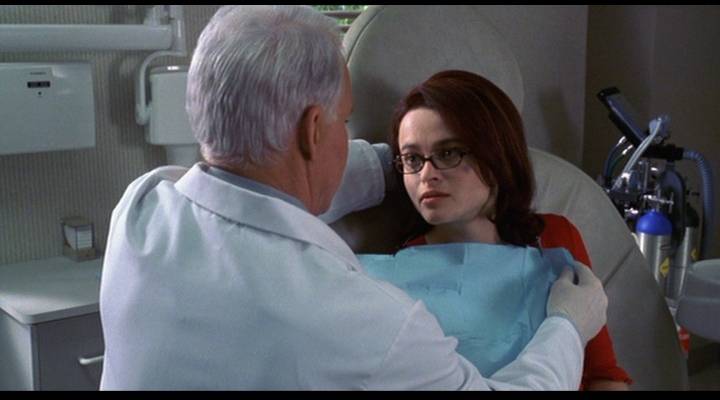
            However, for all the bullshit that Martin attached his name to during this era, he would occasionally still shine through with some truly great moments. 2001’s Novocaine is one of these occasions. Martin plays Dr. Frank Sangster, a dentist whose mostly straight-laced life becomes anything but when a new patient, Susan Ivey (played by Helena Bonham Carter), arrives in his office. Frank is immediately attracted to Susan, even though it is revealed that she is clearly there to scam him out of painkillers. As their relationship begins to develop, Frank is pulled into a web of crime that involves drugs, deceit and murder. His once quiet life now turned upside down, Frank finds himself a fugitive wanted for murder. Normally I would say more about the plot here, but there are so many subtle plot twists that I really don’t want to give anything away.
            The first thing I noticed about the film was that it looked amazing. First time director David Atkins, evidently coming from a family of dentists, uses a montage of dental x-ray shots during the opening credits that continue as scene wipes throughout the film. Novocaine is pure noir, with its combination of banal scenes from inside the dentist’s office (symbolizing Frank’s boredom with his life), intercut with intense, almost Hitchcockian scenes of intrigue (revealing what might have been if he’d chosen a different path), all underscored by Frank’s voice-over narration and a phenomenally eerie score by Steve Bartek (with the help of soundtrack veteran Danny Elfman). Instead of shadowy back alleys, however, this film’s chief location is the sterile, brightly-lit Dr. Sanger’s office, which brings to the forefront the shadowy secrets and desires of the main characters.
The film also gives us plenty of glimpses into Martin’s comedic past, as we get to see him do both physical and verbal comedy without rendering any of the scenes silly, which is something my younger self would have appreciated. Another unlikely source of comedy relief comes in the form of Dr. Sangster’s hygienist and fiancée, Jean, played flawlessly by Laura Dern. Jean is the kind of overly-peppy that can often be terrifying in a fellow human being. She is devoted to Frank to a fault, helping him cover up crimes he’s involved in after continuously lying to her. She runs her life and her work with an OCD-like precision, which seems to act as a coping mechanism for her when things in her life get intense.
Novocaine did terribly at the box office, probably because of Martin’s aforementioned aimless drifting from one forgettable picture to the next during this time. I wish that I could say that it’s become a cult classic since then but, reading reviews recently, it doesn’t appear that the public’s reception is generally favorable. But there is no denying that the plot is a true original, blending mystery and intrigue with comedy in a way that just isn’t done much, if at all. Trust me when I say that if you are now or have ever been a fan of Steve Martin’s work, Novocaine is a picture you must see. I wouldn’t exactly call it a return to form, save for a few moments of slapstick here and there, but it’s not exactly much of a departure for him either.
-         Jonathan Eagle


Monday, September 3, 2018

I'd Love to Turn You On #213 - Wolfmoon – Wolfmoon


          I discovered the Wolfmoon record years ago while working in a small record shop in Iowa. As a vinyl-obsessed collector, I was immediately drawn to the cover art. Who was this purple cloaked cosmic warrior, palming the planet Earth like a basketball? Prince before there even was a Prince? Was he some long-lost fuzz-funk disciple of Funkadelic? Perhaps a forgotten psychedelic soul singer that I could brag about discovering? I had to know. To my surprise, Wolfmoon was all of these things and none of these things. The music on the record was a beautiful combination of gospel and Southern soul with occasional brilliant flourishes of funk, rock and even country. Upon further research, I discovered that he was associated with the legendary producer and songwriter, Swamp Dogg, of whom I was a big fan. I bought it sight unseen and it’s been in heavy rotation at my house ever since.
The story of how the Wolfmoon record came about is almost as interesting as the music itself. In the early 1960s, Tyrone Thomas began a successful career as an R&B singer in his hometown of Richmond, Virginia. A teenager at the time, Thomas, who was calling himself Lil Tommy (pre-Soundcloud rapper days), quickly established himself as a talented performer with his various backing groups, including the Teenagers, the Parakeets and the Out of Sights, and securing opening slots for such international acts as Fats Domino and Sam Cooke. It was around this time that Thomas decided that it was time for him to go solo. This decision led him to his first national tour at age 14. However, it was a hometown gig with fellow Richmond artist Brooks O’Dell that perhaps changed the trajectory of Thomas’ career for the better.
O’Dell was immediately impressed with the young Thomas and decided to introduce him to his friend Jerry Williams Jr., aka Swamp Dogg. If you’re a fan of southern soul music at all, no doubt you’re familiar with Swamp Dogg, whose first three albums are considered classics of the genre and solidified Swamp as a cult figure and legendary performer. But the Swamp Dogg persona would not come to be until a few years later. Williams began writing and recording songs for Tyrone Thomas starting as early as 1964. The relationship was tumultuous almost immediately. Williams invited Thomas to live in his house for a while and, according to Williams, he wore out his welcome very quickly. The first two songs they recorded together were “I’m Hurt” and its B-side “Lov’h,” which Thomas immediately took back to Richmond and submitted to local record producer Mr. Wiggles and, according to Williams, tried to pass them off as his own. Still, Williams believed in Thomas’ talents enough to work with him again.
In 1969, Williams, who was just starting to cultivate the Swamp Dogg sound and image that he would become notorious for, signed a deal with Canyon Records and was looking to pad his new label with like-minded artists, of which Thomas was to be the newest. Swamp Dogg re-dubbed Thomas as Wolfmoon and the pair recorded the ten tracks that would become the first and only Wolfmoon record; seven original Swamp Dogg compositions and three cover versions. However, the album would not see the light of day for another four years, as the Canyon Records deal fell through and the two were left without a label. Finally, in 1973, the small Fungus Records imprint released the Wolfmoon record.
Still not much is known about the actual man, Tyrone Thomas himself, apart from what Swamp Dogg has said in interviews and in print which generally tends to paint him in an unfavorable light. In one recent interview, Swamp said of Thomas “this motherfucker has no integrity… It’s all about him” and citing multiple occasions of feeling taken advantage of by Thomas. Personal animosity aside, the two managed to put out an incredible piece of R&B history. The songs range from the spiritual (“God Bless,” “If He Walked Today”) to the funky (“My Kinda People”) and many other styles in between. An epic 8+ minute sendup of Curtis Mayfield’s “People Get Ready” showcases the multi-instrumental talents of Swamp Dogg while the piano ballad “Treasures That I Found” allows Wolfmoon to demonstrate his incredible vocal range.
Unfortunately, the record went almost completely unnoticed and it remained an obscure gem among record collectors for decades. Original copies were being sold for high sums of money for quite some time. That is, until 2013, when garage pop label Alive Natural Sound out of Los Angeles gave the album (and a handful of other Swamp Dogg releases) a proper CD and vinyl reissue, thus reintroducing the world to Wolfmoon. And let me tell you, this reissue sounds amazing. The only digital copies that I was able to find prior to the re-release were clearly vinyl rips that sounded kind of terrible. Alive presents the record with fully cleaned-up audio plus new detailed liner notes written by Swamp Dogg which alone is well worth the price.
-         Jonathan Eagle

Monday, August 27, 2018

I’d Love To Turn You On At The Movies #199 - Star Trek VI: The Undiscovered Country (1991, dir. Nicholas Meyer)


The summer of 1991 was a wonderful time to be a Star Trek fan. The franchise was celebrating its 25th anniversary, Star Trek: The Next Generation had completed its fourth season and was rivaling its predecessor in terms of popularity, and a new movie with the original cast was due in a few months. I walked into a theater that July to watch a movie I remember nothing about, but witnessed something I’ll never forget, the teaser trailer for Star Trek VI: The Undiscovered Country. Images from episodes of the original series and earlier films filled the screen in an overlapping, shifting collage while a narrator described the exploits of the crew of the Starship Enterprise over the last quarter century. Just as the narrator invited the audience to join the crew for “one last adventure,” the camera pulled back to reveal that the patchwork of scenes had been projected onto the hull of Enterprise itself, right before the ship jumped to warp speed!
I’ll be the first to admit that it’s not always easy to be a Star Trek fan because there’s so much inconsistency within a franchise that’s now over 50 years old. After a very uneven beginning with Star Trek: The Motion Picture in 1979, director Nicholas Meyer effectively restarted and rejuvenated the movie series in 1982 with Star Trek II: The Wrath of Khan, which has become one of high points of the entire franchise. The series expanded over the next few years and actor Leonard Nimoy, best known for his performance of the Vulcan science officer Spock, directed the next two installments and delivered another franchise high point with Star Trek IV: The Voyage Home (best known to the general public as “the one with the whales”). William Shatner, who portrayed Captain Kirk, nearly harpooned the series with the dreadful, bloated, and misguided Star Trek V: The Final Frontier, which he wrote and directed. After this low point, Meyer and Nimoy teamed up once more to craft The Undiscovered Country, one of Star Trek’s brightest moments, which just never seems to get enough credit.
The original television series in the mid-1960s established that Klingons were the primary enemies of the United Federation of Planets and served as stand-ins for Soviet era Russians in a loose parallel to the Cold War that ran through many episodes. Decades into the future, as depicted in Star Trek: The Next Generation, we know that hostilities have ended between the Federation and the Klingons, but we don’t know any of the details of how it happened. Meyer and Nimoy wisely seized the moment of current events with the recent collapse of the Soviet Union to illustrate how this peace was achieved. This story brings a logical conclusion to the series’ Cold War parallels, offers up one last great challenge for the original cast that allows all seven actors to shine, and merges the narratives of the original cast and The Next Generation (Nimoy also guest starred on a two-part episode of that series in a tie-in with the movie just weeks before its release). In addition to the seven original cast members, the movie features an outstanding ensemble of supporting actors including Christopher Plummer, Kim Cattrall, Brock Peters, Rosanna DeSoto, David Warner, and Michael Dorn (who plays the grandfather of his character, Worf, in The Next Generation). Yes, I could certainly go on about all of the fascinating minutiae connected to this movie, but I don’t want to distract from the fact that is an exciting sci-fi adventure with elements of a political mystery that’s well worth your time.
As a fan of Star Trek, there have been few moments that compare with the excitement and wonder I felt when I watched that teaser for The Undiscovered Country in the summer of 1991. The reason those feelings have stayed with me over the last 27 years stems from the fact that the movie delivered on the promise of that trailer as well as the entire series itself. When Gene Roddenberry created Star Trek in 1966, he wanted to present an optimistic view of the human race exploring the universe in the future. In a way that few other Star Trek stories have been able, The Undiscovered Country reconciles that positive outlook with a view of humanity with which the audience can identify. On the path to universal peace, Meyer and Nimoy were willing to reveal the flaws and prejudices of a noble group of heroic explorers. Traveling through this darkness allows the light of peace and reconciliation to shine with meaning and consequence. On the final voyage of the U.S.S. Enterprise, the veteran crew members show us once again how to meet the future (the undiscovered country) with courage, humor, and hope.

-         John Parsell

Monday, August 20, 2018

I'd Love to Turn You On #212 - TV on the Radio – Return to Cookie Mountain


           Last Wednesday I witnessed one of those magical moments that can only happen at Red Rocks. TV on the Radio opened for Father John Misty and drew an impressive crowd so early in the night. As light began to fade from the sky about halfway through their set, vocalist Tunde Adebimpe mused in a playful sing-song voice, “I see the moon and the moon sees me.” The band gave the audience a moment to turn around and regard the crescent moon rising between the amphitheater’s rock formations before launching into a blistering rendition of their biggest hit, “Wolf Like Me.” Just as the moon triggers a supernatural transformation within the song, it played a key role in morphing the relatively subdued audience into an ecstatic, howling mass during the song. The enduring appeal of “Wolf Like Me” hints at what makes Return to Cookie Mountain, one of this young century’s greatest albums.
 
TV on the Radio built on the promise of their debut EP, Young Liars, and their dynamic first full-length album, Desperate Youth, Blood Thirsty Babes, and delivered a mind-blowing collection of genre-defying, cathartic songs with Return to Cookie Mountain. Looking back, I remember how much I looked forward to the release of Return to Cookie Mountain in the summer of 2006. Sure, I had enjoyed the band’s first couple of releases, but I had a feeling that this new album would help me get through the very challenging times I was going through personally and professionally. Well, the album certainly didn’t disappoint me and the opening track, “I Was a Lover,” provided a well-tailored soundtrack and a much needed outlet to transcend the miserable situation surrounding me. Through the orchestrated cacophony of an overdriven bass drum, a sorrowful horn sample, layers of glitchy distortion, and countless other sonic elements, Kyp Malone and Adebimpe inject passion and anguish into Malone’s brainy, surreal lyrics that capture the fever-dream paranoia that results from the implosion of a relationship. “Province” treads on similar thematic territory, but ascends with a tentative sense of hope and optimism for what the future holds. David Bowie joins Malone and Adebimpe on vocals for this song and not only helps create one of this band’s finest moments, but also marks a highlight among his late career collaborations. When the band played the Boulder Theater three years ago, Malone introduced “Blues from Down Here” by skewing the now common on-stage banter about legal marijuana in Colorado and asked the audience if they would seek justice for those who have been imprisoned under severe drug laws. This literal application of Malone’s harrowing metaphor within the song surprised me at the time, but has helped me appreciate the layers of meaning contained in this haunting perspective of isolation, oppression, and hopelessness.
As much as I love Return to Cookie Mountain, I have to admit that a lot of what makes it such an amazing work can also weigh it down if you’re not feeling up for taking the album’s emotional journeys. In 2008, when TV on the Radio released their next album, Dear Science, I was delighted that the band offered up a bright, beautiful set of songs as complex, innovative, and satisfying as their earlier work. Two of that album’s high points, “Golden Age” and “Lover’s Day,” feel like intentional counter-balances to the heaviness of Return to Cookie Mountain. In 2011, the band released Nine Types of Light, an album I’ve liked, but never really loved (a point I’ve had to debate repeatedly with a number of TVOTR fans over the years). Three years later, TV on the Radio’s fifth album, Seeds, won me back with a set of concise, polished, and upbeat songs proving that these remarkable musicians still have plenty of room for exploration and expression.

-         John Parsell


Monday, August 13, 2018

I’d Love To Turn You On At The Movies #198 - Body Heat (1981, dir. Lawrence Kasdan)


In one of my favorite scenes from The Simpsons, Nelson Muntz is seen coming out of a movie theatre showing Naked Lunch. He angrily looks up at the marquee and says, “I can think of at least two things wrong with that title!” If Nelson were exiting Lawrence Kasdan’s stylish noir thriller Body Heat, he would not have said the same. Body Heat delivers on all three things promised in its title. Hot stars William Hurt (in his third appearance) and Kathleen Turner (in her first film role) are undressed and entwined A LOT in this movie. We know much about their bodies by the end of the film. The movie takes place during a stifling heat wave in a small Florida town, and by the end, one is dying for nothing more than a cool shower. And finally, the movie gives flesh to the idea of “body heat” or human sexual chemistry as few films have.
William Hurt plays Ned Racine, an ambulance-chasing lothario whose crappiness as a lawyer is only outdone by his lack of discrimination in sexual partners. He’s defended every loser in the city, and slept with most of the single and unhappily married women. He’s good looking, in a sleazy 70’s porn-star way, so he’s lucky but he seems bored with his usual prey. One night while cruising for love, he meets a beautiful and mysterious woman named Matty Walker (Turner) and begins a wild sexual affair with her. This is not your typical movie affair. Director Kasdan mixes equal parts film technique and softcore porn levels of eroticism to create some seriously hot scenes. The slavish rules of film noir lighting, dialogue (often hilariously stilted), and camera angle were never put more directly to the task of filming sex, and as a result the entire genre is moved forward just a little bit. More than any other way, Body Heat succeeds almost as a tribute to the noir genre and specifically films like The Postman Always Rings Twice.
Obviously, there’s a rub, and it is that Matty is unhappily married to another man (Richard Crenna), who happens to be fabulously wealthy. Matty convinces Ned that if he kills her husband they can live sexily ever after with the money she inherits. Ned, being a sleazy small-town lawyer doesn’t need a lot of convincing. Like many of the best noir thrillers, the characters seem to inhabit an alternate universe where morality is for the weak, and the spoils go the brash. Hmmm, considering the state of the world we currently inhabit, I wonder whether this is the alternate or the actual state of things. Situational ethics and expected results from hard-boiled threats may seem like a crazy way to live, but look how far they’ve taken our president. All this is to point out that there are no protagonists in this film, just antagonists and double-crossers. Even Ned’s friends, a local police detective and the town’s D.A. (ably played by J.A. Preston and an impossibly young Ted Danson respectively) turn out to be the guys leading the investigation of the murder. Nobody can be trusted and loyalty is only skin deep - no matter how beautiful your skin is.
As the investigation heats up and Ned and Matty’s relationship shows cracks, a sense of claustrophobic disaster reigns. Eroticism is replaced with dread as the story devolves into one of the more memorable cross, double-cross, triple-cross, hidden identity plot twists and revelations of modern cinema. Of course, none of it is really that believable, but throughout, Body Heat succeeds as a stylish tribute to film noir sensibilities and conventions, while offering two important actors early screen cred and a scrap book of themselves when they were young and beautiful. For the viewer, it is simply a hell of a lot of fun.

-         Paul Epstein