Monday, February 25, 2019

I’d Love To Turn You On At The Movies #212 - Beaches of Agnès (2008, dir. Agnès Varda)


          “I’m playing the role of a little old lady, pleasantly plump and talkative, telling her life story. And yet it’s others I’m interested in, others I like to film.” So begins the autobiographical documentary Beaches of Agnès with the words spoken by director Agnès Varda herself, on the cusp of turning 80 years old, over images of her walking barefoot on a beach. And as if to demonstrate that she’s more interested in filming others, the very next sequence finds her and her crew setting up a group of mirrors on the beach (a simple and not belabored metaphor for looking back, reflecting on her life and work), and before she says anything about herself she’s introducing her crew in spoken “credits” over their reflections in mirrors. But after this, she begins to set up and review photographs of herself as a young girl, talking about time spent visiting beaches with her family. And then we’re off on a chronological tour of her life in a fairly normal documentary fashion. That is, we would be if Varda could ever make a fairly normal documentary.
            She receives word that the new owners of a house she use to live in would allow her to come visit and film in the home, but as quickly as she’s there talking about her childhood, she’s off on a tangent again, digressing into a detour that indulges her curiosity about the new owner’s train collection, her interest in him as a person and what interests and compels him overriding the need to tell her own story. And so it goes - the film revisits periods of her life and digresses repeatedly into eddies and detours about other things as they strike her, sometimes for only a shot or two with a comment, sometimes for a short sequence before looping back to her own story (and work). But we still get plenty of Agnès - her youth during wartime, reflections on her parents and siblings, and before long, her films themselves. And Jacques Demy - especially Jacques Demy.
            Varda started work as a professional photographer before she decided to make films - as she notes: “without experience, without having been an assistant before, without having gone to film school” - beginning with the 1954 film La Pointe Courte, an assured debut that shows a strong eye for composition that is one of the hallmarks of her work. That film formalizes the discursive mode that would later be more thoroughly integrated in her work by separating the film’s documentary approach to showing a fishing community in southeastern France and the narrative story of two lovers within that community. It flip-flops between narrative and the documentary, but these two modes would be intertwined throughout her career, with her documentaries often featuring staged sequences and humorous asides (as in the charming Uncle Yanco, a film about her eccentric uncle she meets living in the U.S., or in a whimsical interlude in Beaches of Agnès itself, where she recreates her film company's office outside and has her co-workers doing their jobs on a sandy beach recreated on the street), and her narrative films almost always featuring the realistic digressions and sidetracks like those noted above. The film is also considered a precursor to the French New Wave cinema of the early 60s, five years before either Godard or Truffaut had features out.
Early on as the New Wave was bubbling up, Varda met Jacques Demy in 1958; they married a year later and, despite ups and downs, separations and reconciliations, remained married until his death in 1990. Their lives are intertwined personally, and professionally with Varda directing Demy's autobiographical final script Jacquot de Nantes, completing the filming only weeks before Demy's passing. Since his death, Varda has largely worked in documentary, circling often around her own life and Demy's, with 1993's The Young Girls Turn 25 a touchback to Demy's earlier The Young Girls of Rochefort and 1995's The World of Jacques Demy a direct tribute to his works. After this, Varda began to look to her own life and experience for documentary material - she'd done it before, with Uncle Yanco and others, and in Documenteur, a narrative film reflecting on events of her own life and separation from Demy while in the States.
And so Beaches of Agnès looks to sum up more than five decades of filmmaking from this unique director, who blurred the line between documentary and fiction to the point where it doesn't matter. She talks about many of her films - from the award-winning New Wave classic Cléo from 5 to 7, to her feminist mid-70s masterpiece One Sings, the Other Doesn't (due out from Criterion in May), to her terrific late-period documentary The Gleaners and I - but mostly reflects on the importance of her family, her many friendships and artistic acquaintances, her 80th birthday, and her life with Jacques Demy, circling back over and over to the most important relationship in her life, and ultimately learning to accept his passing and that of other friends she'd known over time. The feel of the work is valedictory, as though Varda was making her swan song, and in doing so talking about her work but mainly thinking about others, always her modus operandi. It's touching, beautifully shot and conceived and, yes, discursive. There are those who find her meanderings and whimsy a touch light, but I find her interest in others and her way of presenting herself utterly winning. And though this feels like a final film that she made at 80 years old, she's made some short works since its release and in 2017 released the excellent, Academy Award-nominated Faces Places just after she turned 89. And now IMDB lists a new documentary, Varda by Agnès, which received its first release only weeks ago, and described as "an unpredictable documentary from a fascinating storyteller" - sounds like she's still going strong as she moves past 90.
-         Patrick Brown

Monday, February 18, 2019

I'd Love to Turn You On #225 - James Blood Ulmer - Free Lancing


           James “Blood” Ulmer is a guitarist filed in our jazz section, but don’t hold that against him. One quick listen to the distortion-laden soloing in “Night Lover” starting right around 3:25 and running into the tumult he’s creating just under a minute later tells you he’s as beholden to electric blues and rock guitar as to the clean, single-note picked lines that the phrase “jazz guitar” usually calls to mind. Or you could start at the very beginning (a very good place to start) with the lead cut “Timeless” and in less than a minute you’ll know that though Blood Ulmer may know and respect Wes, Django, and Grant, he’s got no use for their gentility and clean tones. Hendrix and Delta Blues are his sonic touchstones and the loose-knit harmonic freedom of his former bandleader Ornette Coleman his conceptual one, and his career - a varied mix that lands him in our jazz section because of the Ornette connection but could just as easily find him solidly placed in the blues section - is a remarkable one that continues unabated to this day.
            Free Lancing is his third released album, and one that found him signed to Columbia Records, who worked with him for three (very good) albums before cutting him loose, when the mid-1980s ushered in a different kind of jazz than Ulmer was making. Which is what, exactly? I often see this called "free funk" or "jazz-rock" or something hyphenated that suggests that its mixture of jazz, funk, R&B, blues, and rock is as hard for folks to put a finger on and define as Ulmer's polyglot guitar playing itself.
After growing up in South Carolina, Ulmer bounced around a bit before finding his way to New York City in 1971. There he played with several notable ensembles before connecting with Ornette Coleman, who Ulmer credits with helping him define the direction of his music. His debut album Tales of Captain Black (which features Ornette) set the template for his earlier recordings - catchy themes and knotty soloing, a dash of sonic chaos, mostly quick tempos - though it occupies a decidedly jazzier realm than this one. The follow-up, Are You Glad to Be in America?, with its pointedly race-conscious title track, folded more blues and R&B into the mix, though the horn section of David Murray, Olu Dara, and Oliver Lake simultaneously touched on jazz and soul, with solos and charts that hit different styles as needed. These (and his playing on Arthur Blythe's superb album Lenox Avenue Breakdown and its follow-up) brought him to the attention of Columbia Records, where he took advantage of their excellent recording facilities to make his best-sounding and most rocking record yet.
            The album kicks off with "Timeless" featuring its basic trio: Amin Ali on electric bass and G. Calvin Weston on drums, providing the galloping rhythm with Ulmer’s sharp, inquisitive soloing leading the charge, then running non-stop throughout. Sometimes his playing is delivered in a fast run of notes, or a short cutting burst that stops on a dime; sometimes he's floating more serenely over the rhythm before taking an abrupt turn back into the maelstrom. And sometimes the whole group becomes untethered, relishing in noise for its own sake before snapping back into the gallop on command. But then the sound and fury of the lead cut changes abruptly into the funky soul of "Pleasure Control" where Ulmer's vocals get as raw as his guitar sometimes, though they're not as omnipresent as his constant guitar. This track sounds like an errant outtake from some funk group’s recording sessions where they revved up the tempos, let the guitar cut loose, and brought in the female backing singers (and second guitarist Ronnie Drayton, who's along on all three vocal tracks) just for fun before getting back to the business of making slow burns. But it sounds great. And it's followed by the aforementioned "Night Lover," another burning trio instrumental that even finds a snatch of melody from Ulmer’s “Tales of Captain Black” sneaking into his soloing. We get another vocal funk cut in "Where Did All the Girls Come From," which sports the mellowest rhythm yet, then the original side-ender of "High Time" which pulls the horn section from the previous album for a funky instrumental track.
            The second half progresses similarly - trio plus horns on the fast funky opener "Hijack," another vocal cut in "Stand Up To Yourself," and the mellowest cut the basic trio put on the album, "Happy Time," which ends the record on a fade that insinuates they could keep on going all night if you asked them. But in between those, there are a couple more standouts of note. On the record's title track, Ulmer cuts loose with the wildest guitar playing of the record, in what sounds like slide work (but I don't think it is). And "Rush Hour," another funky, horn-accented track with a quick, staccato rhythm features an uncredited harmonica player and saxophonist David Murray taking a burning solo - or perhaps duet is more appropriate, seeing as he's entangled throughout his solo with Ulmer blurring the line between comping support and soloing on his own, a trick straight out of Ornette’s book.
            Hopefully this isn't your first encounter with Ulmer. And if it is, hopefully it's not your last. Throughout the 1980s, Ulmer continued to pump out great albums - Free Lancing is only the tip of the iceberg. Find the never-on-a-domestic CD Black Rock if you can (keep an eye on the used vinyl bins!), or the superb guitar/drums/violin trio Odyssey, which finds Ulmer exploring a country-ish vibe for much of the album. Or pretty much anything by his more exploratory jazz-centered groups Music Revelation Ensemble or Phalanx. Or one of his more straight-up blues albums, particularly those produced by Vernon Reid (and especially Memphis Blood: The Sun Sessions or No Escape from the Blues: The Electric Lady Sessions). Or maybe his most recent album Baby Talk, a live collaboration with European free jazz trio The Thing. Are you getting the idea that you more or less can't step wrong with Ulmer? Then my review did what it's supposed to. The catalog keeps appearing and disappearing from being in print, so take advantage of this one while it's still around, and then start exploring.
-         Patrick Brown

Monday, February 11, 2019

I’d Love To Turn You On At The Movies #211 - F For Fake (1973, dir. Orson Welles)


Let’s just get this out of the way: Orson Welles was a genius. Settled? Cool.
Alright, maybe you need some more convincing. Maybe you’re not utterly compelled by his work directing, writing, and starring in the likes of Citizen Kane, The Magnificent Ambersons, or even the recently released, long-gestated The Other Side of the Wind. Maybe you need something headier, more philosophical, more experimental. If that’s the case, then I’ve got the perfect film for you: 1973’s essential meditation on art, hubris, and mortality, F For Fake.
You probably have some questions about F For Fake. Namely, what kind of movie is it? That’s a great question! I don’t know the answer. Here at Twist & Shout, we categorize it as a documentary. But it’s also a narrative film, with entire sections fabricated by Welles, and it also functions as an autobiography, an insight into our aging, tired, embittered auteur. (This was, after all, the last film Welles completed before he died, making it hard not to consider it a manifesto.) Most of all though, this is a metatext, a film about filmmaking. Art about art. Cinema about trickery.
Ostensibly, F For Fake is a documentary about the infamous fake artist, Elmyr de Hory, whose forgeries of Picasso, Matisse, and Renoir all landed spots in high-end galleries across the world. But Welles isn’t vindictive toward Elmyr, instead treating his subject with a certain reverie; to Welles, Elmyr represents a fundamental question for the art world - is a forger still an artist? Welles extends that question to Clifford Irving, a biographer that covered Elmyr’s story... who also, it turns out, forged Howard Hughes’s autobiography.
Amid these philosophical questions, Welles gives details of his own experience as an artist; there’s a soft, lyrical sequence in the film that finds our guide reflecting on his youth as an actor in Europe, a position Welles himself conned his way into: “I started at the top, myself,” he tells us, before adding the poignant, soft-spoken joke, “I’ve been working myself down ever since.” Welles - who I called a genius mere minutes ago - contextualizes himself as a fake, too!
But F For Fake highlights Welles as an artist at the height of his creative powers. The documentary footage is shot with all the depth and focus of his narrative films, and the editing of the film somehow manages to juggle all these various narratives with the deft ease of a skilled street magician. Or maybe he’s a pickpocket. A mime? Who’s to say? Throughout the film, you get the feeling that you’re being played, conned, tricked. And you are - but maybe you always have been, Welles suggests, in any movie you’ve ever watched.
            In case you couldn’t tell, it’s hard to talk about the fine details in F For Fake. This is a film that deals in the very abstractions that Picasso’s - or is it Elmyr’s? - work tackles. In case you also couldn’t tell, F For Fake is one of my favorite movies ever made. I’m astounded, consistently, by this film and all of its intricacies and depths and nuances; stunningly shot, Welles’s careful camera placements and focuses simultaneously reinforce and undermine thematic concerns of authorship and authenticity. These broad themes somehow still feel personal and introspective; sitting from the editing bay, Welles muses directly to us, making the showy editing feel like Welles’s own stream-of-consciousness. Watching F For Fake feels like you’re falling down the rabbit hole; at the end, you’re in Welles’s own wonderland.
I cannot understate how much F For Fake fundamentally reshaped how I consume film, art, music, and pop culture. Welles is a charlatan, a trickster, an artist; he’s the very essence of cool in this film. So, let’s reiterate: Orson Welles was a genius. Settled? Cool.
-         Harry Todd

Monday, February 4, 2019

I'd Love to Turn You On #224 - Screaming Trees – Dust (1996)


            Having spent pretty much all my formative years in the 1990s, a big part of my musical upbringing revolved around mainstream radio’s changing of the guard from glam metal to “grunge” (as it was referred to at the time, though it’s pretty much just classic rock nowadays). As a die-hard metal fan all through the ‘80s I resisted this shift at first, but even I was powerless to deny the allure of these incredible bands coming from the Pacific Northwest. Much of it was still extremely heavy, yet it somehow seemed more accessible, more like the garage bands that I was used to playing in. I mean, I loved metal, but let’s face it, nobody that I was playing with at 12 years old was going to be able to rip through a George Lynch guitar solo. So it wasn’t so hard to see why this new grunge flavor rocketed in popularity, leaving metal in its dust.
One of the more overlooked bands to come to prominence in this movement was Seattle’s Screaming Trees. Likely this is because they were coming from a background more concerned with blues and psychedelic rock and less focused on punk aesthetics than many of the other bands in that scene. However, they did have all the ingredients to be huge. A monolithic rhythm section, crushing, fuzzed-out guitar tone and a vocal delivery by one of the best vocalists in the business, one Mr. Mark Lanegan. By the time their seventh album (and third for a major label), Dust was released in 1996, they had gone through a lot as a band, from in-fighting and personnel changes to substance abuse and the loss of friends and contemporaries to such addictions.
These events were perhaps where Lanegan was coming from in his songwriting, as Dust explores a gothic sensibility more akin to his later solo work. Not that the Trees’ songs were ever all that sunny, but Dust seems to capture a darkness that had previously only been hinted at. The album’s opener, “Halo of Ashes,” for instance, kicks off with guitarist Gary Lee Connor’s jangly, Yardbirds-esque opening riff which is joined by a booming, tribal drum lead-in courtesy of drummer Barrett Martin. Lanegan’s lyrics come in, immediately exploring themes of mortality and defeat. The album’s first single, “All I Know” is an anthemic blues-rock staple that stands as one of the record’s highlights. Also worthy of mention is the sweet yet macabre ballad “Sworn and Broken” with a haunting organ solo by guest player Benmont Tench from Tom Petty & the Heartbreakers.
Production-wise, Dust is arguably the best-sounding record by the Trees. The band tapped George Drakoulias to produce. Known for his work with many American Recordings artists like the Black Crowes and the Jayhawks, Drakoulias’ finished product was a more polished, arena-ready sound than previous efforts. To top it off, Andy Wallace (of Nirvana’s Nevermind fame) was hired to master, further adding to the album’s sheen. Perhaps this was a last-ditch effort to cash in on the grunge trend and get the Trees onto bigger tours. Unfortunately, the album’s release came just a hair too late, and the grunge sound started to become less and less relevant in the subsequent years. The Trees took an extended hiatus after that, officially disbanding for good in 2000, making Dust their final record.
It’s truly baffling to me that Screaming Trees weren’t one of the biggest bands of the 1990s. They rose to prominence at the same time as the Nirvanas and Pearl Jams of the world, they were a huge part of the Seattle underground music scene since as early as the mid-1980s and their single “Nearly Lost You” introduced them to the mainstream via the same film soundtrack as other grunge behemoths of the day, Cameron Crowe’s Singles. With all the stars in alignment at the time, superstardom seemed inevitable for them and it just didn’t happen. While this is a real shame, it also set the stage for a very lucrative solo career for Lanegan, not to mention his being a sought-after commodity for guest spots. So maybe it’s all for the best. However, I implore anyone, especially Lanegan fans, to explore the Trees’ back catalog because it is all incredible. And Dust is a hell of a swansong.
-         Jonathan Eagle

Monday, January 28, 2019

I’d Love To Turn You On At The Movies #210 - D.C. Cab (1983, dir. Joel Schumacher)


Whenever I talk about how D.C. Cab is one of my favorite films to anyone familiar with it, the most common response that I get is, “and you said you DON’T smoke weed, right?” This makes sense, considering the film is essentially a series of sight gags meandering around plot points and subplot points that make very little sense together. This is not a hindrance. The film is perfect for those with the shortest of attention spans.
D.C. Cab is Joel Schumacher’s second theatrical film, and everything about it screams “low budget,” down to the editing and the film stock. Even the DVD release is bare bones. It has no subtitles, no other languages but English and lacks even a menu for chapter selection. Prior to D.C. Cab’s release, Mr. Schumacher released The Incredible Shrinking Woman (1981) and would follow it up with the one-two punch of box office favorites St. Elmo’s Fire (1985) and The Lost Boys (1987), so it’s not like Mr. Schumacher didn’t already have his footing as a filmmaker. No, he made D.C. Cab awful-looking on purpose. Since the plot revolves around a ramshackle taxicab company in Washington D.C., I think the low budget, almost “new-hire-training video” quality was completely intentional. Especially when you consider the cast, on which Schumacher absolutely did not skimp. The cast is made up of a combination of ‘80s pop culture giants (Mr. T, the Barbarian Brothers), up-and-coming stand-up comedians (Bill Maher, Paul Rodriguez) former sitcom stars (Max Gail, Whitman Mayo) and Gary Busey. It even features a small but significant cameo from R&B singer Irene Cara as herself.
Albert (Adam Baldwin) is a wide-eyed twentysomething with big dreams to become a cab driver. Obviously every young person dreams of one day driving a cab when they get older, so no issue there really. When his father dies Albert decides to move to Washington, D.C. and track down his dad’s best friend Harold (Max Gail), who owns the D.C. Cab Company. Albert goes through a series of ride-alongs with the eccentric staff of the cab company, including Cleveland Rastafarian Bongo (Otis Day), womanizing racist Elvis fan Dell (Busey), fast-talking Tyrone (Charlie Barnett), and tough but sensitive Samson (Mr. T) to name a few. Many of the ride-alongs happen in almost rapid-fire succession, creating a sort of sketch or vignette effect for the first half of the film. The fledgling company eventually comes into some money when a valuable violin is recovered from one of the cabs and the staff are granted the reward. Even though most of the staff make it clear that they hate driving cabs and would rather take the money and run, Harold, with the help of an inspiring pep-talk from Albert, convinces the staff to invest their share back into the company. This leads to the drivers renewing their licenses (including special permits for airport drop-offs) and new paint jobs on both the cab stand and the cars, but that’s about it. Somehow, this boosts morale so much that the drivers start loving their jobs and their new co-worker. Albert is then implicated in a kidnapping (because of course) and it is left up to the drivers to bail him out and save the day.
And, again, besides the multiple random subplots that pop up throughout the course of the film, that is pretty much it for story. The reason that D.C. Cab is able to keep your attention is because it never stops moving. It continuously hits you over the head with so many jokes, gags and slapstick moments that by the time you realize what you just watched made little sense, the credits are rolling. And speaking of the credits, because the drivers save the day in the end (and that’s not really a spoiler), the credits roll over a funny and charming parade sequence that the city decided to hold in their honor. Each and every cabbie slowly drives through the parade, dancing and carrying on atop one of the cabs. It’s hard not to smile during this, despite it being almost aggressively corny.
I defy any comedy fan, particularly those who came of age in the 1980s to not instantly fall in love with Schumacher’s D.C. Cab. I personally can’t help but grow nostalgic when I watch this film. To this day, it’s perhaps my favorite comedy of the 80s, rivaled only by Fletch. But that’s a film for another entry. And, yes, since we are after all in Colorado, I will give it my “excellent pick to watch while high” endorsement.
Jonathan Eagle

Monday, January 21, 2019

I'd Love to Turn You On #223 - Mastodon - Blood Mountain

I feel like I got introduced to Mastodon in completely the wrong way - I read about them before ever listening to them. Their drummer, Brann Dailer, wants to play drums like Randy Rhodes played guitar, to the extent of having a polka dot drum kit to match Randy’s famous guitar. Loving the intent behind his playing, I picked up their most recent album at the time, Blood Mountain​, without even knowing what they sounded like. I was 14, a freshman in high school, and from the massive drum fill that pummels you in the first few seconds, I became a part of their cult. If you aren't familiar with the band, immediately prior to this album Mastodon had released ​Leviathan, a concept album chronicling the story of Moby Dick in a way no other band or storyteller has. They gave the book a soundtrack and mood that nobody knew it needed. It allowed you to internalize the mentality of these characters in unheard of ways, and for some like myself, introduced me to Moby Dick as more than a reference I would see on TV or in movies. With ​Blood Mountain Mastodon took their newfound success and came out with an album that was even darker, heavier, and more progressive than ​Leviathan​. Above all else this album accomplished the ultimate goal - getting this kid to have a deep love of heavy metal ever since.
When this album starts it grabs you by the hair and drags you into a snowy cave to begin the experience that is Blood Mountain. The Joseph Campbell-inspired story is that of an unnamed character in search of the Crystal Skull to put atop the Blood Mountain - which he will later find out has dire consequences. On his journey he has to fight vicious monsters and overcome obstacles that could most definitely take his life. As our hero ascends the mountain, he comes across a Sasquatch that can see into the future and a colony of half-tree people, the Birchmen.
All of this seems utterly mad until you listen to the music that is behind it. The drum performance by Brann Dailer sounds like the footsteps of our hero as he is running for his life. Bill Kelliher’s guitar playing gives life to the mountain that is trying to protect itself. Troy Sanders' bass and Brent Hinds' guitar provide meaning and vivid images of what our hero is facing, while both of them on vocals (along with an array of guests) give the illusion of hearing voices and hallucinations. As a kid I wasn’t searching for all of that, I was just into it for the music. It wasn’t like anything I had heard before. The only metal music I knew at the time was Iron Maiden and some Metallica, but this album had very clear nods to some other favorites of mine like Yes and King Crimson, references that I heard but wasn’t able to really place. It was the first time I was able to hear the influence of prog bands in heavy music and it didn’t seem forced, it was just a part of their musical language.
By the time the album is in the final stretch with songs like "The Mortal Soil," our hero gets warned of the dangerous territory and his fate as he is approaching the peak, but that won’t stop him. "Siberian Divide" is where this album metaphorically peaks, our hero almost reaching the top, but failing as he starves to death underneath an avalanche. "Pendulous Skin" takes us out of the physical body of our hero as he ascends into the afterlife, which is what was meant to happen all along. No man is ready to conquer the Blood Mountain. After this album ends, and you look back on the trials and tribulations of our unnamed hero, it feels like the kind of folk tale that you can project your own meaning onto. Whatever your Blood Mountain is, even if you don’t succeed in making it to the peak, there is still a lot that went into the journey. All that you learned about yourself on this journey wasn’t necessary for getting to the peak of Blood Mountain, but they are things you now have for your journey into your next life which you are now ready to conquer.
-         Max Kaufman


Monday, January 14, 2019

I’d Love To Turn You On At The Movies #209 - In A Lonely Place (1950, dir. Nicholas Ray)


In 1950, Humphrey Bogart was one of the top-grossing film stars in the country and had just established his own Santana Productions film company to create interesting work outside the rigid Hollywood studio system (though still relying on studios for distribution) after being known the industry as a somewhat willful star to work with. At the same time, director Nicholas Ray had made three moderately successful films (one of them via Santana Productions) and his star was rising; his biggest success, Rebel Without A Cause, still lay years ahead of him. Ray was in a tempestuous marriage with actress Gloria Grahame, also an up-and-comer with several supporting roles to her credit, but her only starring role to date had come a couple years earlier in the film noir Crossfire. These three strong artistic personalities found themselves together to create the best film Santana Productions made - and also one of the best works any of the three produced in their careers - the noir-ish drama In A Lonely Place, adapted from the Dorothy B. Hughes novel of the same name.
            Bogart stars in one of his all-time best performances as Dixon Steele, a screenwriter who hasn’t had a hit since “before the War,” whose violent temper we see erupt three separate times in only the first six minutes of the film, and whose penchant for drinking doesn’t help matters. Gloria Grahame plays Laurel Gray, a neighbor in the same apartment complex who’s seen Steele (usually called “Dix” in the film) around and when he’s accused of murdering a young woman who left his apartment after going there to help him work on a script - a story the police hardly believe - she provides his alibi, though official suspicion is still aimed squarely at him. As Laurel and Dix get to know each other, romance blossoms and his writer’s block begins to lift, but as Laurel learns more about his explosive temperament, she (and the audience) begins to wonder if she did the right thing in helping him - and if perhaps her own life might be in danger. Nicholas Ray, who advocated for his wife to play the role after both Lauren Bacall and Ginger Rogers proved unavailable, has an unerring eye and ear for the tone of the film, which starts out like a whodunit and then quickly loses interest in the murder mystery as the principles fall for each other and the film instead drifts into the turbulent waters of their relationship (though the murder always lurks in the background). There’s never been a more threatening ‘love scene’ than when Dix is making breakfast for the increasingly suspicious Laurel, with the dialogue standard romantic fare but the body language and the absolutely perfect tone of Grahame’s delivery reading as pure terror.
In fact, it’s hardly a noir at all, even though it’s tagged as such on most film sites, and even though a murder sets things in motion. Nowhere are the shadowy, high-contrast cityscapes of noir, the standard femme fatale (instead we may have noir’s first homme fatale), the greed and cynicism driving most of the great noirs - instead we have an examination of a delicate, fragile relationship, one that’s constantly under threat of being blown apart by Dix’s behavior. This examination of the relationship of outsiders, and especially of masculine stereotypes, is common to Ray’s films - think of James Dean in Rebel, fighting against the school gang leader for honor and disappointed in his father’s inability to stand up to his mother, think of James Mason in Bigger Than Life, undermining the role of paternal protector to his family as his addiction spirals out of control, think of Johnny Guitar and its inversion of gender roles wherein women play the respective heads of a town in roles usually doled out to male actors and Sterling Hayden’s titular character is just an ex-flame and hired gun to Joan Crawford. And right in this line we have In A Lonely Place and Dix Steele, supposedly a successful artist in Hollywood, but also a heavy drinker, and a brawler when provoked - and he gets provoked at the drop of a hat. His masculine ego simply can’t take it when he feels attacked, rightly or wrongly, and as the film progresses and he gets closer to Laurel Gray, he gets more paranoid and jealous, rather than more intimate and trusting. It’s an unsettling examination of toxic masculinity decades before that phrase was even coined.
As it was in the script, so it was in life. Actress and writer Louise Brooks wrote in Sight & Sound magazine about Bogart’s performance that “In a Lonely Place gave him a role that he could play with complexity because the character's pride in his art, his selfishness, his drunkenness, his lack of energy stabbed with lightning strokes of violence, were shared equally by the real Bogart.” And the relationship of Dix and Laurel gets closer and closer in the first half of the film, then slowly falls apart for the second half, mirroring that of Ray (who was also a heavy drinker) and Grahame, who separated during the filming and who divorced two years later. Ray, after filming the original script’s ending, decided it didn’t ring true and created an improvised new ending with Grahame, Bogart, and co-star Art Smith. The ending, which I won’t spoil for you, replaced the noir-styled downer finale of the novel with a more devastating and unexpected one that gives the film its lasting sting and resonance.
            Time hasn’t been as kind to Ray’s work as when he was revered by French critics of the 50s and 60s, but In A Lonely Place has endured, his only film to place on the most recent once-a-decade international critics’ poll in Sight and Sound magazine. He’s got a lot of great work but this film, with its personal resonance for the three key artists involved in its making, cuts the deepest of any of his films.
-          Patrick Brown

Monday, January 7, 2019

I'd Love to Turn You On #222 - Tune-Yards - Bird-Brains


 2009 was an interesting year for music. There were no real game-changers in 2009, but there was at least one album that presaged a dominant mode of music-making in the 2010’s: Tune-Yards’ Bird-Brains. The debut record from Merrill Garbus’ discordant pop outfit is an outstanding record, not only for how it set the stage for Tune-Yards’ continued growth, but also for how it weaves the mid-00’s indie rock sensibilities with the out-there, lo-fi, rhythmic production styles that rose to even greater prominence in the recent teens. Add in some seriously engaging political rhetoric, and it’s easy to see that Bird-Brains is well worth your time.
            Recorded entirely on a handheld voice recorder (and then released initially on recycled cassette tapes), Bird-Brains has a distinctly tinny feeling. Garbus’s music offers steady, thumping rhythms that put the listener into a sort of tranced, zoned state and while the instrumentation is danceable, the lyrics are anything but; throughout the album, Garbus sings of gendered injustices, motherhood, and problems of self-image. “Hatari,” the album’s lead single, is dangerous in how much it makes you want to groove while ignoring the injustices being sung about. The lyrics and instrumentation hit that perfect sweet spot between frictional and lovely, making it easy to understand Bird-Brains as an album of contradictions and double-standards; it’s a deceptively complicated album filled with elements both harsh and tender that force the listener to listen without passivity.
Consider, for example, the interminably groovy mid-album cut “Jumping Jack.” The bass is crunchy, the xylophone seems to be hitting the upper register limits of the recorder, and the simple drum-fill takes on a Madlib-esque vocal quality. Like other great Tune-Yards songs, the lyrics rework a nursery rhyme (“Jack and Jill” here) into a modern feminist anthem that provides ample catharsis in a world overwhelmed by patriarchal standards: “Driving past in his fast car / Jill says man you are bizarre / Trying to tell me what to do / Watch out cause I’ll knock you out,” Garbus sings simply and softly, weaponizing her traditionally feminine musical impulses over the more traditionally masculine instrumentation. Garbus forces us to recognize how she’s using these musical impulses, and how the gendered presuppositions of them is ultimately a negative aspect that the music industry stands to grow from.
            There are moments like this feminist catharsis on nearly every song on Bird-Brains, and the album is better for it. “Fiya,” the album’s most well-known track, offers a nuanced, understated perspective on feminine image issues that is equal parts bitter sadness and incredible rage. Likewise, “News” attempts to critique the inherent gendered power dynamic with the act of getting pregnant; “I can get real pregnant from men and birds / Who sing much prettier than you,” Garbus conveys, undermining the masculine figure’s potential. Garbus’s lyrics are never quite heavy-handed, but neither are they understated – just like all of the gonzo rhythmic palettes throughout the album.
Yet, Bird-Brains is not entirely angry; there is a certain sweetness that pervades even the record’s harshest moments, one that, for all the rage and dissatisfaction, still envisions a better world. That stage is set by the album’s opening track, “For You,” which has Garbus sing an empathetic four bars over a tender acoustic guitar to a young girl. After she’s done singing, we hear that young girl enthusiastically playing with blueberries; there’s discovery here, an innocence yet untarnished by the overwhelmingly negative world so prominent on the rest of the album. It should come as no surprise that that young girl never comes back on Bird-Brains. Garbus could only protect her from the realities of our world for so long, but the album she made for her – whoever she is – offers a steady, helpful, groovy guide to this overwhelmingly shitty world.
So do the rest of the works in Tune-Yards’ discography. W H O K I L L, 2011’s follow-up, is a defining record of the 21st century, expanding in interesting ways on the groundwork set by Bird-Brains. Most recently, Garbus scored one of the most emphatically political films of 2018, Boots Riley’s Sorry to Bother You, which viciously, hysterically points out the myriad of flaws in our capitalist society. Likewise, Tune-Yards’ most recent record, I can feel you creep into my private life, finds Garbus confronting the ways that she could be a better political citizen, all the while combining the powerful rhetoric with rhythmic, exuberant, groovy instrumentation. With Tune-Yards, being angry takes on a certain fun quality.
-          Harry Todd

Monday, December 31, 2018

I’d Love To Turn You On At The Movies #208 - Hot Fuzz (2007, dir. Edgar Wright)


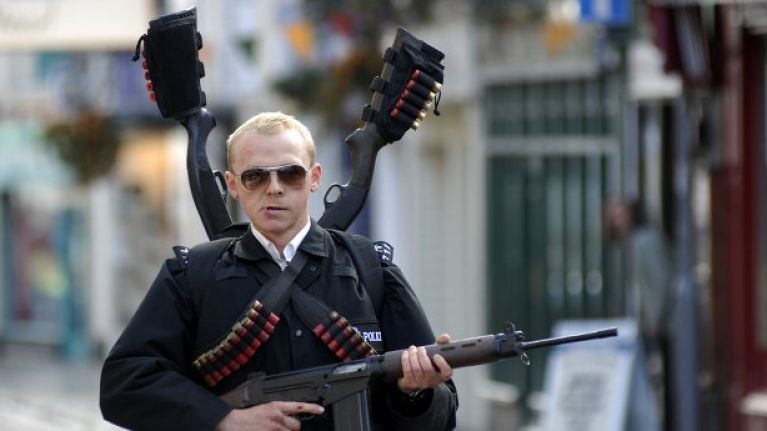
Hot Fuzz, the second release in writer/director Edgar Wright’s loosely correlated “Cornetto Trilogy” is, for my money, one of the funniest comedies of the 2000s. Conceived as an homage to the likes of such ‘90s box office smashes Point Break and Bad Boys, the film places Wright’s longtime collaborators Simon Pegg and Nick Frost in a buddy-cop dynamic in the British countryside. Pegg plays Nicholas Angel, an all-business, no-bullshit cop recently transferred from London in a political ploy from the higher ups; Frost is his new oaf of a partner, Frank Butterman. Together, the two make an all-too-perfect straight man and foil dynamic, with Wright almost too referential (and reverential) for the comedic forebears he quotes throughout the film.
            Almost. It’s a miracle Hot Fuzz can sustain itself under the barrage of references, quotes, and gags it throws at the audience on a minute by minute basis, but, like the other films in the Cornetto Trilogy, Shaun of the Dead and The World’s End, what makes Hot Fuzz work is Wright’s commitment to developing actual characters with flaws and motivations amid all the jokes. Likewise, the mystery present in Hot Fuzz – which centers around a series of murders related to property development and a local cult – is actually interesting, and, better yet, has a nuanced perspective on topics such as gentrification, class dynamics, and citizen surveillance. Pegg and Frost are believable in their overblown roles, as is Timothy Dalton in his sleazy turn as Simon Skinner, the grocery store magnate at the center of Hot Fuzz’s mystery. The extended members of the Sanford Police Department each have their own moment in the spotlight, and some of the funniest gags are given to characters whose names you’ll likely not remember as the credits roll.
            Indeed, the writing is superb, but what makes Hot Fuzz shine is the same thing that makes all of Wright’s movies great - the editing. Somehow, despite intricate plot threads, joke set-ups, and a breakneck pace, the viewer never gets lost in the film. Visual gags are given time to unfold in long shots and rapid editing alike, and never is Wright content with delivering a joke through just sound. It always has to be visual, and Hot Fuzz is a better film because of this mentality. Everything feels manageable in Hot Fuzz, and there’s even some eloquent storytelling done via the editing, a rarity in modern comedies. In other words, what Wright and editor Chris Dickens hone in on here is the same spirit that defined the slapstick greats of early cinema; make sure the gag makes sense, and never – never! – take the easy route.
            The camerawork is likewise impressive throughout the film. Wright is a meticulous stylist who obeys strict conventions of cinema and art; his frames are always perfectly balanced, and he weaponizes the rule-of-thirds in the same way a stand-up comedian uses the rule of threes. Every visual element in Hot Fuzz serves a purpose; to talk about just the spoken jokes would be to ignore half the jokes in the film. I love, for example, the fence gag, in which Simon Pegg sprints at a series of fences and eloquently hops them; Butterman, the aforementioned oaf of a partner, opts instead to just plow straight through the fences, all in one clean, agile shot. It’s a silly joke, certainly, but it comes at the end of an inspired chase sequence that both deifies and subverts the hallmarks of great action filmmaking.
            In an alternate post for Hot Fuzz, I might’ve just listed all my favorite jokes and barked at you about why they’re so funny. I could talk, extensively, about how funny I find a one-off impersonation Pegg does of the way another character says “Yarp,” for example, or how the antagonistic other members of the Police Department are always entering the shots in funny ways. Hot Fuzz is so much more than just being funny though, it’s got an engaging mystery and some real societal critique, all of which is heightened by Wright’s signature style. I’ve forced countless friends and family members to watch it, and I’m sure I’ll force so many more in the years to come. Hot Fuzz is an utter delight to watch – and rewatch, and rewatch, and rewatch.
-          Harry Todd

Monday, December 24, 2018

I'd Love to Turn You On #221 - Bonobo - Black Sands


Bonobo’s record Black Sands was released in 2010 and is his fourth record. Issued on the Ninja Tune label it shows a surprising amount of sonic depth. The first track, "Prelude," introduces a variety of instruments and develops a rich theme with lovely orchestration. The sophistication of the orchestration quickly informs us that our ears are in for a treat. When I think of electronic music, rarely does a product this polished, refined, or intricate come to mind. I’d love to turn you on to Black Sands!
"Kiara," the second track, is an interesting bit of layering in which the song progresses and evolves by combining and featuring different parts. At times it will expose aspects to allow certain parts to be featured and for the song to evolve. It begins with a suspended tone and a shimmering electronic tone struck together, these tones hover and the pitch bends just a moment before the beat eases in with the bass line. At times the bass and drums are faded out while Bonobo introduces slight variations, or different combinations of melody and texture. Keeping track of what is happening becomes a pleasant game for the ear. What combinations have happened? What change will occur next? It also takes what could be potentially overwhelming for the ear and thins it out, letting him control the tension and release by subtly orchestrating these themes and variations. "Kong," the third song, while having different melodic content than "Kiara" could be a different result of a strict set of the same procedural guidelines that both songs seem to follow. Once again Bonobo shows us textures, motifs, and snippets of recurring melodies that layer and combine in different aspects to develop and release tension.
On "Eyesdown" the vocalist Andreya Triana has a chance to take over. She has a relaxed, calm vibe that fits over a hazy and shimmering keyboard line and bass progression. This simple chord progression shows off Triana’s vocal skill and Bonobo’s production skills. While the overall production is cloudy and thick, the percussion is clear and punctuated by cymbal bell hits, snare rim shots, and cymbal slides that produce haunting and shrieking sounds, all subtly buried in the mix.
"El Toro" starts out with a semi-bossa nova groove and introduces a melody fragmented between violin and different wind instruments. The melody thickens into a bigger horn and orchestral section as the phrase builds. It repeats, seemingly folding in on itself, gaining complexity and momentum. This then yields to horn hits trading with percussion breaks. Eventually the rhythm section gives way and the strings and horns are left in an ostinato pattern exposed, repeating and briefly creating a quick transition to the next song. It is an interesting effect, by exposing the horns and strings and removing the rhythm section the listener's ear is drawn to it, and the introduction motif of the next song is quickly inserted. It acts as a palate cleanser, or an audio redirection.
"We Could Forever" is the next song. I think this title speaks to the groove of the song. It wants to put the listener in a place where they are satisfied and do not want to leave. The song starts out with a high-hat pattern and recurring guitar riff. A deep bass progression that eases us thru the tune is introduced, along with other samples. These atmospheric samples of reverb-drenched sax and wood flute over a bed of Rhodes keyboard and guitar are great. Enough variation is used so that the ear is not bored but the vibe is not ruined.
"All In Forms" introduces a sample of Pisces' song "Elephant Eyes" and elaborates upon it. A vocal sample from the Six Boys In Trouble song "Why Can’t I Get It Too?" is also repeated through the song. These elements seem to be the framework on which other sonic explorations are hung. Shimmering pads are panned to one side of a stereo mix, faint percussion fades in and out, and suspended tones are experimented with. It seems to be variation upon a central theme, with certain unifying plot lines that guide the song, keeping the mood and context intact while allowing for sonic exploration.
The next two songs once again feature Andreya Triana. "The Keeper" begins with xylophone and drums in a laid back groove. Bass and guitar are added, establishing an impressive polyphony that is catchy and restrained. As the singing enters, the xylophone and guitar drop out to momentarily to feature the vocals. It is this level of detail and production finesse that makes these songs fun and rewarding repeated listening. New details expose themselves with additional study. Andreya Triana has a great voice for this contemporary R&B style. "Stay The Same" is a more straightforward song rather than some of the theme-and-develop pieces that are on the album. This shows Bonobo’s ability to compose in a more traditional verse/chorus/verse/chorus format while featuring a vocalist, rather than the theme-and-variation content which makes up much of this record.
"Animals" starts out with a light cymbal rim hits and is joined by a guitar ostinato and a bass clarinet playing a melody on top of it. Bass joins in next, adding up to a really unique and great texture. This song unfolds like many on the record, but around the 3:30 mark it stops to rebuild in a slightly different feel. Before it a was 4/4 time signature and it becomes more of a 12/8 triplet-heavy, Afro-jazz feel with an oboe solo. This eventually gives way to drums and screeching waves of sound which fade out.
Black Sands becomes in essence Program Music, or music that strives to render an extra-musical narrative. Yes, you have the musical themes, interesting instrumentation, and development, all done excellently, but what is it saying? It becomes up to the listener to interpret. What does the imagery of the sounds make you feel? For me it evokes emotions and questions - I wonder what Black Sands meant to Bonobo. I feel melancholy and longing, I wonder where the Black Sands are, I wonder when they were. I think that anytime an artist can produce this level of emotional reaction their endeavor has been a success. I’d Love To Turn You On to Black Sands and I hope you take the time to check it out if it’s not already in your collection.
 - Doug Anderson

Thursday, December 20, 2018

I’d Love To Turn You On At The Movies #207 - Miller’s Crossing (1990, dir. Joel Coen)


            The Coen Brothers get a lot of love around here. Their films have been written about three times before. In fact, I myself wrote about my love of their films when I reviewed A Serious Man just this past May. So it’s only fitting that I write about another of their films for my last Spork entry of 2018. Today, I’m going to talk about another of their oft-overlooked films, the 1990 gangster-noir film Miller’s Crossing.
            Like many of the Coens’ films, Miller’s Crossing is steeped in snappy dialogue, sometimes making it hard to follow the relatively simple plot. But the gist is this - Tom Reagan (played by Gabriel Byrne) is second in command to a powerful Irish mob boss, Leo O’Bannon (Albert Finney) in Prohibition-era America. At the onset of the film, Tom acts as a kind of mediator between Leo and rival Italian kingpin Johnny Caspar (Jon Polito) when the two men meet to discuss business. Caspar wants to have Bernie (John Turturro), a small-time bookie, killed for divulging secrets about Caspar’s organization. Bernie, however, pays for protection, and Leo refuses to give him up. This causes Caspar to become extremely angry, spewing a diatribe about ethics and threatening all-out war. After Caspar leaves, Tom tries to convince Leo that giving up Bernie to avoid a turf war is the smarter move. It is then revealed that Leo has another reason for not giving up Bernie - he is romantically involved with Bernie’s sister Verna (Marcia Gay-Harden). Leo’s refusal to budge does end up starting a war, beginning with a failed attempt on Leo’s life. This prompts Tom to try again to reason with Leo about handing over Bernie to Caspar. This time, he reveals to Leo that Verna is not worth protecting Bernie for as she has been stepping out on him… with Tom. Leo reacts violently, kicking the shit out of Tom and throwing him out of his establishment. Tom then begins working for Caspar, acting as a catalyst for the ongoing war between the sides.
            Having already dipped their toes in the film noir genre with their debut Blood Simple, by the release of Miller’s Crossing the Coens had the genre perfected. With this film, however, they stumbled upon something different. Cinematographer Barry Sonnenfeld (pre-directing days) shot the film, making full use of darkness and shadow to create a somber and paranoid atmosphere where no one can be trusted. For all intents and purposes, Miller’s Crossing should have been the film that made the Coens a household name. They put a lot of grit and soul into getting the film made, even struggling with writer’s block during the screenwriting process for a three week stretch. On top of that, their original choice for the role of Leo O’Bannon, Trey Wilson (Nathan Arizona from their previous film Raising Arizona) died of a brain hemorrhage just two days before shooting began, opening the door for last minute fill-in Finney. Unfortunately, the film was a total bomb in the box office, only grossing about $5 million. This pattern would continue to plague them until the release of Fargo in 1996.
On the bright side, Miller’s Crossing has since become something of a cult classic and has garnered a lot in home video and DVD/Blu-ray sales. It’s the Coens’ third film, early enough in their careers that I hadn’t yet become the fanatic for their films that I am now. Having been completely blown away by Raising Arizona, as far as I knew these filmmakers excelled at making screwball comedies. I immediately loved Miller’s Crossing though, and it’s been one of my favorite films of theirs and in general ever since. It perfectly combines their trademark subtle wit with a hint of The Godfather and a dash of Double Indemnity. Their casting is always spot-on, but I was particularly taken with J.E. Freeman’s portrayal of Caspar’s majordomo Eddie Dane (or simply “The Dane”). There is something so menacing about that character, yet somehow kind of calming or soothing about his demeanor. It’s a performance that still hasn’t been topped in any of their films. And Byrne’s acting, in my observations, can sometimes feel a little flat, but in this film, he absolutely shines as the scheming, manipulative and perpetually drunk Tom. It is bar-none his best role.
The brothers have made some of the most unforgettable and amazing films of the last two decades. I recently watched them all in order back to back, ending with their most recent Netflix vehicle The Ballad of Buster Scruggs. Each of their films truly has a unique voice of its own, but there is something about Miller’s Crossing that stands out even among an entire career’s worth of pure gems. I watched that one twice.
-         Jonathan Eagle